Partner Ecosystem: How to Build and Scale with AI and Automation
A modern partner ecosystem is a complex network of companies collaborating to create and sell value. Successfully building and scaling this network now requires advanced AI and automation strategies.
In today's competitive landscape, businesses can no longer rely on traditional, linear channel sales models. The future belongs to dynamic, multi-faceted business ecosystems that drive innovation and market reach.
These networks include a wide variety of partners beyond simple resellers. They involve technology partners, service providers, consultants, integrators, and even influencers.
Managing this diverse group manually is an impossible task for any growing organization. This is where artificial intelligence and automation become essential tools for sustainable growth.
By leveraging technology, companies can streamline operations from recruitment to performance analysis. This approach allows channel managers to focus on strategy and relationship building rather than administrative tasks.
A well-managed partner ecosystem acts as a powerful extension of your own sales and marketing teams. It unlocks new markets and customer segments you could not reach alone.
This guide will explore how to construct and expand your alliance network using smart technologies. We will provide actionable steps to transform your channel strategy for the modern era.
Key Takeaways
TL;DR
- A modern partner ecosystem includes diverse entities like technology partners, service providers, and consultants.
- Building a scalable ecosystem requires a clear strategic framework and defined partner profiles.
- AI significantly enhances partner recruitment by identifying and vetting ideal candidates automatically.
- Automation is critical for delivering consistent partner enablement through training and content distribution.
- Data analytics, including predictive analytics, are essential for tracking performance and optimizing your channel strategy.
- A Unified Partner Management (UPM) platform is the foundation for managing a complex partner network effectively.
- Adopting these technologies helps companies move from administrative burdens to strategic growth initiatives.
Why is a Strategic Framework Crucial for Your Partner Ecosystem?
A strategic framework provides the essential blueprint for building a successful channel program. Without a clear plan, your efforts will likely be disorganized and ineffective.
This plan begins with defining what you want to achieve with your partners. It involves setting specific, measurable, achievable, relevant, and time-bound (SMART) goals.
Your strategy must clearly outline your ideal partner profile or IPP. This helps you focus your recruitment efforts on partners who align with your brand and objectives.
Consider their industry expertise, geographic reach, customer base, and technical capabilities. A detailed IPP prevents you from wasting resources on unsuitable partnerships.
Furthermore, you need to articulate a compelling partner value proposition. Why should a potential partner choose to work with you instead of a competitor?
This proposition should include tangible benefits like generous margins, marketing support, and sales enablement resources. Communicating this value clearly is vital for attracting top-tier partners.
A structured approach also involves creating tiered partner programs. This allows you to provide different levels of support and benefits based on a partner's performance and commitment.
Tools like partner programs management software help you manage these tiers effectively. They automate the process of tracking requirements and allocating rewards.
Business planning is another critical component of a strong framework. You should work with key partners to develop joint business plans that align your mutual goals.
Collaborative partner business planning ensures both parties are invested in success and understand their roles. This process fosters deeper commitment and drives better results over time.
Finally, your framework for a partner ecosystem should be agile and adaptable. The market is constantly changing, so your strategy must evolve with it.
Regularly review your goals, partner profiles, and value proposition to ensure they remain relevant. This continuous improvement cycle is the hallmark of a healthy and growing partner network.
The foundation you lay with a strategic plan determines the long-term viability of your channel. It is the most important first step in building a world-class partner ecosystem.
Investing time in this planning phase will pay significant dividends later. It transforms your channel from a collection of ad-hoc relationships into a powerful growth engine.
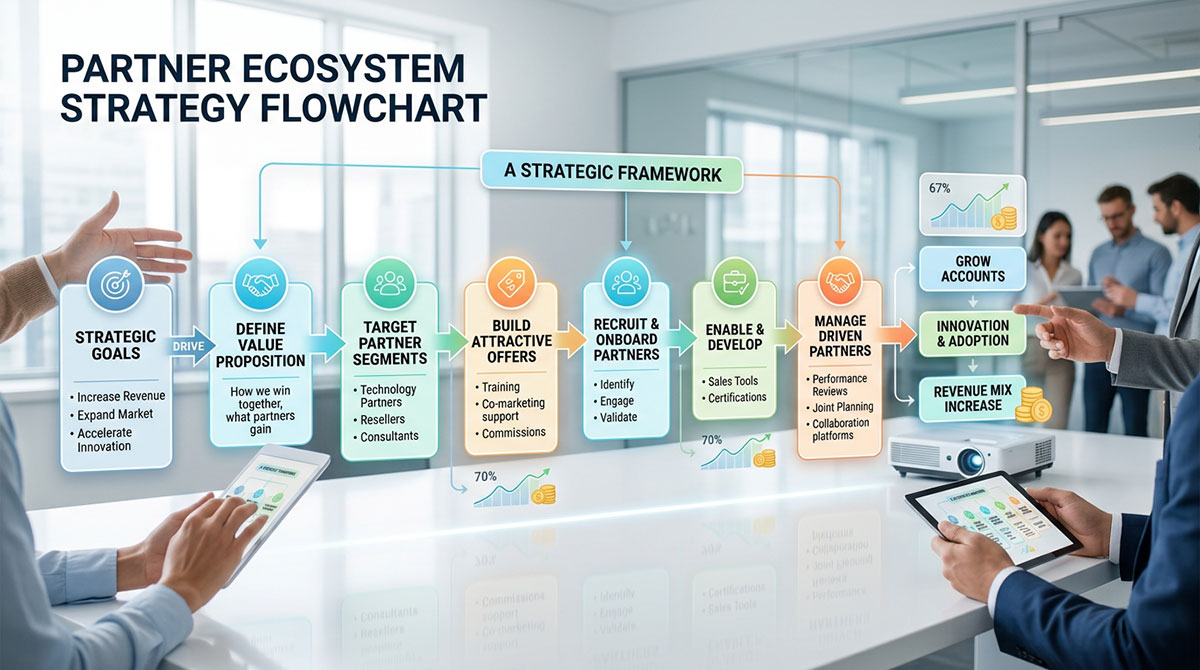
A robust strategic framework for your partner ecosystem is not a one-time effort. It demands ongoing attention and refinement to stay aligned with business objectives.
Regular performance reviews against the plan help identify gaps and opportunities. This ensures your channel strategy remains a dynamic asset for your company's growth.
Contracts form the legal backbone of your partnerships, defining expectations and obligations. Using a standardized but flexible contract management system is crucial for consistency.
Systems for partner contracts management streamline this process. They ensure compliance and provide a clear record of agreements with every member of your channel.
Ultimately, a strong framework brings order and purpose to your entire channel operation. It enables you to scale your partner ecosystem without creating chaos.
By defining every aspect of the partnership journey, you create a predictable and positive experience. This professionalism attracts and retains the very best partners in the industry.
How Can AI Revolutionize Recruitment in a Partner Ecosystem?
Artificial intelligence is transforming how companies identify, recruit, and onboard new channel partners. It replaces manual guesswork with data-driven precision and efficiency.
AI algorithms can analyze vast datasets to find potential partners that match your ideal profile. This process is far faster and more accurate than human-led research.
These algorithms look beyond simple company demographics. They can assess a potential partner's digital footprint, customer sentiment, and market influence.
This gives you a much deeper understanding of their true potential. You can prioritize outreach to companies that are genuinely a good fit for your business.
Once potential partners are identified, AI-powered automation can handle the initial outreach. It can send personalized email sequences to engage prospects at scale.
This frees up your channel managers to focus on building relationships with qualified, interested partners. They spend their time on high-value conversations instead of cold prospecting.
AI can also help score and prioritize incoming partner applications. It evaluates applications against your predefined criteria to rank candidates automatically.
This ensures you are focusing your attention on the most promising applicants first. It creates a fair and efficient evaluation process for every potential partner.
The benefits of AI extend into the onboarding phase of partner management. AI can help personalize the onboarding journey for each new partner.
Based on a partner's profile and needs, an AI-driven system can recommend specific training modules. This tailored approach accelerates their time to revenue and improves engagement.
A sophisticated partner management platform integrates these AI capabilities seamlessly. It creates a cohesive experience from أول contact to full productivity.
This technology fundamentally changes the economics of scaling a partner ecosystem. It allows you to expand your network without proportionally increasing your headcount.
For example, AI can analyze a candidate's existing technology stack. It can then identify potential synergies and integration opportunities with your products.
This level of insight is invaluable for crafting a compelling recruitment pitch. It shows prospects you have done your homework and understand their business.
Moreover, AI can monitor market trends and competitor activities. It can alert you when a competitor's partner may be looking for a new vendor.
This proactive intelligence provides a significant competitive advantage in the race for top talent. You can engage potential partners at the perfect moment.
Ultimately, AI makes the entire recruitment process smarter, faster, and more scalable. It is an indispensable tool for any company serious about growing its partner ecosystem.
By embracing these technologies, you build a powerful and continuous pipeline of high-quality partners. This is the foundation for sustained channel growth and market leadership.
What Role Does Automation Play in Enabling Your Partner Ecosystem?
Automation is the engine that drives scalable partner enablement. It ensures every partner receives the training and resources they need to succeed, regardless of size or location.
Effective enablement is crucial for turning a signed partner into a revenue-generating one. Manual enablement processes simply cannot keep up with a growing partner network.
A key area for automation is partner training and certification. A partner learning management system (LMS) provides on-demand access to courses.
Partners can learn about your products, sales methodologies, and marketing best practices at their own pace. Automation tracks their progress and manages certifications.
Content delivery is another area where automation provides immense value. Partners need easy access to the latest marketing collateral, sales presentations, and technical documents.
An automated content library management system ensures materials are always up-to-date. It can also push new content to partners based on their tier or specialty.
Video content is particularly effective for training and marketing. A dedicated video library management solution allows you to organize and share video assets securely.
You can track which videos partners are watching, helping you understand what content is most effective. This data helps refine your enablement strategy over time.
Co-branding is a powerful tool, but it can be a logistical nightmare to manage manually. Automation simplifies the creation of co-branded assets for your partners.
With a co-branded assets management tool, partners can generate customized materials in seconds. They simply upload their logo, and the system creates approved marketing assets.
This maintains brand consistency while empowering partners to market effectively in their local territories. It removes a significant bottleneck for partner-led marketing initiatives.
Marketing automation for partners, often called through-channel marketing automation (TCMA), is a game-changer. It allows you to execute sophisticated campaigns through your partner network.
You can provide pre-built email marketing campaigns, social media content, and landing pages. Partners can launch these with just a few clicks, amplifying your brand's reach.
Social media syndication is a powerful feature of TCMA. It automatically posts approved content to your partners' social media profiles.
This ensures a consistent stream of messaging across the entire partner ecosystem. Platforms with social syndication management make this process effortless.

Event marketing can also be streamlined through automation. Tools for event marketing management help partners plan, promote, and execute local events.
This includes webinars, lunch-and-learns, and trade show participation. The system can manage registrations, send reminders, and track leads generated from events.
By automating these core enablement functions, you create a scalable support system. It ensures a consistent and high-quality experience for every member of your partner ecosystem.
This level of support fosters partner loyalty and motivation. Well-enabled partners are more engaged, more productive, and more likely to invest in the relationship.
Automation transforms enablement from a cost center into a strategic growth driver. It empowers your channel to perform at its peak potential.
The result is faster partner ramp-up, increased channel-driven revenue, and a stronger, more competitive partner ecosystem. It's an investment that delivers a clear and substantial return.
How Do You Measure and Optimize Performance in a Partner Ecosystem?
Measuring and optimizing performance is essential for the health of your partner ecosystem. You cannot manage what you cannot measure effectively.
Data-driven insights allow you to identify top-performing partners, uncover challenges, and make informed strategic decisions. This requires robust analytics and reporting capabilities.
A unified platform provides a single source of truth for all channel data. It aggregates information from sales, marketing, and training activities into one cohesive view.
This allows you to track key performance indicators (KPIs) across your entire partner network. Common KPIs include deal registrations, pipeline value, close rates, and training completions.
Deal registration is a cornerstone of channel sales management. An automated deal registration management system prevents channel conflict and provides pipeline visibility.
It gives you a clear picture of what your partners are working on. This helps with forecasting and resource allocation.
Business intelligence tools are critical for making sense of this data. They transform raw numbers into actionable insights through dashboards and reports.
A comprehensive business intelligence and reports module allows you to slice and dice data. You can analyze performance by partner, territory, product, or time period.
Beyond historical data, leading platforms are now incorporating predictive analytics. These advanced algorithms analyze past performance to forecast future outcomes.
Predictive analytics can identify partners who are at risk of disengaging. They can also highlight which partners have the highest potential for future growth.
This foresight allows channel managers to intervene proactively. They can offer support to struggling partners or invest more resources in high-potential ones.
According to research from Forrester, advanced analytics can dramatically improve marketing and sales effectiveness. Applying this to the channel is a logical and powerful step.
Performance analytics also help you refine your partner programs. You can see which incentives are driving the desired behaviors and which are not.
For example, you might find that market development funds (MDF) are more effective than rebates for certain partners. This insight allows you to optimize your incentive spending.
Managing incentives like MDF, rebates, and commissions is complex. An automated system simplifies the process of allocation, claims, and payments.
This transparency and efficiency in incentive management build trust with your partners. It ensures they are rewarded promptly and accurately for their efforts.
Regular performance reviews are a crucial part of this optimization loop. Share performance data with your partners during quarterly business reviews (QBRs).
This collaborative approach helps align goals and fosters a sense of shared ownership. It reinforces the idea that you are both working toward mutual success.

Optimizing your partner ecosystem is a continuous cycle of measurement, analysis, and action. It requires a commitment to data-driven decision-making.
By leveraging powerful analytics, you can fine-tune every aspect of your channel strategy. This ensures you are always maximizing the return on your channel investments.
Ultimately, a deep understanding of performance separates leading channel programs from the rest. It is the key to building a sustainable and high-growth partner ecosystem.
This focus on data transforms your channel from a perceived cost center into a predictable revenue driver. It provides the visibility and control needed to scale confidently.
What are the Benefits of a Unified Platform for a Partner Ecosystem?
Managing a modern partner ecosystem with a collection of disconnected tools is inefficient and risky. A Unified Partner Management (UPM) platform provides a much better solution.
A UPM platform integrates all the necessary tools into a single, cohesive system. This breaks down data silos and creates a seamless experience for both you and your partners.
One of the primary benefits is a single, secure point of access for partners. They can log in to one portal to access everything they need to be successful.
This includes training, marketing assets, deal registration, and incentive claims. This simplicity dramatically improves the partner experience and increases engagement.
For channel managers, a unified platform provides a 360-degree view of the entire partner ecosystem. You can see all partner activities and performance data in one place.
This complete visibility is impossible when using separate systems for CRM, LMS, and marketing automation. A UPM solution like ZINFI's connects all the dots.
Workflow automation is another significant advantage. A UPM platform allows you to automate complex cross-functional processes with tools like FlexiFlow.
For instance, you can automate the process from deal registration to approval and commission payment. This reduces manual effort, speeds up cycle times, and minimizes errors.
Centralized administration simplifies the management of your channel program. User access, content, and program rules are all controlled from one central console.
Tools for user management and access management ensure that partners only see the information relevant to them. This provides security and a personalized experience.
A unified approach also ensures data consistency and accuracy. When all your channel data lives in one system, you can trust the insights you derive from it.
This reliable data is the foundation for effective performance analytics and strategic planning. It eliminates the tedious and error-prone process of manually consolidating data from multiple sources.
Integration capabilities are crucial for a successful UPM implementation. The platform must connect with your existing business systems, such as your corporate CRM or ERP.
A centralized interconnect module facilitates these integrations. It ensures a smooth flow of data between your channel platform and other core business applications.
Ultimately, a unified platform brings order, efficiency, and intelligence to your channel management. It provides the scalable foundation needed to grow a complex partner ecosystem.
Investing in a UPM platform is an investment in the future of your channel. It is the enabling technology for building a world-class partner program.
Traditional vs. AI-Powered Ecosystem Management
| Aspect | Traditional Approach | AI-Powered Approach |
|---|---|---|
| Partner Recruitment | Manual research, cold calling, based on intuition. | Data-driven identification, automated outreach, predictive scoring. |
| Partner Onboarding | One-size-fits-all, manual process, slow ramp-up. | Personalized learning paths, automated workflows, faster time-to-revenue. |
| Partner Enablement | Static content portals, manual updates, inconsistent delivery. | Dynamic content delivery, automated training, co-branding automation. |
| Marketing Support | Providing PDF assets, lack of campaign visibility. | Through-channel marketing automation (TCMA), social syndication. |
| Performance Tracking | Manual spreadsheet tracking, delayed and incomplete data. | Real-time dashboards, automated BI reports, performance analytics. |
| Optimization | Reactive, based on historical and anecdotal evidence. | Proactive, using predictive analytics to identify opportunities/risks. |
| Overall Management | Siloed tools, high administrative overhead, difficult to scale. | Unified platform, low administrative tasks, built for a scalable partner ecosystem. |
Building Your Partner Ecosystem with ZINFI
ZINFI's Unified Partner Management (UPM) platform provides all the tools you need in one solution. It empowers you to build, manage, and grow a thriving channel.
Our platform is built on a foundation of automation and data-driven intelligence. This helps you scale your partner ecosystem efficiently and effectively.
With ZINFI, you can automate the entire partner lifecycle. This journey goes from recruitment and onboarding to enablement, sales, and incentives.
Our modular approach allows you to start with the solutions you need now. You can easily add more capabilities as your channel program matures.
We provide enterprise-grade solutions that are surprisingly easy to use for you and your partners. ZINFI is designed to drive adoption and deliver rapid ROI.
Here are some of the key features of ZINFI's UPM platform:
- Complete Automation: Our platform automates workflows across marketing, sales, and management. This includes tools for email marketing, deal registration, and MDF management.
- Integrated Modules: ZINFI offers three core suites for Partner Relationship Management (PRM), Partner Marketing Management (PMM), and Partner Sales Management (PSM). These are all seamlessly integrated into one platform.
- Advanced Analytics: Gain deep insights into your channel performance with our powerful business intelligence and reporting tools. You can make data-driven decisions to optimize your partner ecosystem.
- Content and Learning Management: Enable your partners with a state-of-the-art LMS and a dynamic content management system. Ensure your partners always have the knowledge and assets they need.
- Scalable and Secure: Our platform is built on a highly secure, multi-tenant cloud architecture. It can scale to support thousands of partners across the globe.
- Unparalleled Support: ZINFI provides comprehensive implementation, training, and support services. We act as a true partner in your channel success.
Frequently Asked Questions
What is the first step in building a partner ecosystem?
The first step is to develop a clear strategic framework. This involves defining your goals and identifying your ideal partner profile.
How is a partner ecosystem different from a traditional channel?
An ecosystem is a broader, more dynamic network of diverse partner types. A traditional channel is often a linear, reseller-focused model.
Why is automation so important for partner enablement?
Automation ensures consistent, scalable delivery of training and resources. It allows every partner to receive the support they need to succeed.
Can small businesses benefit from building a partner ecosystem?
Yes, smaller businesses can leverage partnerships to expand their reach and resources. A focused partner ecosystem can accelerate growth significantly.
How do you measure the ROI of your partner program?
You measure ROI by tracking channel-influenced revenue against the costs of your program. Key metrics include pipeline growth, sales, and partner acquisition cost.
What is the biggest mistake companies make with their partner programs?
A common mistake is a lack of commitment and inconsistent support. Partners will disengage if they do not feel valued and enabled.
How does AI help in partner recruitment?
AI analyzes data to identify ideal-fit partners much faster than manual methods. It also automates outreach and helps score potential candidates.
What is a Unified Partner Management (UPM) platform?
A UPM platform integrates all tools for channel management into a single solution. It covers PRM, PMM, and PSM in one seamless interface.
How can I keep my partners engaged over the long term?
Consistent communication, reliable support, and fair incentives are key. Regularly sharing performance data and collaborating on business plans also keeps them engaged.
Is it expensive to implement an AI-powered partner management platform?
The cost varies, but the ROI from increased efficiency and revenue often outweighs the investment. Modern SaaS platforms offer flexible pricing models for different needs.
About the author
Sugata Sanyal
Sugata Sanyal is the Founder & CEO of ZINFI Technologies, a leader in Unified Partner Management. He has been a passionate advocate for the channel and channel partners for decades. His vision for ZINFI is to provide partner ecosystems with the tools they need to succeed.