How to Use AI for Partner Portal Personalization by User Role
You can use AI to personalize partner portal content by leveraging machine learning to analyze user data. This analysis allows the system to automatically present the most relevant information to each user. Different roles, such as sales, marketing, or technical support, see unique and tailored experiences. This AI-driven approach transforms a static partner portal into a dynamic, responsive asset.
Key Takeaways
TL;DR
- AI content personalization anaylzes user data to deliver relevant content within your partner portal. Different partner roles receive a customized experience based on their specific needs and behaviors.
- A personalized partner portal significantly improves partner engagement. It presents tools, training, and marketing assets that are directly useful, reducing friction and frustration.
- AI-powered systems use predictive analytics to suggest relevant training and certifications. This helps partners develop skills that align with market demand and your program goals.
- Automating content delivery saves channel managers significant time and effort. The system ensures the right content reaches the right partners without manual intervention.
- Implementing AI personalization requires clean data and clearly defined user roles. A unified platform is crucial for gathering and analyzing data from various sources effectively.
- Measuring the impact of personalization is key to optimization. Use performance analytics to track engagement, content consumption, and sales outcomes, then refine your AI models.
- A superior user experience in your partner portal leads to higher partner satisfaction. It makes partners feel valued and understood, strengthening your channel relationships.
Why is personalization in a partner portal so important?
Personalization in a partner portal is critically important for driving partner engagement. A generic, one-size-fits-all approach no longer works in today's competitive landscape. Partners expect digital experiences that are tailored to their specific needs and goals.
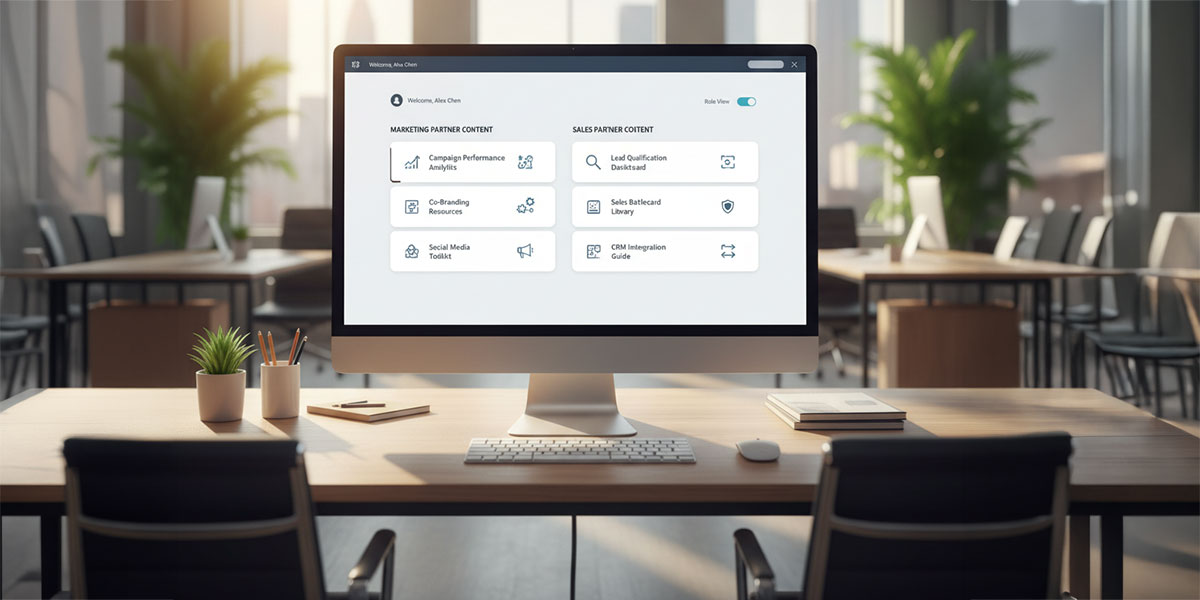
Different user roles within a partner organization have vastly different requirements. A sales representative needs quick access to deal registration and pricing tools. A marketing manager looks for campaign assets and market development funds information.
Without personalization, users must sift through irrelevant information to find what they need. This creates friction, wastes valuable time, and can lead to partner frustration. A poorly organized partner portal can even cause partners to disengage from your program entirely.
Delivering personalized digital experiences demonstrates a deep understanding of your partners' business. It shows you value their time and are invested in their success. This builds loyalty and strengthens the relationship between your company and its channel partners.
Furthermore, a personalized partner portal improves the effectiveness of your enablement efforts. When training materials and sales plays are aligned with a partner’s role, they are more likely to be consumed. This leads to a more knowledgeable and effective partner ecosystem.
AI content personalization takes this a step further by learning from user behavior. It adapts the partner portal experience in real time. This ensures that the content remains relevant as a partner’s needs evolve over time.
The impact on business outcomes is significant. Companies using AI-powered personalization see higher rates of partner activation and productivity. Partners who can easily find what they need are better equipped to market and sell your products.
Consider the partner onboarding process. A new sales partner can be guided through a specific learning path with relevant sales training. A new technical partner can be directed to certification courses and technical documentation.
This targeted approach accelerates the time to first sale. It ensures that partners become productive members of your channel much faster. A well-executed personalization strategy is a powerful competitive differentiator for your partner program.
Ultimately, investing in AI for your partner portal is an investment in your channel's success. It transforms the portal from a simple content repository into a strategic business tool. This tool actively helps your partners grow their business with you.
How does AI personalize partner portal content for different user roles?
AI personalizes partner portal content by analyzing vast amounts of data. It uses machine learning algorithms to identify patterns in user behavior and attributes. This allows the platform to predict what content will be most useful for each individual.
The process starts with data collection from multiple sources. This includes user profile information, such as job title, industry focus, and geographical location. It also includes behavioral data like content downloads, page views, and training module completions.
An advanced partner portal integrates with other business systems like your CRM. This provides access to crucial performance data. For example, it can see sales records, deal registrations, and lead conversion rates for specific partners.
With this comprehensive data set, AI models can build a detailed profile for each user. It understands not only their defined role but also their engagement level and performance. This forms the basis for delivering AI personalized content for partner portals.
For a sales role, the AI might prioritize content related to closing deals. It could surface new battle cards, competitive analysis documents, and links to your deal registration management tool. It can also recommend sales training based on past performance data.
A marketing manager would see a completely different view of the partner portal. The AI would highlight new marketing campaigns, co-brandable assets, and social media content. It might also show performance data from their past campaigns.
For a technical support specialist, the focus would be on technical documentation and training. The AI would push alerts about product updates and present knowledge base articles. It could also suggest advanced certification paths to deepen their expertise.
This dynamic content delivery is automated. A channel manager defines the rules and segments, but the AI handles the execution. This ensures the experience is always relevant without constant manual adjustments.
The system uses predictive analytics to go even further. It can anticipate a partner's future needs based on their current trajectory. For example, if a partner starts engaging with content for a new product, the AI can proactively suggest related training.
This intelligent system ensures that the partner portal evolves with the partner. It creates a continuous cycle of learning and improvement. The result is a highly effective and engaging platform that drives channel performance.
What are the key AI technologies used in partner portal personalization?
Several key AI technologies work together to enable partner portal personalization. Machine Learning (ML) is the foundational technology. It provides the system with the ability to learn from data without being explicitly programmed.
ML algorithms analyze user behavior to identify patterns and make predictions. For example, an ML model can learn which types of content lead to higher sales performance. It can then recommend that content to similar partners to replicate success.
Natural Language Processing (NLP) is another critical component. NLP allows the AI to understand and process human language from content and user queries. This helps in automatically tagging and categorizing content for better discovery.
When a partner uses the search function, NLP helps deliver more accurate results. It understands the intent behind a query, not just the keywords used. This makes finding the right asset or document much faster and more intuitive.
Predictive analytics is a powerful application of AI used in this context. It uses historical and real-time data to forecast future outcomes and behaviors. This helps in proactively guiding partners toward success.
For instance, predictive analytics can identify partners at risk of churn based on declining engagement. The system can then trigger an automated workflow to re-engage them. This might include a personalized email or a notification from their channel account manager.

Recommendation engines are another common AI technology used in a modern partner portal. These engines work similarly to those on e-commerce or streaming sites. They suggest content, training, or tools based on a user’s past behavior and the behavior of similar users.
These suggestions help with cross-selling and up-selling opportunities. The AI can recommend complementary products a partner is not yet certified to sell. It then provides a direct link to the necessary training in your partner learning management system.
Finally, AI-powered automation orchestrates many of these processes. It handles the dynamic assembly of portal pages and the delivery of personalized notifications. Automation ensures the personalized experience is delivered seamlessly and at scale.
A recent Harvard Business Review article highlights how AI is reshaping B2B sales. The same principles apply to empowering your sales partners. These technologies working in concert create a truly intelligent and responsive partner portal.
What are best practices for implementing AI-personalized content in a partner portal?
Implementing AI-personalized content in a partner portal requires a strategic approach. The first and most critical best practice is to ensure high-quality data. AI models are only as good as the data they are trained on.
You must establish strong data hygiene practices. This includes cleaning, standardizing, and enriching your partner data. A unified platform that consolidates data from CRM, PRM, and other systems is essential for this task.
Next, you must clearly define your user roles and segments. Create detailed personas for your sales, marketing, and technical partners. Understand their unique goals, challenges, and content needs to inform the AI.
Start with a pilot program before rolling out personalization across your entire channel. Choose a specific user segment or geography to test your strategy. This allows you to gather feedback and refine your AI models in a controlled environment.
Integration is another key best practice. Your partner portal should be deeply integrated with other core business systems. Our Centralized Interconnect module can facilitate this, creating a seamless data flow for better personalization.
You must also set clear objectives and key performance indicators (KPIs). What do you want to achieve with personalization? Goals could include increasing partner engagement, reducing onboarding time, or boosting sales of a specific product.
Use performance analytics to continuously track your progress against these KPIs. Monitor metrics like content consumption, training completion rates, and sales impact. This data is crucial for measuring ROI and demonstrating the value of your investment.

A robust governance framework is also necessary. This includes policies for data privacy and security. You must be transparent with your partners about how their data is being used to enhance their experience.
Don't forget the human element. While AI automates much of the process, channel managers still play a vital role. They should use the insights from the AI to have more strategic conversations with their partners.
Finally, choose a technology partner with a proven track record in partner management. A platform with built-in AI capabilities and robust business intelligence and reports will accelerate your path to success. This provides the foundation you need to build a world-class, personalized partner portal experience.
Traditional vs. AI-Powered Partner Portal Content
| Feature | Traditional Approach | AI-Powered Approach |
|---|---|---|
| Content Delivery | Static, one-size-fits-all content repositories. | Dynamic, personalized content delivery based on user role and behavior. |
| User Experience | Users must manually search through extensive libraries. | Relevant content is proactively surfaced for each user. |
| Onboarding | Generic onboarding paths for all new partners. | Customized onboarding journeys tailored to the partner's role and business model. |
| Enablement | Broad-based training catalogs requiring manual selection. | Predictive analytics recommend specific training and certifications. |
| Asset Discovery | Relies on folder structures and basic keyword search. | AI-powered search and recommendations make finding assets easy. |
| Analytics | Basic reporting on logins and content downloads (performance analytics). | Advanced analytics on content effectiveness and its impact on sales. |
| Scalability | Requires significant manual effort from channel managers to maintain. | Automated processes allow for personalization at scale across thousands of partners. |
How ZINFI’s Unified Partner Management Platform Enhances Personalization
ZINFI’s Unified Partner Management (UPM) platform provides the ideal foundation for AI-driven personalization. Our comprehensive suite of tools allows you to manage the entire partner lifecycle from a single, integrated solution. This consolidation of data and processes is essential for creating truly effective, personalized experiences in your partner portal.
- User and Access Management: ZINFI enables you to create highly granular user roles. This ensures the right people have the right access, which is the first step in personalization. Our User Management and Access Management modules provide complete control.
- Automated Workflow Management: Use our Workflow Management tool to build automated journeys. You can guide partners through personalized onboarding, training, and marketing activities based on AI-driven triggers.
- Integrated Learning Management: Deliver role-based training and certifications with our Partner Learning Management Plus. The platform can track progress and recommend next steps, powered by intelligence on what drives performance.
- Dynamic Content Libraries: Our Content Library Management allows for sophisticated metadata tagging. This makes it easy for AI algorithms to categorize and surface the most relevant assets for each portal user.
- Co-branded Assets Management: Empower marketing partners with our Co-branded Assets Management solution. The system can suggest the most effective assets for a partner’s specific industry focus or customer base.
- Advanced Analytics & Reporting: ZINFI provides deep insights into partner performance with our Business Intelligence & Reports. Use this data to fuel your AI models and continuously improve your personalization strategy.
Frequently Asked Questions
What is a personalized partner portal?
A personalized partner portal is a platform that dynamically adjusts the content, tools, and layout. It tailors the view for each user based on their role, behavior, and performance data. The goal is to provide a more relevant and efficient experience.
How does AI determine a user's role for personalization?
AI uses a combination of data points to determine a user's role. This includes profile information provided during registration (like job title) and behavioral data. The system observes the type of content the user engages with to refine their profile.
Is it difficult to set up AI personalization in a partner portal?
The difficulty depends on your platform's capabilities. A unified platform with built-in AI features simplifies the process significantly. The key initial steps involve defining user roles and ensuring your partner data is clean and organized.
What kind of data is needed for AI content personalization?
You need both user-profile data (role, region, specialty) and behavioral data (logins, content views, training completed). Integrating performance data from your CRM, such as sales records and lead conversion rates, makes the AI even more effective.
Can personalization improve partner sales performance?
Yes, absolutely. By providing sales partners with the right assets, tools, and training at the right time, you reduce friction. A personalized partner portal helps them find what they need to close deals faster, improving overall sales performance.
Will AI replace the need for channel account managers?
No, AI does not replace channel account managers. Instead, it empowers them. AI handles the routine task of content delivery, freeing up managers to focus on strategic relationship-building and coaching, using insights provided by the AI.
How do you measure the ROI of a personalized partner portal?
Measure ROI by tracking key metrics tied to your goals. This can include increases in partner engagement, faster onboarding times, and higher certification rates. Ultimately, you should track the impact on channel-driven revenue and partner productivity.
Can I personalize content for other roles besides sales and marketing?
Yes. Any distinct role within your partner ecosystem can have a personalized experience. This includes technical support staff, finance contacts who manage incentives, or executives who want high-level performance dashboards.
What is the difference between personalization and customization?
Customization is when a user manually changes settings to their preference. Personalization is when the system automatically tailors the experience for the user. A modern partner portal uses AI to deliver true personalization.
How does a personalized partner portal help with partner retention?
A personalized portal creates a better, more efficient user experience. It makes partners feel understood and valued, which increases satisfaction and loyalty. This positive relationship makes them less likely to leave your program for a competitor's.
About the author
Sugata Sanyal
Sugata Sanyal is the founder and CEO of ZINFI Technologies. He is a recognized leader in the field of channel management and marketing. With years of experience, he provides valuable insights into building and managing successful partner ecosystems. His expertise helps businesses worldwide optimize their channel strategies.