

Strategic Overview: PRM for Midsize Tech in 2026
The partner relationship management (PRM) software market is accelerating in 2026, driven by digital-first partner ecosystems and growing pressure on midsize technology companies to scale indirect revenue without proportionally scaling headcount. For SaaS vendors, cloud infrastructure providers, and managed service providers operating at mid-market scale, the right PRM platform is the difference between a partner program that compounds and one that stagnates.
Unlike enterprise-only deployments of five years ago, modern PRM platforms now offer modular pricing, no-code configuration, AI-driven analytics, and CRM-native integrations that make them accessible and high-value for technology companies with 50 to 2,000 active channel partners.
The vendors reviewed in this guide were evaluated across four dimensions most relevant to midsize technology buyers:
Feature Depth & Automation
Breadth and configurability of onboarding, deal registration, MDF, co-marketing, and analytics capabilities.
CRM Integration Flexibility
Native vs. API-based connectivity with Salesforce, HubSpot, and Microsoft Dynamics—and the depth of bi-directional data sync.
Pricing Transparency & Scalability
Published vs. custom pricing, total cost of ownership at mid-market scale, and absence of punitive per-seat models.
Implementation Speed & Usability
Time-to-live for a typical midsize deployment, no-code configuration depth, and long-term platform usability for non-technical admins.
The 7 Top PRM Vendors — In-Depth Profiles
Each profile below covers the vendor's core differentiator, key capabilities, ideal use case, pricing signal, and critical considerations for midsize tech buyers.
ZINFI delivers a unified, end-to-end approach to PRM purpose-built for mid-to-large technology companies managing diverse partner ecosystems. Its modular architecture allows organizations to deploy only what they need—starting with a partner portal, deal registration, or co-marketing module—and expand capabilities seamlessly as channel programs mature, without the disruptive platform migrations that plague point-solution architectures.
The platform combines core PRM capabilities with through-channel marketing automation (TCMA) and comprehensive payment management covering rebates, claims, and incentive processing. A drag-and-drop workflow builder enables program managers to configure and iterate partner journeys without developer dependency—critical for midsize teams operating with lean IT resources.
xAmplify has emerged as a compelling option for midsize SaaS and cybersecurity companies that need AI-driven partner insights without enterprise complexity. Its intelligent assistant supports predictive partner matching, opportunity scoring, and automated campaign orchestration—capabilities that typically require custom BI tooling in traditional PRM deployments.
A free tier accommodating up to 10 partners makes xAmplify accessible for early-stage programs evaluating AI-native PRM before committing to a paid contract. Paid plans add CRM synchronization, automated marketing flows, and scalability for growing partner networks. For tech firms prioritizing time-to-value with immediate analytic visibility, xAmplify delivers a strong return in the early program phases.
Impartner remains one of the most recognized names in enterprise PRM, consistently cited in analyst reviews for its comprehensive partner lifecycle coverage. Its feature set spans deal registration, MDF management, partner portals, rewards programs, and deep CRM integrations—with responsive customer support that enterprise buyers value for complex multi-region deployments.
Industry reviews in 2026 rate Impartner at approximately 4.3 out of 5, citing broad feature coverage and strong implementation support. However, its extensive functionality can extend implementation timelines—typically around five months—and increase total cost. Impartner is best suited to established midsize-to-large tech firms with mature partner programs that require comprehensive channel controls rather than speed-to-value.
PartnerStack specializes in streamlined affiliate, referral, and influencer management for SaaS and B2B companies running recurring-revenue partner programs. Its defining advantage is automated partner payments—handling commission calculations, payout processing, and tax documentation without manual intervention—making it the preferred choice for programs centered on referral incentives.
Following its 2025 acquisition by AppDirect, PartnerStack enhanced its integration suite and analytics capabilities while preserving its hallmark simplicity. A 2026 rating of 3.9/5 reflects consistent satisfaction among referral-focused programs, though users note its lighter MDF automation and limited certification capabilities compared to full-stack PRM platforms. Best suited for midsize SaaS companies scaling affiliate and referral motions without complex channel workflows.
Formerly operating under the Allbound brand, Channelscaler has refined its offering for midsize organizations that prioritize usability, agility, and co-marketing capability. Its modern partner portals deliver a clean, intuitive experience, and its unlimited user access model eliminates the per-seat pricing friction common in enterprise PRM contracts.
With an average rating of 4.1/5 and a median annual cost of approximately $36,000, Channelscaler offers a strong balance of capability and cost predictability. It suits midsize channel teams expecting moderate customization requirements and deployment timelines of 4–10 weeks. Its co-marketing tools and enablement resources are particularly strong for programs focused on brand consistency across a growing partner base.
Channeltivity stands out in the PRM market by doing something remarkably rare: publishing its pricing publicly. Standard Plan at $1,899/month and CRM Edition at $2,199/month simplify budgeting and procurement cycles for midsize tech companies where finance teams require defined cost lines before vendor evaluation even begins.
The platform's strengths include rapid deployment timelines, a robust library of ready-made partner onboarding and enablement resources, and solid deal registration and MDF tracking. Its trade-offs include lighter workflow automation and fewer third-party integrations compared to ZINFI or Impartner. Channeltivity is the right fit for midsize tech companies that prioritize cost predictability and standardized workflows over deep customization.
Magentrix centers its differentiation on no-code customization—enabling channel operations teams to tailor partner portals, workflows, and dashboards rapidly without developer intervention. This makes it particularly valuable for midsize technology organizations where IT resources are constrained and program requirements evolve frequently.
Its integrated learning management and certification functions suit technology firms with significant training or compliance certification needs. Entry pricing of $359/month (billed annually) with a trial option makes Magentrix one of the most accessible full-featured PRM platforms for companies testing platform fit before scaling investment. Best positioned for teams that need agile workflow adaptation and collaborative content delivery over deep MDF automation.
Side-by-Side Feature & Pricing Comparison
The table below provides a consolidated comparison of all seven vendors across the dimensions midsize technology buyers weigh most heavily in 2026 purchase decisions.
| # | Vendor | Feature Depth | MDF Mgmt | Embedded LMS | AI Features | CRM Sync | Pricing Range | Best For |
|---|---|---|---|---|---|---|---|---|
| 1 | ZINFI | Very High | ✔ Advanced | ✔ Native | ✔ Advanced | ✔ Bi-dir. native | Custom | Global multi-tier programs |
| 2 | xAmplify | High | ⚬ Basic | ⚬ Basic | ✔ AI-native | ⚬ Paid plans | Free → moderate | Fast-moving SaaS teams |
| 3 | Impartner | Very High | ✔ Full | ✔ Native | ⚬ Basic | ✔ Bi-dir. native | ~$35.9K/yr | Mature global ecosystems |
| 4 | PartnerStack | Medium | ✗ | ✗ | ⚬ Basic | ⚬ Partial | $1K–$2K/mo | Referral & affiliate SaaS |
| 5 | Channelscaler | Moderate | ⚬ Moderate | ⚬ 3rd-party | ⚬ Basic | ✔ Bi-dir. | ~$36K/yr | Mid-market channel teams |
| 6 | Channeltivity | Moderate | ⚬ Basic | ✗ | ✗ | ⚬ CRM Edition | $1.9K–$2.2K/mo | Predictable-budget programs |
| 7 | Magentrix | High | ⚬ Moderate | ✔ Integrated | ⚬ AI search | ⚬ API/CRM | From $359/mo | Training-heavy, agile teams |
✔ = Full native support ⚬ = Partial / plugin-based ✗ = Not available. Highlighted row = top-ranked vendor for midsize tech. Data from vendor documentation and independent reviews, June 2026.

Key Features to Look for in PRM Software for Midsize Tech Companies
Channel leaders at midsize technology firms should assess PRM platforms against the following capability checklist. Every item below represents a workflow that, if handled manually or via a disconnected point solution, creates measurable friction in partner program performance.
Partner Onboarding & Certification
Automated journey workflows from registration to certification gate completion, with role-specific learning paths and digital badge issuance.
Deal Registration & Pipeline Tracking
Structured deal submission workflows with real-time CRM sync—preventing channel conflict and ensuring partner deal protection is enforced consistently.
MDF Management
End-to-end market development fund automation: budget allocation, request routing, multi-tier approvals, proof-of-performance upload, and ROI reporting.
Co-Marketing & TCMA
Through-channel marketing automation enabling partners to launch co-branded campaigns, microsites, and email sequences from vendor-approved templates.
AI Analytics & Workflow Automation
Predictive partner scoring, engagement health monitoring, at-risk partner alerts, and next-best-action recommendations that surface in real-time dashboards.
Global Scalability
Multilingual portal support, multi-currency MDF processing, regional data residency compliance (GDPR, PDPA, CCPA), and time-zone-aware communication scheduling.
Pricing & Implementation Considerations
Understanding the full cost picture before signing a PRM contract is essential for midsize technology buyers operating with defined channel program budgets. The pricing landscape in 2026 spans a wide range—from freemium entry points to six-figure enterprise contracts—and the gap between published pricing and total cost of ownership is often significant.
| Vendor | Entry Pricing | Mid-Market (Est.) | Enterprise (Est./yr) | Impl. Timeline | Pricing Model |
|---|---|---|---|---|---|
| ZINFI | Custom quote | Custom | $35K–$75K+ | 4–16 wks (phased) | Modular / tiered |
| xAmplify | Free (≤10 partners) | Custom paid | $20K–$45K+ | 4–8 weeks | Freemium + paid |
| Impartner | ~$2,000/mo | ~$35.9K/yr | $40K–$80K+ | ~5 months | Tiered SaaS |
| PartnerStack | ~$1,000/mo | $1K–$2K/mo | Custom | ~2 months | Per-partner |
| Channelscaler | ~$3,000/mo | ~$36K/yr | $50K+ | 4–10 weeks | Flat / unlimited users |
| Channeltivity | $1,899/mo (Standard) | $1,899–$2,199/mo | Custom | 3–4 months | Published tiers |
| Magentrix | $359/mo (annual) | Custom | Custom | 4–8 weeks | Published + custom |
Total Cost of Ownership Checklist
When comparing PRM vendors on price, always calculate TCO across these five cost categories:
Platform License
Annual or monthly subscription fee, including any per-user, per-partner, or per-module add-on charges not included in the base quote.
Implementation Services
Professional services for configuration, integration development, data migration, and go-live support. Budget 25–40% of Year 1 license cost.
Integration Development
Custom API development costs for non-native integrations. Native connectors eliminate this; API-only integrations require ongoing developer maintenance.
Admin Training
Internal team enablement on platform administration, workflow configuration, and reporting. Platforms with no-code builders significantly reduce this.
Ongoing Support
Annual support SLA, dedicated CSM access, and community resources. Enterprise-tier support packages can add 15–25% to base license costs.
Maximizing ROI with Partner Relationship Management Software
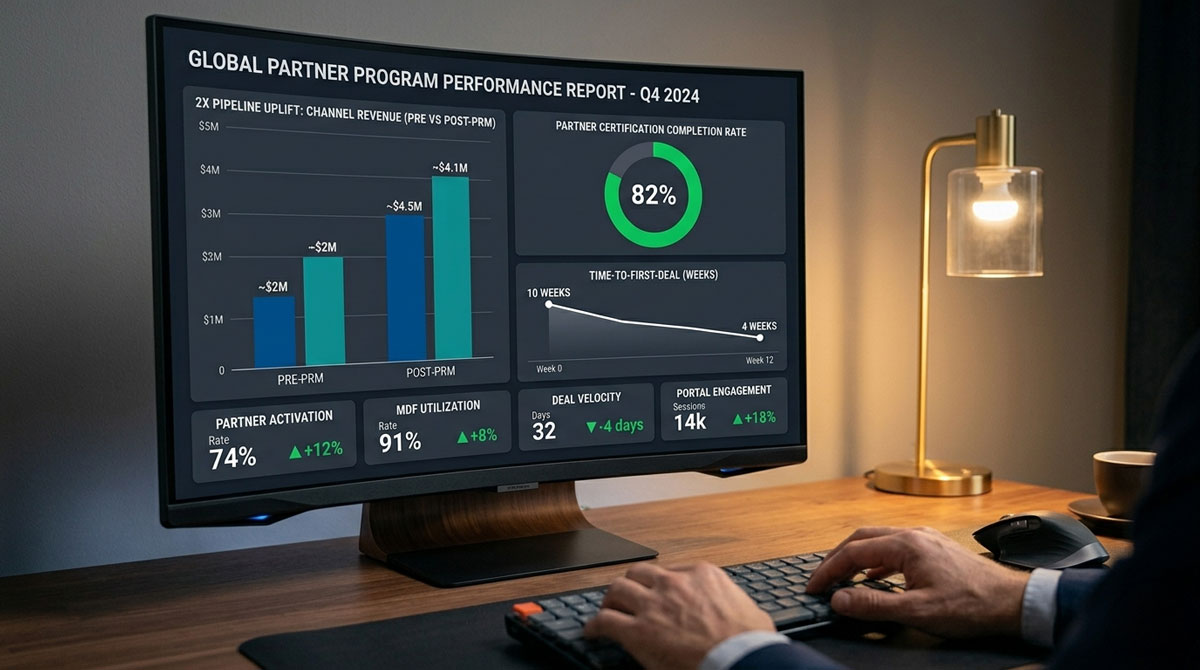
Modern PRM systems deliver measurable ROI when paired with disciplined program management, clear KPI ownership, and data-informed iteration cycles. The following outcomes are consistently reported by technology companies that deploy structured PRM programs with automation-first architectures.
| Metric | Baseline (Manual Programs) | With Structured PRM | Improvement |
|---|---|---|---|
| Partner-sourced pipeline (12 months) | 1× baseline | 2× baseline | +100% |
| Partner onboarding cycle time | 8–12 weeks average | 3–5 weeks average | ~60% faster |
| Channel revenue growth (annual) | Baseline industry rate | +28% above baseline | +28% |
| MDF claim processing time | 3–6 weeks (manual) | 3–7 days (automated) | ~80% faster |
| Partner certification completion rate | <40% (no gating) | 75–85% (gated access) | +35–45pp |
| CAM time spent on admin tasks | 40–50% of CAM hours | 15–20% of CAM hours | ~60% reduction |
How to Choose the Right PRM Vendor for Your Midsize Tech Company
Selecting the right PRM platform is a structured decision—not a vendor demo preference. The following framework maps evaluation steps to the specific considerations most relevant for midsize technology companies in 2026.
Define Your Program Scale and Partner Types
Catalog current partner tiers (resellers, MSPs, SIs, referral agents), active partner count, geographic distribution, and 18-month growth targets. This single step eliminates 3–4 vendors from consideration before the first demo.
Prioritize by Essential Workflow
Identify the one or two workflows where manual process is creating the most measurable friction today—deal registration conflict, MDF bottlenecks, onboarding dropout, or reporting gaps. Select the platform with the deepest native capability in that specific area.
Verify CRM Integration Depth
Request a live demonstration of bi-directional sync with your actual CRM instance—not a canned demo environment. Verify that certification status, deal registration dates, and partner tier changes propagate in real time in both directions.
Run a 60–90 Day Controlled Pilot
Before committing to a full deployment contract, negotiate a structured pilot with 15–30 representative partners across your key tiers. Measure partner activation rate, time-to-first-deal, and admin efficiency during the pilot period before scaling.
Evaluate Long-Term Scalability
Ask the vendor specifically: "What happens when our partner program grows from 200 to 2,000 partners?" Platforms with modular architectures (like ZINFI) expand capabilities without migration; monolithic platforms often require costly re-implementation at scale inflection points.
Frequently Asked Questions
References & Further Reading
- PartnerPlace. What Are the Best PRM Software Solutions Out There? 2026. partnerplace.io
- xAmplify. The Ultimate Guide to PRM Software in 2026. xamplify.com
- ChannelInsider. PRM Software. channelinsider.com
- monday.com. PRM Software. monday.com/blog
- Introw. Best Partner Relationship Management Software. introw.io
- PartnerFleet. Best PRM Tools for Your Partner Program. partnerfleet.io
- ZINFI Technologies. PRM Software Vendor Guide 2025. zinfi.com
- Gartner. Partner Relationship Management Applications Reviews. gartner.com