Unlocking Growth: Your Ultimate Guide to Building a Powerful Partner Ecosystem
A partner ecosystem is a network of companies that collaborate to create more value for customers. This strategic alliance drives innovation, expands market reach, and accelerates revenue growth for all members involved.
Key Takeaways
TL;DR
- A partner ecosystem moves beyond simple linear channels to a complex network of relationships. It focuses on mutual value creation for the customer.
- Modern ecosystems include technology partners, service providers, resellers, and consultants. Diversifying partners is a key to success.
- Building a successful business network requires a clear strategy, effective partner recruitment, and robust onboarding.
- Technology platforms are essential for scaling and managing complex partner relationships and workflows. They provide necessary automation and insights.
- The ultimate goal is to enhance customer experience and value through collaborative solutions. This focus drives long-term loyalty and growth.
- Data analytics, including predictive analytics, are crucial for optimizing performance. They help identify opportunities and manage risks.
- Consistent communication and enablement are vital to keep partners engaged and productive. Your program must support their business goals.
What Exactly Constitutes a Modern Partner Ecosystem?
A modern partner ecosystem represents a significant evolution from traditional channel sales models. It is a community of diverse organizations united by technology and shared business goals.
This network includes a wide variety of partners beyond simple resellers or distributors. It often involves technology partners, solution providers, consultants, integrators, and even influencers.
The core concept shifts from a linear, one-to-many relationship to a many-to-many web. Each participant can collaborate with others to deliver comprehensive solutions for the end customer.
This collaborative framework fosters innovation that a single company could not achieve alone. Partners combine their unique strengths and expertise to solve complex customer problems.
For example, a software company might partner with a cloud provider and a consulting firm. Together they offer a fully managed, customized solution that meets a specific industry need.
The success of the alliance framework is measured by the collective value delivered to customers. This customer-centric approach is a defining characteristic of a thriving business network.
Gartner notes that these collaborations are essential for digital business success. They state that ecosystems enable organizations to scale capabilities beyond their own immediate resources. This external perspective validates the importance of building a robust channel environment.
Effective management requires a platform that supports this complexity and diversity of relationships. A simple portal is no longer sufficient to manage a modern partner ecosystem.

Managing the various roles and permissions within this network is a critical task. You need granular control over who sees what content and data.
Solutions for access management are crucial for maintaining security and relevance for each partner type. This ensures partners only see information pertinent to their role and relationship with you.
The structure of this business network is dynamic and must adapt to changing market conditions. New partners join, and existing relationships evolve based on new opportunities and customer demands.
This flexibility is a key advantage over rigid, traditional channel programs of the past. It allows your company to pivot quickly and capitalize on emerging market trends.
Ultimately, this model is about creating an environment where collaboration is seamless and encouraged. The goal is to build a self-sustaining community that generates ongoing value.
By fostering this collaborative spirit, you unlock new revenue streams and strengthen your competitive position. A well-managed network becomes a powerful and defensible asset for your business.
How Does a Thriving Partner Ecosystem Generate Value?
A thriving partner ecosystem generates immense value by unlocking new growth avenues. It extends your company's reach into new markets and customer segments without direct investment.
Partners bring their own customer bases, industry expertise, and geographical presence. This collaboration provides an efficient path to market expansion and increased brand visibility.
One of the primary value drivers is co-innovation, where partners collaborate on new products. This leads to more comprehensive and compelling solutions than one company could create.
The resulting integrated offerings directly address complex customer needs. This focus on delivering a complete solution significantly enhances customer satisfaction and loyalty.
Moreover, a successful channel environment accelerates sales cycles and increases deal sizes. Partners can act as trusted advisors, influencing purchasing decisions and bundling solutions.
This co-selling motion, managed through tools like partner co-selling management, creates a powerful sales force multiplier. Your team and your partners' teams work together to close larger and more strategic deals.
The network also provides a rich source of market intelligence and customer feedback. Partners are on the front lines and can offer invaluable insights into emerging trends.
This feedback loop allows your organization to adapt its strategy and product roadmap proactively. It ensures your offerings remain relevant and competitive in a fast-paced market.
Effective business intelligence reporting is essential to harness these insights effectively. Using tools for business intelligence and reports helps visualize trends and partner performance.
These reports allow you to measure the impact of your programs and make data-driven decisions. You can see which partners and activities are driving the most value for your business.
The economic model of a partner ecosystem is also highly efficient. It shifts some of the costs of sales and marketing to your partners.
In return, partners gain access to your technology, brand, and support resources. This creates a mutually beneficial relationship where both parties are invested in shared success.
This model encourages specialization, with each participant focusing on its core competencies. The result is a more capable and efficient value chain for delivering customer solutions.
Ultimately, the value generated by a strong alliance framework is exponential. The whole becomes far greater than the sum of its individual parts.
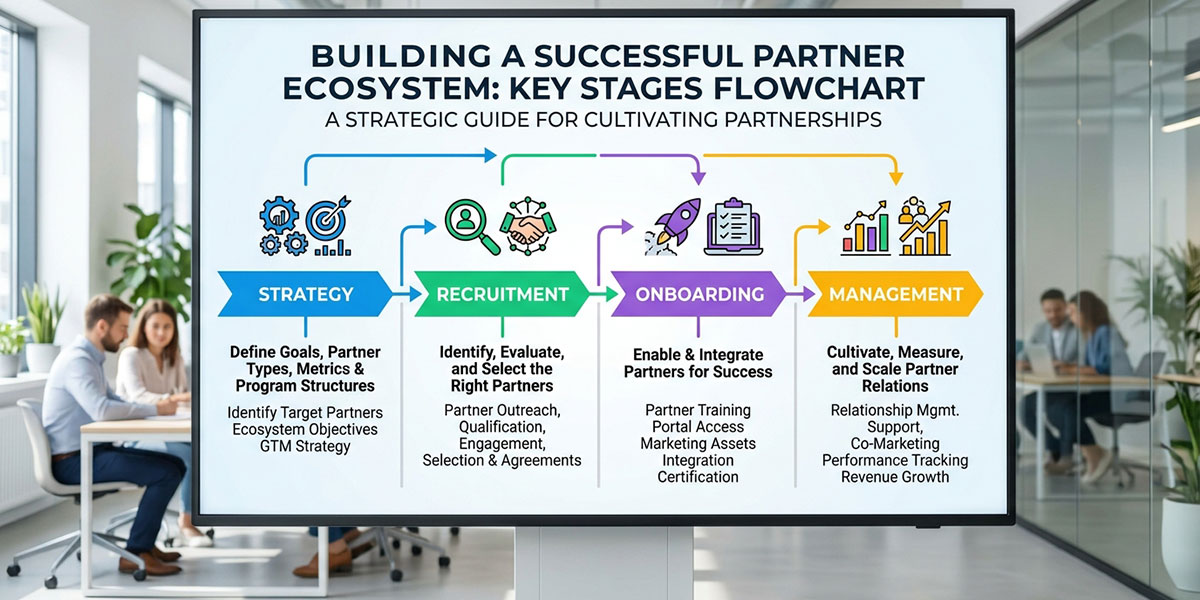
What are the Key Stages for Building a Partner Ecosystem?
Building a successful partner ecosystem involves several distinct, yet interconnected, stages. It begins with a clear and well-defined strategy that aligns with overall business objectives.
This strategy must outline your ideal partner profile and the value proposition for them. You need to understand what you offer partners and what you expect in return.
The next stage is partner recruitment and onboarding, a critical step for success. You need to proactively identify and attract the right companies to join your network.
A robust partner management system can help you track and manage potential recruits. It streamlines the application and evaluation process for new partners joining your program.
Once partners are recruited, a structured onboarding process is essential for their success. This process should provide them with all the necessary information, tools, and training.
Without effective onboarding, even the most promising partners may fail to engage. A strong start sets the foundation for a long and productive relationship together.
Following onboarding is the crucial stage of partner enablement. This involves continuously providing partners with the knowledge and resources they need to succeed.
This includes access to a comprehensive content library, training modules, and marketing assets. Enablement is an ongoing commitment, not a one-time event for your company.
Effective enablement ensures that partners can confidently represent your brand and sell your products. It empowers them to create value for customers and generate revenue for your business.
Another key stage is co-selling and co-marketing engagement to drive market demand. This is where the collaborative aspect of the partner ecosystem truly comes to life.
Joint marketing campaigns, managed through tools like event marketing management, can amplify your reach. They allow you to access new audiences through your partners' established channels.
Similarly, a structured deal registration process is vital for managing co-selling activities. A good deal registration management system prevents channel conflict and ensures fairness.
The final, ongoing stage is performance management and optimization, which needs constant attention. You must continuously measure the health and productivity of your partner ecosystem.
This involves tracking key performance indicators (KPIs) for both individual partners and the network. Using performance analytics helps you identify top performers and areas for improvement.
Regular business planning sessions with key partners are also essential for alignment. A partner business planning tool facilitates this strategic collaboration and mutual accountability.
By systematically progressing through these stages, you can build a sustainable and scalable network. Each stage builds upon the last, creating a strong foundation for long-term growth.
How Can Technology Scale Your Partner Ecosystem Effectively?
Technology is the backbone that enables a partner ecosystem to scale effectively. Manual processes simply cannot handle the complexity of a large and diverse partner network.
A Unified Partner Management (UPM) platform provides the necessary infrastructure for this task. It centralizes all partner-related activities, data, and communications into a single system.
This centralization is the first step toward achieving scalability and operational efficiency. It eliminates data silos and provides a single source of truth for your program.
Automation is another critical role that technology plays in scaling your business network. It automates repetitive tasks such as onboarding, training, and lead distribution.
This automation frees up your channel team to focus on more strategic activities. They can spend less time on administration and more time building strong partner relationships.
For instance, a workflow management tool can automate complex business processes. It ensures consistency and compliance across your entire partner network without manual intervention.
Technology also enables personalized experiences for each partner at a massive scale. The platform can deliver tailored content, training, and marketing campaigns based on partner type.
This level of personalization keeps partners engaged and helps them feel valued. It demonstrates that you understand and support their unique business models and needs.
A powerful content management system is essential for delivering these personalized experiences. It allows you to dynamically control which assets are visible to different partner groups.
Data and analytics are perhaps the most transformative aspects of technology in this context. Modern platforms provide deep insights into every facet of your channel environment.

By leveraging performance analytics, you can track partner engagement, pipeline contribution, and ROI. This data allows for continuous optimization of your program and strategies.
Furthermore, predictive analytics can help you identify which partners are most likely to succeed. This allows you to focus your resources where they will have the greatest impact.
Effective communication is also enhanced by technology through integrated communication tools. Automated alerts and notifications keep partners informed about important updates and opportunities.
A dedicated partner community feature fosters peer-to-peer collaboration and knowledge sharing. This builds a stronger, more connected and engaged partner ecosystem.
Ultimately, technology transforms the management of a partner ecosystem from a reactive to a proactive model. It provides the visibility and control needed to drive strategic growth and scale.
Without the right technology stack, your efforts to scale will be limited. Investing in a robust UPM platform is essential for long-term success of your program.
Traditional Channels vs. AI-Powered Partner Ecosystem
| Feature | Traditional Channel Management | AI-Powered Partner Ecosystem |
| Model Structure | Linear, hierarchical, and often rigid. | Dynamic, networked, and highly flexible. |
| Partner Focus | Primarily on transactional resellers and distributors. | Diverse partners: tech, services, consultants. |
| Value Proposition | Focused on product resale and margins. | Focused on joint value creation for customers. |
| Management Style | Manual, relationship-based, often reactive. | Automated, data-driven, and proactive. |
| Data & Analytics | Basic sales reporting and limited insights. | Deep performance analytics & predictive analytics. |
| Technology Used | Simple partner portals and spreadsheets. | Unified Partner Management (UPM) platforms. |
Why ZINFI is the Ideal Platform for Your Partner Ecosystem
ZINFI offers a comprehensive Unified Partner Management (UPM) solution to run your programs. It is designed to manage the entire partner lifecycle, from recruitment to revenue.
Our platform provides all the tools you need in a single, integrated environment. This eliminates the need for multiple, disconnected point solutions from different vendors.
Here are some of the key features that ZINFI provides for your business:
- A modular platform that allows you to start with what you need now. You can easily add more advanced capabilities as your partner ecosystem matures and grows.
- Advanced partner learning management and certification to ensure partners are fully enabled. This drives partner competency and sales readiness across your entire network.
- Powerful through-channel marketing automation, including email and social media syndication. This helps partners generate demand with minimal effort on their part.
- Integrated partner sales management tools like CPQ and deal registration. These tools streamline the sales process and reduce channel conflict.
- Complete management of partner incentives, including MDF and rebates. Our tools automate complex incentive programs to drive desired partner behaviors.
- Robust analytics with predictive analytics capabilities to optimize program performance. You can make data-driven decisions to increase the ROI of your partner ecosystem.
ZINFI empowers you to build, manage, and scale a world-class alliance framework. Our platform provides the foundation for driving sustainable growth through your partners.
By leveraging ZINFI, you can transform your channel into a strategic competitive advantage. We provide the technology and expertise to help you succeed in today's market.
Frequently Asked Questions
What is the difference between a channel program and a partner ecosystem?
A channel program is typically linear, focusing on resellers selling your products. A partner ecosystem is a broader network of diverse partners collaborating to create value.
What types of partners are in an ecosystem?
An ecosystem includes technology partners, service providers, consultants, and resellers. It also has integrators, marketing agencies, and other entities that influence customers.
Why is customer value important in an ecosystem?
Focusing on customer value aligns all partners toward a common goal. This approach leads to better solutions, higher satisfaction, and increased loyalty.
How do I start building a partner ecosystem?
Start with a clear strategy defining your ideal partner and value proposition. Then focus on recruiting a small group of pilot partners to refine your program.
What is partner enablement?
Partner enablement is the process of providing partners with tools, training, and content. It ensures they are equipped to market, sell, and support your products effectively.
How does a UPM platform help manage an ecosystem?
A UPM platform centralizes all partner activities, automates workflows, and provides analytics. It brings order and scalability to a complex web of partner relationships.
What are the biggest challenges in managing a partner ecosystem?
Challenges include maintaining alignment, preventing channel conflict, and ensuring partner engagement. You also need to measure the ROI of diverse partner contributions effectively.
How do I measure the success of my partner ecosystem?
Success is measured by metrics like partner-influenced revenue and new market penetration. You should also track customer satisfaction with joint solutions and partner engagement levels.
What is co-selling in a partner ecosystem?
Co-selling is when your direct sales team collaborates with a partner's sales team. They work together to close a deal with a shared customer or prospect.
Why is partner onboarding so critical?
A strong onboarding process sets the tone for the entire relationship. It quickly integrates partners into your program and accelerates their time to first revenue.
About the author
Sugata Sanyal
Sugata Sanyal is the Founder & CEO of ZINFI Technologies, a leader in Unified Partner Management. He has been a passionate advocate for the channel and channel partners for decades. His vision for ZINFI is to provide partner ecosystems with the tools they need to succeed.