The Ultimate Guide to Ecosystem Orchestration: How to Scale Revenue with POEM, POET, SONG, & PROSE
Ecosystem orchestration is the strategic coordination of diverse partners to deliver value to customers. It moves beyond simple channel sales to build a dynamic, interconnected network.
This approach helps companies scale revenue and deliver superior, integrated customer solutions. It requires a significant shift from managing a linear supply chain to guiding a collaborative web.
Modern buyers demand comprehensive solutions that a single vendor often cannot provide alone. Effective ecosystem orchestration allows you to meet this demand by leveraging partner strengths.
Success requires the right strategy, frameworks, and technology to manage complex relationships. This guide explores the frameworks and tools leaders need to master this critical capability.
Key Takeaways
TL;DR
- Ecosystem orchestration coordinates multiple partners to create superior customer value and outcomes.
- It differs from traditional channel management by focusing on co-creation, not just reselling.
- Frameworks like POEM, POET, SONG, and PROSE provide structure for managing ecosystems.
- Technology, specifically Unified Partner Management platforms, is crucial for successful execution.
- The ultimate goal is scalable revenue growth through a well-managed partner network.
- Effective governance and clear objectives are essential for long-term ecosystem health.
- Metrics shift from sales volume to influenced revenue and customer lifecycle value.
What is Ecosystem Orchestration and Why Does It Matter Today?
At its core, ecosystem orchestration is the active management of a multi-partner business network. It is about aligning diverse organizations toward a shared goal of customer success.
These partners can include technology providers, consultants, service integrators, and resellers. Each contributes a unique piece of value to the end customer's complete solution.
The orchestrator, typically the primary vendor, does not command but rather enables collaboration. This entity fosters communication, aligns incentives, and provides shared resources for the group.
This model matters more than ever because customer problems have become increasingly complex. No single company has all the answers or capabilities for every customer need.
A well-orchestrated ecosystem pools resources and expertise to solve these complex challenges. It creates a solution that is far greater than the sum of its parts.
This collaborative approach directly drives innovation and uncovers new revenue opportunities. Partners can co-develop solutions that neither could build or market on their own.
Furthermore, it enhances competitive advantage by creating deep, defensible customer relationships. Switching from an integrated solution is much harder than replacing a single product.
Strategic ecosystem orchestration involves moving from a one-to-many to a many-to-many model. It's a fundamental shift in how businesses think about partnerships and value creation.
The orchestrator invests in the health of the entire network, not just individual transactions. This long-term view builds trust and resilience within the partner community.
Organizations must adopt new skills in relationship management, governance, and platform technology. They must transition from being a seller to becoming a market-maker for their partners.
This dynamic creates a powerful engine for scalable and sustainable business growth. It allows companies to expand their reach and capabilities without massive internal investment.
For example, a software company might partner with implementation specialists and data analysts. This creates a full-service offering for clients who need more than just software.
The customer receives a seamless experience, unaware of the complex coordination happening behind it. This is the hallmark of truly successful network management and orchestration.
Ultimately, this approach is about placing the customer's total need at the center. It builds a network designed specifically to meet and exceed those expectations comprehensively.
How Do POEM and POET Frameworks Guide Strategic Ecosystem Orchestration?
Structured frameworks are essential for managing the complexity of a partner ecosystem. POEM and POET provide clear, actionable guidance for building and running your network.
POEM stands for Plan, Onboard, Engage, and Measure, a lifecycle for partner management. This framework ensures you cover all critical stages of a successful partner journey.
The "Plan" phase is the strategic foundation of your entire ecosystem orchestration effort. It involves defining your ecosystem's purpose and identifying your ideal partner profiles.
During this stage, you must set clear business objectives and key performance indicators. This ensures that every action taken serves a specific, measurable strategic goal.
"Onboard" focuses on creating a frictionless and welcoming process for new partners. First impressions matter greatly and set the tone for the entire relationship.
Effective onboarding includes comprehensive training, access to a central content library, and clear initial tasks. It should empower partners to start contributing value as quickly as possible.
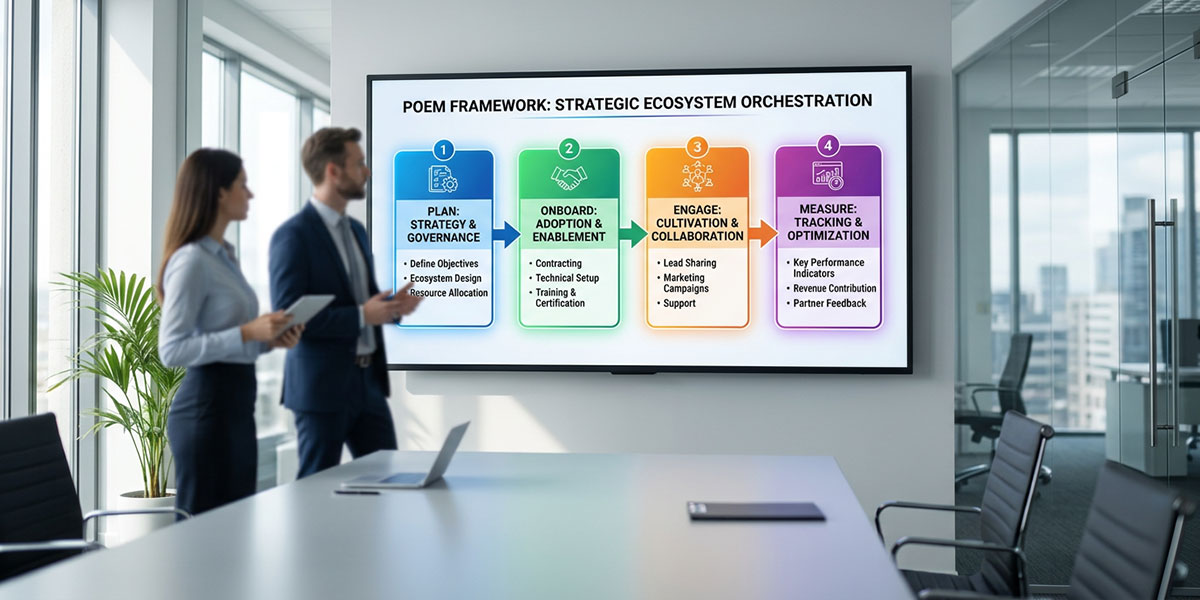
The "Engage" phase involves fostering continuous collaboration and open lines of communication. An unengaged partner is a dormant asset that provides no value to the network.
Engagement strategies include joint business planning, co-marketing campaigns, and regular performance reviews. Tools like a partner community portal are vital for fostering this interaction.
Finally, "Measure" is about tracking the performance of both individual partners and the ecosystem. It is crucial to move beyond simple sales volume and revenue metrics.
This involves analyzing influenced revenue, partner engagement scores, and customer satisfaction data. Using data from performance analytics helps you optimize your strategy and reward top performers effectively.
The POET framework offers another perspective, focusing on key structural elements. POET stands for Partners, Objectives, Engagement, and Technology, the pillars of your program.
The "Partners" element emphasizes the critical importance of partner selection and recruitment. You must recruit partners who align with your strategic goals and company culture.
This requires a clear ideal partner profile and a structured partner management process. Quality over quantity is the guiding principle for a healthy, productive ecosystem.
"Objectives" reinforces the need for mutually beneficial and clearly articulated goals. Every partner must understand what success looks like for them and for the ecosystem.
These objectives should be documented in partner contracts and business plans. Transparency here is the bedrock of a trusting and collaborative partnership from the start.
The "Engagement" component of POET mirrors the one in POEM, stressing active participation. It highlights the design of programs that incentivize and facilitate partner collaboration.
This could involve creating tiered partner programs or offering market development funds. The goal is to make it easy and profitable for partners to engage.
"Technology" is the final, critical pillar that underpins the entire structure. Managing a dynamic ecosystem with spreadsheets and email is simply not feasible.
A unified platform is necessary to manage onboarding, collaboration, and performance measurement. This technology is the central nervous system of modern ecosystem orchestration, enabling scale and efficiency.
What Role Do SONG and PROSE Play in Advanced Ecosystem Orchestration?
As an ecosystem matures, new frameworks are needed to manage its growing complexity. SONG and PROSE are designed for scaling and optimizing an established partner network.
SONG stands for Scale, Optimize, Nurture, and Govern, guiding mature ecosystem management. It shifts the focus from building the foundation to expanding and refining it.
"Scale" addresses the challenges of growing your ecosystem without sacrificing quality or control. This involves recruiting partners in new regions or with new specializations.
A scalable process for partner recruitment and onboarding is critical at this stage. Automation and self-service portals become essential assets for handling increased volume.
The "Optimize" phase is about using data to make continuous improvements across the network. It's about finding efficiencies and enhancing the performance of every single partner.
This requires sophisticated business intelligence and reporting capabilities. Using predictive analytics can help identify partners with high growth potential or those at risk.
"Nurture" emphasizes the importance of investing in the long-term success of your partners. Mature ecosystems thrive when partners feel valued and see a path for growth.
This includes providing advanced training through a learning management system and offering dedicated support. Nurturing loyal, expert partners creates an incredible competitive barrier over time.

"Govern" becomes paramount as the number of partners and interactions skyrockets. Governance establishes the rules of engagement to prevent chaos and channel conflict.
This involves clear policies for deal registration, conflict resolution, and data sharing standards. Strong governance maintains trust and ensures fair play for every ecosystem member.
The PROSE framework focuses on the operational side of strategic ecosystem orchestration. It stands for Process, Resources, Operations, Systems, and Enablement, a blueprint for execution.
PROSE provides the "how-to" for implementing the strategies outlined in the other frameworks. It translates high-level goals into tangible, day-to-day activities and structures.
"Process" is about standardizing workflows to create efficiency and predictability for partners. This includes automating tasks like lead distribution or MDF claims and approvals.
Using a workflow management tool can streamline these processes. This reduces administrative overhead for both you and your partners, freeing up time.
"Resources" refers to providing partners with the assets they need to be successful. Easy access to the right sales and marketing materials is absolutely crucial.
This includes a well-organized content library and tools for co-branded asset creation. Partners must be equipped to represent your brand accurately and professionally.
"Operations" encompasses the daily management tasks that keep the ecosystem running. This team is responsible for partner support, communications, and program administration.
A dedicated partner operations team becomes essential as the ecosystem scales up. This team serves as the main point of contact and support for all partners.
"Systems" highlights the need for integrated technology to connect all operational aspects. A fragmented technology stack creates data silos and enormous frustration for partners.
A Unified Partner Management platform provides this single source of truth. It integrates everything from partner relationship management to incentive payments.
Finally, "Enablement" is the continuous process of equipping partners with skills and knowledge. An enabled partner is a more confident, capable, and productive contributor.
This goes beyond initial onboarding to include ongoing product training and sales coaching. Enablement ensures your partners can articulate the value of your joint solutions perfectly.
Traditional Channel vs. Ecosystem Orchestration
| Feature | Traditional Channel Sales | Modern Ecosystem Orchestration |
|---|---|---|
| Structure | Linear, one-to-many (vendor to reseller) | Networked, many-to-many (collaborative web) |
| Partner Focus | Primarily reselling finished products | Co-creation, co-marketing, co-selling, and influencing |
| Primary Goal | Driving transactional sales volume | Delivering customer lifecycle value and solutions |
| Technology | Siloed CRM and basic partner portals | Unified Partner Management (UPM) platforms |
| Key Metrics | Revenue booked, units sold | Influenced revenue, customer satisfaction, partner engagement |
| Communication | Top-down, vendor-to-partner directives | Collaborative, peer-to-peer, and community-driven |
| Value Creation | Focused on distribution and fulfillment | Focused on innovation and integrated solutions |
The table above clearly illustrates the fundamental differences between these two approaches. Traditional channel management is a linear, transactional model focused on distribution.
In contrast, modern ecosystem orchestration is a dynamic, relational model focused on co-creation. It's about building a network to solve customer problems in a holistic way.
According to research from Gartner, this collaborative approach yields significant results. Providers who co-sell can realize an immediate revenue increase of at least 10%.
This highlights the tangible financial benefits of moving toward a more orchestrated model. The shift is not just theoretical; it has a direct impact on the bottom line.
How Can Technology Enable Effective Ecosystem Orchestration?
Managing a complex web of partner relationships is impossible to do manually. The sheer scale and dynamism of a modern ecosystem require a dedicated technology platform.
Spreadsheets, emails, and disconnected tools create data silos and operational chaos. This results in a poor partner experience and an inability to scale effectively.
A Unified Partner Management (UPM) platform is the essential technology for this task. It serves as the central hub for all partner-related activities and data.
This platform automates and streamlines the entire partner lifecycle, from recruitment to performance analysis. It provides a single pane of glass for managing your entire network.
Effective ecosystem orchestration relies on several core technological capabilities. These include partner relationship management, enablement, marketing, sales, and incentives management.
Partner relationship management modules allow you to recruit, onboard, and manage partner profiles. This ensures you have a comprehensive view of every partner in your ecosystem.

Partner enablement tools provide access to training, content, and certification programs. This helps you equip partners with the knowledge they need to succeed in the market.
Through-channel marketing automation (TCMA) empowers partners to execute marketing campaigns. It provides tools for email marketing, social media syndication, and event management.
Partner sales management features facilitate collaborative selling and revenue tracking. This includes tools for lead sharing, deal registration, and co-selling workflows.
Finally, incentives management automates the tracking and payout of commissions, rebates, and MDF. This ensures partners are rewarded accurately and promptly for their contributions.
A robust UPM solution breaks down the silos between these different functions. It creates a seamless, integrated experience for both your internal teams and your partners.
This integration is key to gathering the data needed for strategic decision-making. It enables comprehensive performance analytics to see what is and isn't working.
By leveraging the right technology, you can move from reactive management to proactive orchestration. You can anticipate needs, identify opportunities, and guide your ecosystem toward greater success.
ZINFI’s Unified Partner Management platform provides a comprehensive solution for this challenge. It integrates dozens of modules into a single, cohesive environment for all partners.
With ZINFI, you can effectively manage the entire partner journey with one platform. This drives efficiency, enhances partner engagement, and accelerates revenue growth through your ecosystem.
Why ZINFI is the Leader in Ecosystem Orchestration
ZINFI offers a complete, enterprise-grade solution for strategic ecosystem orchestration. The platform is built from the ground up to manage complex, multi-partner networks.
It provides a robust set of tools to execute on frameworks like POEM and PROSE. ZINFI empowers organizations to turn ecosystem theory into successful business practice.
- End-to-End Automation: ZINFI automates the entire partner lifecycle, from recruitment and onboarding with powerful workflow management to performance management, reducing manual effort and improving efficiency.
- Deep Enablement Capabilities: The platform includes a world-class Partner Learning Management System (LMS+), content management, and video libraries to ensure partners are fully equipped.
- Integrated Co-Selling and Co-Marketing: ZINFI facilitates true collaboration with modules for partner co-selling, through-channel marketing, and social media syndication, driving joint revenue generation.
- Advanced Analytics and BI: With comprehensive business intelligence reports, you gain deep insights into partner and ecosystem performance, enabling data-driven optimization. This includes performance analytics and predictive analytics.
- Flexible Incentives Management: Manage complex incentive structures including MDF, co-op,SPIFFs, and rebates easily, ensuring partners are motivated and rewarded fairly for their efforts.
- Unified Experience: ZINFI's Centralized Interconnect provides a single portal for all partners, creating a seamless and branded experience that fosters engagement and loyalty across the network.
Frequently Asked Questions
How is ecosystem orchestration different from channel management?
Channel management is linear, focusing on reselling products through a one-to-many model. Ecosystem orchestration is a networked, many-to-many model focused on collaborative value co-creation.
What is the first step in building a partner ecosystem?
The first step is the planning phase, as outlined in the POEM framework. You must define your strategic objectives and identify your ideal partner profile.
What types of partners are in a typical ecosystem?
An ecosystem can include technology partners, service providers, implementation specialists, and consultants. It can also include influencers, advocates, and traditional resellers who are a good fit.
Why is a Unified Partner Management (UPM) platform necessary?
A UPM platform automates and integrates all partner-related activities into a single system. It eliminates data silos and provides the tools needed to manage a complex network at scale.
What are the main benefits of successful ecosystem orchestration?
The main benefits include accelerated revenue growth, increased innovation, and enhanced customer value. It also builds a strong competitive advantage that is difficult for others to replicate.
How do you measure the success of an ecosystem?
Success metrics go beyond direct revenue to include influenced revenue and partner engagement. Customer satisfaction and the number of joint solutions developed are also key indicators.
What is channel conflict in the context of an ecosystem?
Channel conflict occurs when multiple partners compete for the same deal without clear rules. Strong governance in your ecosystem orchestration, like deal registration, helps prevent this issue.
Can small companies benefit from ecosystem orchestration?
Yes, small companies can greatly benefit by leveraging partner capabilities to expand their reach. It allows them to compete with larger players without massive internal investment.
What role does partner onboarding play in the ecosystem?
Onboarding is a critical first step that sets the tone for the entire relationship. A smooth, efficient process empowers partners to become productive members quickly.
How does strategic ecosystem orchestration drive innovation?
It brings together diverse partners with different areas of expertise and perspectives. This collaboration fosters the co-creation of new, integrated solutions that meet evolving customer needs.
About the author
Sugata Sanyal
Sugata Sanyal is the Founder & CEO of ZINFI Technologies, a leader in Unified Partner Management. He has been a passionate advocate for the channel and channel partners for decades. His vision for ZINFI is to provide partner ecosystems with the tools they need to succeed.