The Core Capabilities of a Best-In-Class PRM Software Platform
A best-in-class PRM platform provides unified capabilities for comprehensive partner management. It centralizes partner recruitment, enablement, marketing, and sales into a single, cohesive system.
This integration drives significant efficiency and visibility across your entire channel ecosystem. Companies use this technology to empower partners and accelerate indirect sales growth.
Understanding these core capabilities is crucial for selecting the right solution for your business. The right platform transforms your partner program from a cost center to a revenue driver.
Investing in a robust Partner Relationship Management system is no longer a luxury. It has become a fundamental requirement for competing in today's crowded markets.
This guide will explore the essential features that define a leading software solution. We will cover everything from foundational management to advanced automation and analytics.
Key Takeaways
TL;DR
- A superior Partner Relationship Management platform unifies all partner-facing activities. This includes onboarding, training, marketing, and sales in one accessible portal.
- Core capabilities include robust partner lifecycle management tools. These tools automate recruitment, onboarding, business planning, and contract administration.
- Effective partner enablement is driven by integrated learning management and content libraries. It ensures partners have the knowledge and assets they need to succeed.
- Through-channel marketing automation (TCMA) is essential for scalable partner marketing. It allows partners to easily execute co-branded campaigns across multiple channels.
- Sales automation tools like deal registration and referral management are critical. They protect partners and provide clear visibility into the channel pipeline.
- Advanced analytics and reporting provide deep insights into partner performance. This allows for data-driven decisions and continuous program optimization.
- Incentive management programs automate MDF, rebates, and commissions. They motivate partners and reward top performers for their contributions.
What Foundational Partner Management Features Should a PRM Include?
How Does a Top-Tier PRM Empower Partner Enablement?
Partner enablement is the process of equipping partners with the necessary skills and resources. A top-tier PRM platform makes this process efficient, scalable, and highly effective.
It acts as a centralized hub for all training and content. This ensures partners can always find what they need to sell and support your products.

A sophisticated partner learning management system (LMS) is a core component. This feature allows you to create and deliver structured training courses and certifications.
You can build learning paths tailored to different partner roles, such as sales or technical support. This ensures each individual receives relevant and impactful training.
The LMS should support various content formats, including videos, documents, and interactive quizzes. It should also track partner progress and completion rates automatically.
This provides you with clear visibility into the knowledge level across your partner base. You can identify skill gaps and proactively address them with targeted training initiatives.
Beyond formal training, access to a comprehensive content library is essential. A robust content library management tool organizes all your sales and marketing assets.
This includes datasheets, case studies, white papers, presentations, and competitive battle cards. Advanced search and filtering capabilities help partners find the right asset quickly.
A leading PRM will also offer a dedicated video library management solution. Video has become an incredibly powerful medium for training and marketing.
This tool allows you to host and organize video content securely. Partners can access product demos, training sessions, and marketing videos on demand.
One of the most valuable enablement features is asset co-branding. This functionality empowers partners to personalize marketing materials with their own logo and contact information.
An integrated co-branded assets management tool makes this process seamless. Partners can generate professional, brand-compliant collateral in just a few clicks.
This drives greater adoption of your marketing materials. It also helps partners maintain a professional image while promoting your solutions.
Effective enablement goes beyond just providing resources. A great Partner Relationship Management system uses alerts and notifications to guide partners to relevant content.
For example, the system can recommend specific training based on a partner's profile. It can also suggest sales assets related to a deal they have registered.
This proactive approach ensures that enablement is not a passive activity. It actively pushes the right information to the right partner at the right time.
By unifying these enablement tools, a PRM solution creates a powerful learning environment. It reduces partner ramp-up time and increases their overall effectiveness.
This leads to more confident and capable partners. Ultimately, this confidence translates into better customer interactions and increased sales revenue.
Why is Integrated Marketing Automation Critical for a PRM?
Many partners, especially smaller ones, lack dedicated marketing resources or expertise. A great PRM platform bridges this gap with integrated through-channel marketing automation (TCMA).
TCMA empowers partners to execute sophisticated marketing campaigns with minimal effort. This capability dramatically scales your brand's reach into local markets.
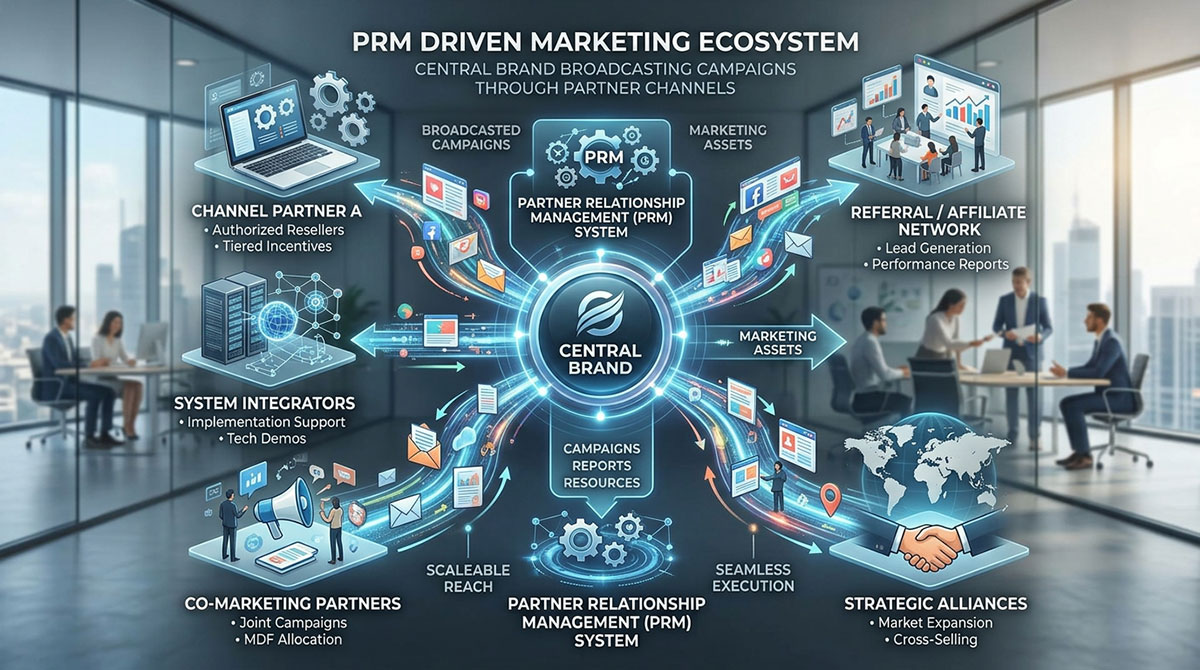
Email marketing is a foundational element of any TCMA suite. The platform should offer a powerful email marketing management tool for partners.
You can provide pre-built campaign templates with compelling copy and graphics. Partners can then easily launch these campaigns to their own contact lists.
This "push-button" approach ensures brand consistency and messaging accuracy. It also removes the creative burden from partners, encouraging wider campaign participation.
The system should handle all aspects of campaign execution. This includes list management, sending, and tracking of results like opens and clicks.
Social media is another crucial channel for modern marketing. A sophisticated solution includes a social syndication management feature.
This allows you to create a stream of approved social media content. Partners can connect their business accounts and automatically share your posts.
This dramatically amplifies your social media presence through your partners' networks. It helps maintain a consistent flow of relevant content with very little partner effort.
For lead generation, microsites and landing pages are indispensable. Your PRM software should provide a microsite and landing page management tool.
Partners can launch co-branded landing pages for specific campaigns or solutions. These professional-looking pages are designed for conversion and capture valuable leads.
This eliminates the need for partners to have web development skills. They can create effective digital storefronts that are fully brand-compliant.
Events, both virtual and in-person, remain a key part of the marketing mix. A best-in-class platform will feature an event marketing management module.
This tool helps partners plan, promote, and manage their marketing events. It can handle everything from registration and invitations to post-event follow-up.
By automating these marketing functions, a Partner Relationship Management system democratizes marketing for all partners. It levels the playing field, allowing even small partners to compete effectively.
The integration of these tools is what creates immense value. A partner can launch a multi-channel campaign from a single interface.
Leads generated from these activities flow directly into the sales management modules. This creates a closed-loop system for tracking marketing ROI.
Ultimately, integrated TCMA transforms your partners into a distributed marketing engine. This capability is essential for any organization looking to achieve scalable growth.
What Sales Management Tools are Essential in a Modern PRM?
Comparative Analysis: Traditional vs. AI-Powered PRM
| Feature | Traditional Channel Management | AI-Powered PRM Approach |
|---|---|---|
| Data Centralization | Data is scattered across spreadsheets, emails, and separate systems. | All partner data resides in a single, unified database for a 360-degree view. |
| Partner Onboarding | Manual, inconsistent process requiring significant admin time. | Automated workflows guide partners through a standardized, efficient onboarding. |
| Marketing Execution | Partners manually create or adapt marketing materials, often with errors. | Partners launch pre-approved, co-brandable campaigns with a few clicks. |
| Sales Tracking | Pipeline is managed through emails and spreadsheets, leading to poor visibility. | Centralized deal registration and lead management provide a real-time sales pipeline. |
| Performance Reporting | Manual data collection and report generation is slow and error-prone. | Automated dashboards and Performance analytics provide instant insights. |
| Partner Support | Channel managers are the primary point of contact, creating bottlenecks. | AI-powered chatbots and knowledge bases provide 24/7 instant support. |
| Scalability | Difficult to scale as adding more partners increases administrative overhead exponentially. | Automation and self-service tools allow for easy scaling of the partner program. |
How Does a PRM Drive Performance with Analytics and Incentives?
A best-in-class PRM is not just an operational tool; it is a strategic asset. It drives performance through powerful analytics and automated incentive management.
These capabilities allow you to move from simply managing partners to actively optimizing their performance. This is what separates leading channel programs from average ones.
Robust analytics and reporting are foundational to this optimization. A comprehensive platform includes a business intelligence and reports module.
This provides real-time dashboards and detailed reports on every aspect of the program. You can track key performance indicators (KPIs) for sales, marketing, and enablement.

Advanced systems go beyond historical reporting with predictive analytics. These tools can forecast future sales performance based on current pipeline data.
Performance analytics help identify which partners are excelling and which are struggling. This allows you to focus your resources where they will have the most impact.
Insights from these analytics are crucial for data-driven decision-making. According to research by Gartner, data is key to building performance-driven partner ecosystems.
You can identify the behaviors and activities that correlate with success. This knowledge helps you refine your training programs and share best practices across the channel.
While analytics provide insights, incentives provide motivation. A leading Partner Relationship Management solution automates the management of various partner incentive programs.
Market Development Funds (MDF) are a common but complex incentive. A dedicated MDF management tool simplifies the entire process.
It automates fund proposals, approvals, claims, and reimbursement. This transparency and efficiency encourage partners to utilize the funds you make available.
Rebates are another powerful tool for rewarding sales volume. A partner rebates management feature automates the calculation and payout of these incentives.
The system automatically tracks sales against rebate targets. This eliminates manual calculations and ensures accurate, timely rewards for your partners.
For referral or commission-based models, a PRM can automate payouts. The partner commissions management module calculates commissions based on closed deals.
This direct link between sales activity and financial reward is a powerful motivator. It ensures partners are compensated accurately and promptly for the business they generate.
Finally, a comprehensive payment management solution ties all these incentives together. It can manage the disbursement of MDF, rebates, and commissions seamlessly.
By combining powerful analytics with automated incentives, a PRM creates a virtuous cycle. You can measure what matters, reward what works, and continuously improve program performance.
Why ZINFI is the Leader in Unified Partner Management
Frequently Asked Questions about PRM
What does PRM stand for?
PRM stands for Partner Relationship Management. It refers to the strategies, processes, and technologies used to manage a company’s channel partners.
What is the main purpose of a PRM platform?
The main purpose is to automate and streamline all interactions with channel partners. This includes onboarding, training, marketing, sales collaboration, and performance tracking.
How does a PRM differ from a CRM?
A CRM (Customer Relationship Management) system manages relationships with direct customers. A PRM is specifically designed to manage relationships with indirect sales partners, like resellers or distributors.
Can small businesses use a PRM solution?
Yes, many modern PRM platforms offer modular and scalable solutions. This makes them accessible and beneficial for small businesses looking to build a channel program.
What is through-channel marketing automation (TCMA)?
TCMA is a key feature of many Partner Relationship Management platforms. It allows vendors to provide marketing campaigns and assets that partners can easily execute.
Why is deal registration important in a PRM?
Deal registration is crucial for reducing channel conflict. It allows a partner to register an opportunity, protecting it from being claimed by another partner or direct sales.
How does a PRM improve partner enablement?
A PRM improves enablement by providing a centralized learning management system (LMS) and content library. This ensures all partners have easy access to consistent training and resources.
What kind of ROI can I expect from a PRM implementation?
ROI comes from increased channel sales, higher partner engagement, and administrative cost savings. It also comes from improved marketing reach and better pipeline visibility.
How long does it take to implement a PRM platform?
Implementation time varies based on complexity and customization. However, modern, cloud-based platforms can often be deployed in a matter of weeks, not months.
Is a PRM necessary if I only have a few partners?
Even with a few partners, a PRM establishes best practices from the start. It creates a scalable foundation that supports future growth without creating chaos.
About the author
Sugata Sanyal
Sugata Sanyal is the Founder & CEO of ZINFI Technologies, a leader in Unified Partner Management. He has been a passionate advocate for the channel and channel partners for decades. His vision for ZINFI is to provide partner ecosystems with the tools they need to succeed.