Channel Partner Strategy: How to Build a Partner-Led Go-to-Market with VADs and Recurring Revenue
A channel partner strategy is a comprehensive plan for marketing and selling products through third-party partners. This approach helps businesses scale their reach and enter new markets more efficiently.
Developing a robust plan is critical for maximizing the value of your partner network. It aligns your business goals with the activities and motivations of your channel partners.
Without a clear framework, partnership efforts can become disorganized and produce inconsistent results. A well-defined program ensures that both you and your partners are working toward success.
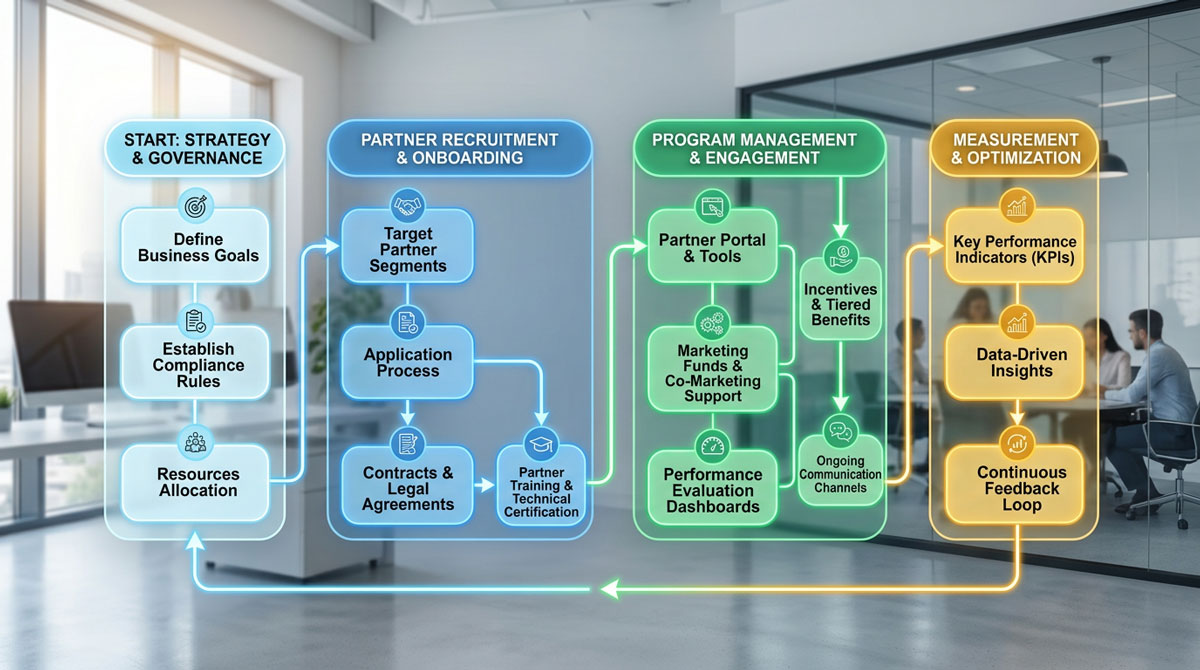
This framework should cover partner recruitment, onboarding, enablement, and ongoing management processes. It also defines how you will measure success and reward high-performing partners.
Ultimately, a sophisticated partnering approach transforms a simple sales channel into a dynamic growth engine. It creates a collaborative ecosystem that drives revenue and enhances your brand's market presence.
Key Takeaways
TL;DR
- A channel partner strategy is a formal plan to manage and grow sales through partners. It provides structure for recruitment, enablement, and performance measurement to scale business.
- Effective partner ecosystem management involves treating partners as a true extension of your business. This requires sophisticated tools for collaboration and communication to build strong relationships.
- A value-added distributor (VAD) can significantly amplify your reach and provide crucial services. Integrating VADs into your plan requires clear rules of engagement and support.
- A partner-led go-to-market model empowers partners to own the sales cycle. This approach can rapidly increase market penetration and reduce direct sales costs.
- Focusing on an annual recurring revenue channel is vital for predictable, long-term growth. Your strategy must include incentives and support for subscription-based sales models.
- Automating processes with a Unified Partner Management (UPM) platform is essential for efficiency. Technology provides the data needed for informed decision-making and continuous improvement.
Why is a formal channel partner strategy essential for modern B2B growth?
A formal channel partner strategy provides a necessary blueprint for sustainable expansion in today's market. It moves a business from opportunistic partnerships to a structured, scalable growth model.
This structured approach ensures consistency in how partners are recruited, trained, and managed. It aligns every partner with your company's core objectives and brand standards.
Without a deliberate plan, companies often struggle with channel conflict and inconsistent partner performance. A clear framework helps mitigate these risks by defining roles and expectations clearly.
Effective partner ecosystem management begins with this foundational document. It serves as the single source of truth for your entire indirect sales organization.
Your plan should detail the ideal partner profile, outlining the skills and market focus you need. This helps you recruit partners who are genuinely equipped to sell your solutions effectively.
Moreover, a formal program makes your company more attractive to high-quality partners. They see a commitment to mutual success, backed by well-defined processes and resources.
The development of a strategic framework also forces internal alignment across different departments. Sales, marketing, and support teams must collaborate to provide a seamless partner experience.
This alignment improves efficiency and ensures partners receive the support they need to succeed. A cohesive internal approach is a hallmark of a mature and effective partnering approach.
As you build your plan, consider the entire partner lifecycle from start to finish. This includes detailed plans for onboarding, ongoing training, and co-marketing initiatives.
A comprehensive partner learning management system becomes crucial for delivering consistent and scalable training programs to all partners.
The market landscape is constantly evolving, requiring an adaptable partnering approach. Your plan should be a living document, reviewed and updated regularly to reflect changes.
According to research from Gartner, today's B2B buying journey is increasingly complex and non-linear. Partners play a critical role in helping customers navigate this complexity.
A well-executed channel plan empowers partners to act as trusted advisors to end customers. It provides them with the knowledge and tools to guide buyers through their decision process.
This creates a significant competitive advantage in crowded markets. Your partners become a differentiated extension of your sales and marketing teams.
Finally, a formal channel partner strategy is essential for measuring return on investment. It establishes the key performance indicators (KPIs) you will use to track success.
With clear metrics, you can identify what is working and where improvements are needed. This data-driven approach allows for continuous optimization of your partner program and overall growth.
How do you integrate a value-added distributor into your channel partner strategy?
Integrating a value-added distributor (VAD) requires careful planning and clear communication. VADs can significantly expand your market reach and provide logistical support.
They act as intermediaries, managing relationships with a broad network of smaller resellers. This two-tier model allows you to scale much faster than a direct-to-partner approach alone.
A successful channel partner strategy must define the specific role of the VAD. This includes responsibilities for inventory management, credit services, and technical support.
A strong relationship with a VAD is built on trust and mutual benefit. You must treat them as a strategic extension of your own organization.
Start by selecting VADs that align with your industry focus and geographic goals. A distributor specializing in your target market will have established relationships with relevant resellers.
Once selected, you must provide the VAD with comprehensive training and enablement resources. They need to understand your products and value proposition as well as your own team does.
Your partnering framework should include specific programs and incentives tailored for distributors. These may differ from the programs you offer to direct reseller partners.
For instance, VADs often receive incentives based on sales volume and reseller recruitment numbers. This motivates them to actively grow your presence within their partner network.
Effective partner management software is crucial for managing the complexity of a two-tier model. It provides visibility into the entire sales chain, from the distributor to the end customer.
This visibility helps prevent channel conflict and ensures accurate sales attribution. You can track performance at both the distributor and the individual reseller level.
Clear rules of engagement are also necessary to avoid friction in the channel. Define which accounts are handled directly versus which are managed through the VAD and its partners.
This prevents your direct sales team from competing with your channel partners. A well-defined territory plan is a key component of a harmonious ecosystem.
Furthermore, you should collaborate with your VAD on joint marketing and demand generation. Leveraging their marketing capabilities can greatly amplify your message in the market.
This might include co-hosted webinars, email campaigns, or participation in industry events. These activities help drive leads to the VAD's network of resellers.
Regular business reviews with your VAD are essential for maintaining a strong partnership. These meetings should focus on performance, pipeline, and strategic planning for the future.
This ongoing dialogue ensures that your partnership evolves with changing market conditions. It keeps both organizations aligned on goals and priorities for continued success.
What defines a successful partner-led go-to-market channel partner strategy?
A successful partner-led go-to-market model empowers partners to drive the entire sales process. It shifts primary ownership of the customer relationship from your direct team to your partners.
This approach is powerful for rapid scaling and entering new markets. Partners with local expertise and established customer relationships can achieve results quickly.
The foundation of this model is deep trust and significant investment in partner enablement. You must equip partners to handle everything from lead generation to closing deals.
An effective channel partner strategy designed for this model focuses on partner autonomy. It provides them with the tools and freedom to run their own sales cycles effectively.
This includes providing robust marketing resources through a co-branded assets management solution. Partners need professional, brand-compliant materials they can easily customize for their own campaigns.
A deals-based registration system is also fundamental to a successful partner-led approach. A deal registration management tool protects partner-sourced opportunities and prevents channel conflict.

This builds trust and encourages partners to invest in prospecting for new business. They know their efforts will be rewarded without fear of being undercut.
The compensation and incentive structure must strongly favor this partner-led motion. Margins and bonuses should be highest for deals that partners manage from start to finish.
This model is particularly effective for building an annual recurring revenue channel. Partners are well-positioned to sell subscription-based services and manage customer renewals over time.
Their close relationship with the customer makes them ideal for identifying upsell and cross-sell opportunities. This contributes directly to increasing customer lifetime value and predictable revenue streams.
To support this, your program must provide partners with excellent post-sales support resources. They need access to your technical support teams and knowledge base to serve customers effectively.
A partner support portal, managed through a tool like ZINFI's Partner Support Management, becomes a vital lifeline. It ensures partners can get answers and resolve customer issues promptly.
The role of your direct sales team changes in a partner-led go-to-market model. They become channel managers and partner specialists rather than direct sellers.
Their focus shifts to coaching partners, co-selling on large or complex deals, and recruiting new talent. This collaborative approach enhances the capabilities of your entire partner ecosystem.
Metrics for success in this model go beyond just revenue. You should track partner-sourced pipeline, deal registration volume, and partner certification levels.
These leading indicators show the health and engagement of your partner network. A strong ecosystem plan relies on these metrics for continuous partner performance improvement.
How can technology automate and enhance your channel partner strategy?
Technology, specifically Unified Partner Management (UPM) platforms, automates and streamlines channel operations. It replaces manual processes with efficient, scalable workflows for better results.
Automation frees up your channel team to focus on high-value strategic activities. They can spend more time building relationships instead of managing administrative tasks.
A robust channel partner strategy is nearly impossible to execute at scale without technology. Spreadsheets and email simply cannot handle the complexity of a modern partner ecosystem.
UPM platforms provide a centralized portal for all partner interactions. This single pane of glass simplifies communication, content sharing, and performance tracking.
For example, a content management system ensures partners always have access to the latest sales and marketing materials. It eliminates the risk of them using outdated or off-brand content.
Automated onboarding workflows ensure every new partner has a consistent and positive experience. A platform can guide them through training, contract signing, and initial business planning.
This accelerates their time-to-revenue, which is a critical metric for program success. Partners who can start selling quickly are more likely to stay engaged and productive.
Marketing automation is another area where technology delivers significant value. Tools for email marketing and social media syndication empower partners to generate their own demand.
This allows you to scale marketing efforts across hundreds or thousands of partners. They can execute pre-approved campaigns with just a few clicks, extending your brand reach.

The most transformative impact of technology comes from data and analytics. UPM platforms capture a wealth of data on every aspect of partner performance.
This data powers both performance analytics and predictive analytics. You can see not only what happened but also what is likely to happen next.
Performance analytics, available through business intelligence and reports, offer dashboards that visualize key metrics. Channel managers can quickly identify top-performing partners and those who need more support.
This allows for data-driven coaching and resource allocation. You can focus your efforts where they will have the greatest impact on revenue.
Meanwhile, predictive analytics can help identify partners at risk of churn or those with high growth potential. This allows for proactive intervention to improve partner retention and success.
A sophisticated ecosystem framework leverages these insights to continuously refine its programs. It creates a cycle of measurement, analysis, and optimization that drives sustained growth.
What are the key metrics for measuring the success of a channel partner strategy?
Measuring the success of your channel partner strategy requires a balanced scorecard of metrics. Focusing solely on revenue can obscure underlying issues or opportunities in the program.
A comprehensive measurement framework should include leading and lagging indicators. This provides a holistic view of the health and performance of your partner ecosystem.
Lagging indicators, like total channel revenue and market share, measure past performance. They confirm the ultimate financial impact of your channel sales efforts across the board.
While important, these metrics do not provide early warnings of potential problems. That is the role of leading indicators, which measure current channel activities.
Key leading indicators include the number of new partner recruits and their engagement levels. Tracking how many partners log into the portal or complete training is crucial.
Partner pipeline generation is another critical leading indicator of future success. This includes the volume and value of new opportunities registered by partners.
The deal registration-to-close ratio is also a powerful metric to track carefully. It reveals the effectiveness of your partners at converting leads into paying customers.
This can also highlight potential issues in your sales process or enablement programs. A low close rate may indicate a need for more advanced sales training.
Another important area to measure is partner enablement and certification. The number of partners completing training courses correlates strongly with their future sales performance.
Implementing a robust learning management system allows you to track these certifications effectively. You can tie training completion directly to sales outcomes to prove ROI.
Your strategic framework for partners should also measure partner satisfaction scores. Regular surveys can provide invaluable qualitative feedback on your program and support.
High partner satisfaction often leads to greater loyalty and discretionary effort. Satisfied partners are more likely to lead with your products over competitors.
For businesses with a subscription model, tracking the annual recurring revenue channel is paramount. Metrics like net new ARR from partners and partner-influenced renewals are vital.
This shows the channel’s contribution to predictable, long-term business health. It demonstrates the value of partners beyond just the initial transactional sale.
Ultimately, all these metrics should be accessible through a centralized dashboard. This provides real-time visibility for channel managers and executive leadership alike.
A data-centric approach to management allows you to optimize your channel partner strategy. It ensures your investments in the channel deliver the maximum possible return.
Traditional Partnering vs. Modern Ecosystem Strategy Comparison
| Aspect | Traditional Partner Program | Modern Partner Ecosystem |
| Focus | Recruiting a high volume of resellers | Developing a diverse lifecycle with all partner types |
| Structure | Linear and tiered (Gold, Silver, Bronze) | Networked and collaborative, value-based |
| Partner Type | Primarily transactional resellers | Includes influencers, tech partners, and consultants |
| Engagement | Manual, spreadsheet-driven communication | Automated, portal-based, self-service engagement |
| Value Creation | Focused on transactional product sales | Focused on joint value co-creation for customers |
| Key Metrics | Sales volume and partner quantity | Partner influence, engagement, and customer value |
| Technology | Email, spreadsheets, and disconnected tools | Unified Partner Management (UPM) platforms |
How ZINFI Can Power Your Channel Partner Strategy
ZINFI’s Unified Partner Management (UPM) platform provides a complete solution. It helps you build, manage, and grow a world-class partner ecosystem.
Our technology automates the entire partner lifecycle, from recruitment to revenue generation. ZINFI empowers you to execute a sophisticated channel partner strategy with efficiency and scale.
- Centralized Partner Management: Manage all partner data, contracts, and business plans in one place. Our Partner Management module gives you a 360-degree view of your entire ecosystem for better oversight.
- Automated Partner Enablement: Onboard partners faster and deliver continuous training. Use our Partner Learning Management module to ensure partners are always equipped with the latest knowledge.
- Integrated Marketing Automation: Empower partners to generate demand with powerful, easy-to-use tools. The platform includes Social Syndication and co-branded asset management to scale your marketing.
- Streamlined Sales Collaboration: Drive revenue with clear rules of engagement and deal protection. Our Deal Registration Management system builds trust and motivates partners to bring you new opportunities.
- Comprehensive Incentive Programs: Motivate partners with flexible and automated incentive programs. Manage everything from Market Development Funds (MDF) to rebates and commissions simply.
- Actionable Analytics & Reporting: Make data-driven decisions with powerful analytics. Our Business Intelligence module tracks every aspect of performance, showing your true channel ROI.
Frequently Asked Questions
What is the first step in creating a channel partner strategy?
The first step is to clearly define your business objectives for the channel. You must determine what you want to achieve, such as entering new markets or increasing sales capacity. This goal-setting phase provides a north star for all subsequent decisions.
Once your objectives are clear, you should develop your ideal partner profile. Consider the expertise, customer base, and business model that will best help you achieve your goals.
How does partner ecosystem management differ from traditional channel management?
Partner ecosystem management is a broader, more holistic approach than traditional channel management. It encompasses a diverse range of partner types, including technology partners, consultants, and influencers. Traditional methods focused almost exclusively on transactional resellers, creating a very linear model.
The modern ecosystem approach also emphasizes co-creation of value for the end customer. It is less about a simple resale transaction and more about collaborative solution-building.
What is the role of a value-added distributor (VAD) in a channel?
A value-added distributor acts as a crucial intermediary in a two-tier channel model. They purchase products from a vendor and sell them to a network of smaller resellers. VADs provide important services like logistics, credit, technical support, and training to these resellers.
Their primary role is to help a vendor scale its reach efficiently. They manage hundreds of smaller partner relationships, which would be too resource-intensive for the vendor to handle directly.
Can a partner-led go-to-market model work for any industry?
A partner-led go-to-market model is highly effective across many industries, especially in technology and B2B services. It works best where local expertise, specialized knowledge, or established customer relationships are critical for success. This approach empowers those with the right connections to lead the sales motion.
However, it may be less suitable for highly transactional, simple products sold directly to consumers. The success of the model depends on the complexity of the sale and the value a partner can add.
How is an annual recurring revenue channel different from a traditional one?
An annual recurring revenue channel focuses on subscription-based products and services rather than one-time sales. This requires a shift in how partners sell, support, and engage with customers over time. The goal is to secure long-term customer relationships and predictable revenue streams for the business.
Partner incentives in this model are often tied to renewals and customer lifetime value. This is different from traditional channels where commissions are based solely on the initial transaction value.
Why is automation crucial for a modern channel partner strategy?
Automation is crucial for managing the complexity and scale of a modern partner ecosystem. Manual processes like spreadsheets and email are inefficient and prone to errors. They simply cannot support a large and diverse network of partners effectively and consistently.
Automated platforms like UPM systems streamline everything from onboarding and training to marketing and incentives. This frees up channel managers to focus on strategic relationship-building and performance coaching.
What are common mistakes to avoid in partner ecosystem management?
A common mistake is a lack of a clear and formal channel partner strategy. Without a plan, efforts become reactive and inconsistent, leading to poor results. Another error is treating partners as a secondary sales channel instead of a true extension of your business.
Failing to provide adequate enablement, resources, and transparent communication can also doom partnerships. Lastly, neglecting to use technology to automate and scale operations will limit your program's growth potential.
How do you ensure channel partners are properly enabled?
Ensuring proper partner enablement requires a structured, ongoing program, not a one-time training event. Start with a comprehensive onboarding process that covers your products, market, and sales processes. This foundational knowledge is absolutely essential for any new partner joining your ecosystem.
After onboarding, provide continuous learning opportunities through a learning management system (LMS). Offer advanced certifications, regular product updates, and sales skills training to keep partners sharp and engaged.
What is a partner business plan and why is it important?
A partner business plan is a formal document outlining a partner's goals and strategies. It aligns the partner's objectives with the vendor's expectations for a mutually successful relationship. This plan typically includes revenue targets, marketing activities, and key resource commitments from both sides.
It is important because it creates a shared sense of ownership and accountability. The business plan serves as a roadmap for the partnership, guiding activities and providing a basis for regular performance reviews.
How can ZINFI's platform help build a better channel partner strategy?
ZINFI's Unified Partner Management platform provides the technological foundation for a world-class channel strategy. It automates manual tasks, allowing your team to focus on strategic growth and relationships. The platform offers a full suite of tools to manage the entire partner journey.
From partner relationship management to marketing automation and powerful analytics, ZINFI centralizes all activities. This gives you complete visibility and control, enabling you to execute your ecosystem plan with precision and scale.
About the author
Sugata Sanyal
Sugata Sanyal is the Founder & CEO of ZINFI Technologies, a leader in Unified Partner Management. He has been a passionate advocate for the channel and channel partners for decades. His vision for ZINFI is to provide partner ecosystems with the tools they need to succeed.