How PRM Software for Manufacturing Frees Your IT Department
PRM software for manufacturing significantly reduces the burden on IT departments. It achieves this by centralizing partner data, automating processes, and providing self-service tools.
This centralization eliminates the need for IT to manage disparate, disconnected systems. It also empowers channel managers to handle day-to-day operations without technical support.
As a result, your IT team can shift its focus to strategic initiatives. They are freed from the constant cycle of maintenance, custom integrations, and user support.
Implementing a robust Partner Relationship Management (PRM) platform creates a more efficient ecosystem. It benefits your company, your partners, and especially your over-extended IT staff.
Manufacturers often rely on a complex network of dealers, distributors, and resellers. Managing these relationships with makeshift tools like spreadsheets creates immense IT overhead.
A dedicated solution automates key functions from onboarding to performance tracking. This automation is the key to unlocking IT resources for higher-value projects.
Ultimately, the right system enhances channel performance while optimizing internal resources. It is a strategic investment in both partner success and operational efficiency.
Key Takeaways
TL;DR
- A centralized PRM platform unifies partner data, reducing IT's need to manage multiple systems.
- Automation of partner onboarding, training, and marketing frees IT from manual process management.
- Scalable architecture allows the partner network to grow without requiring constant IT intervention.
- Built-in security features and access controls reduce the security management workload for IT teams.
- Self-service partner portals empower partners to find resources, which minimizes support tickets for IT.
- Detailed analytics provide insights without requiring custom reports built by the IT department.
- Integrating with existing systems like CRM and ERP becomes simpler with a dedicated platform.
How Does a Centralized PRM System Reduce IT Workload?
A primary benefit of a PRM system is the creation of a single source of truth. It consolidates all partner-related information and activities into one unified platform.
Without this, data is often scattered across spreadsheets, emails, and various internal systems. Your IT department is then tasked with connecting and maintaining these fragmented sources.
This continuous integration and maintenance work consumes countless hours of valuable IT time. It also increases the risk of data silos and inconsistencies across the organization.
A centralized platform eliminates this major pain point almost instantly after implementation. IT is no longer the middleman for every data request or system synchronization.
Channel managers can access and manage partner profiles, contracts, and performance data directly. This autonomy reduces their dependence on technical staff for routine operational tasks.
Furthermore, a tool like ZINFI’s Centralized Interconnect module streamlines connections to other business systems. This makes integration a simpler, more manageable process from the start.
When you add a new dealer or update a partner program, it reflects everywhere. This consistency is nearly impossible to achieve with a patchwork of non-integrated tools.
The IT team is relieved of the duty of ensuring data integrity manually. The partner relationship management system handles the synchronization and validation of partner information automatically.
This allows IT professionals to focus on broader infrastructure and security goals. They can work on strategic projects instead of putting out data-related fires.
For example, instead of debugging a broken API connection, they can improve network security. This shift from reactive to proactive work is a massive gain for any manufacturing company.
The impact extends to reporting and analytics as well. A unified system offers built-in business intelligence tools for powerful insights.
Sales and marketing teams can generate their own reports on partner performance. They do not need to file a ticket with IT for a custom data pull.
This self-sufficiency speeds up decision-making and empowers business units to act on data. It fosters a culture of data-driven management without straining technical resources.
In essence, the centralized nature of a PRM redefines IT's role. It shifts from being a constant support function to a strategic business enabler.
Why is Scalability in PRM Crucial for Manufacturing Growth?
Manufacturing companies must be prepared for growth in their channel partner ecosystems. This growth includes adding more partners, expanding into new regions, or launching new products.
A non-scalable, manual approach to partner management creates significant bottlenecks as you expand. Each new partner adds a disproportionate amount of work for the IT department.
They might have to set up new accounts, configure permissions, and integrate new data points. This manual effort is not sustainable and hampers the speed of your expansion.
A scalable PRM solution is designed to handle this growth seamlessly. The platform’s architecture allows you to add thousands of partners without a linear increase in IT work.
This is because the system automates the most time-consuming aspects of expansion. New partner onboarding can be handled through automated workflows within the portal.
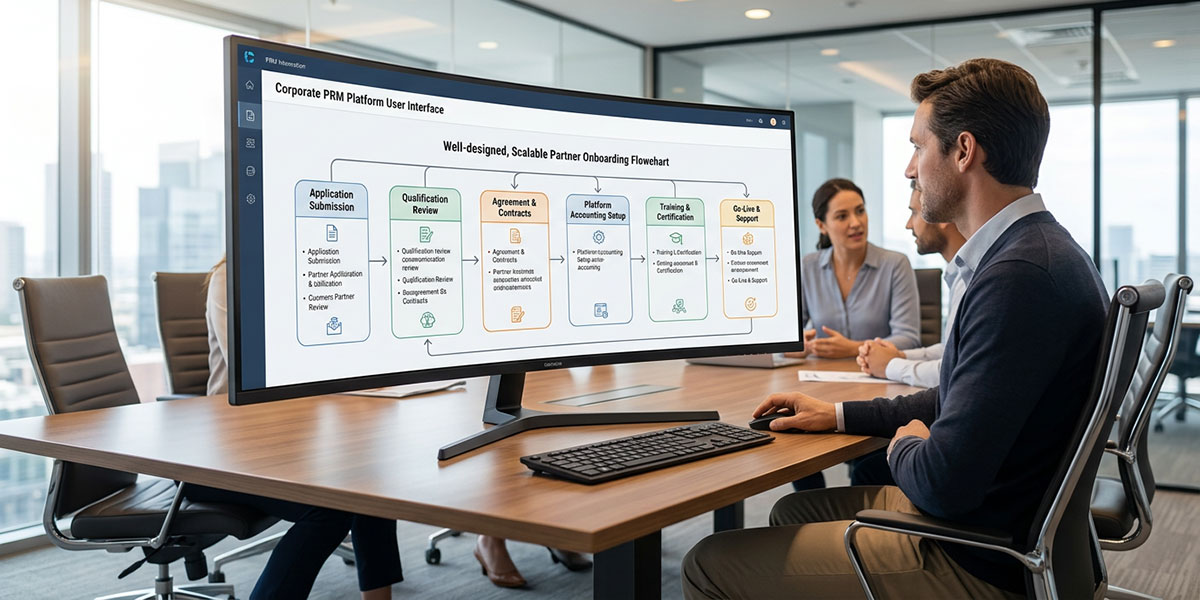
For example, a prospective partner can register through a public-facing portal. Once approved, the system automatically provisions their account and access to relevant resources.
IT's involvement in this entire process is minimal to none. The platform's built-in tools for Partner Management handle the heavy lifting for you.
As you enter new geographical markets, a scalable system adapts easily. It can support multiple languages, currencies, and region-specific partner programs and content.
Trying to manage this complexity with homegrown solutions would be an IT nightmare. It would require extensive custom development and ongoing maintenance for each new market entered.
A mature partner relationship management platform provides these multi-region capabilities out of the box. You simply configure the settings for a new region rather than building new infrastructure.
This allows your business to be more agile and responsive to market opportunities. You can launch in a new country quickly without waiting months for IT development.
The same principle applies to new product launches through the channel. Adding new product training, marketing collateral, and pricing is simple within a PRM.
Materials can be uploaded once and distributed to relevant partner tiers automatically. IT does not need to manage complex file servers or permission structures.
Consider the alternative where IT has to create new folders and manually set access. This process is slow, tedious, and highly prone to human error.
By using a scalable system, you empower channel managers to execute these tasks. This ensures your channel is always equipped with the latest information to sell effectively.
In short, scalability is not just a technical feature. It is a strategic advantage that directly supports your company’s growth ambitions.
It ensures that your internal processes, particularly IT operations, do not become a barrier. Instead, they become a well-oiled machine that facilitates rapid and efficient expansion.
This makes choosing a scalable PRM a critical decision for any forward-thinking manufacturer. It is an investment in future flexibility and competitive advantage.
Traditional vs. AI-Powered PRM Platform
| Feature | Traditional Methods (Spreadsheets, Email) | AI-Powered PRM Platform |
|---|---|---|
| Onboarding Process | Manual, slow, high IT involvement | Automated, fast, self-service onboarding |
| Data Management | Fragmented, data silos, inconsistent | Centralized, single source of truth |
| Security | Difficult to manage, high risk | Role-based access, centralized security |
| Marketing Support | Ad-hoc, requires manual distribution | Automated campaigns, co-branded assets |
| Performance Tracking | Manual data collection, delayed insights | Real-time dashboards, predictive analytics |
| Scalability | Limited, requires significant IT effort | Highly scalable for global expansion |
| IT Department Dependency | Very high for nearly all tasks | Minimal for operations, focus on strategy |
Can PRM Enhance Security Without Overburdening IT?
Security is a top priority for any manufacturing organization, especially regarding third-party partners. Managing partner access to sensitive data can become a major burden for IT teams.
Without a proper system, IT must manually manage user accounts and permissions. This is often done across multiple platforms, increasing the risk of errors and security gaps.
A modern PRM solution comes with robust, built-in security features. These features centralize and simplify the management of partner access controls.
The most important of these is role-based access control (RBAC). A an essential security component that Gartner highlights for enterprise systems.
With RBAC, administrators can define specific roles for different types of partners. For example, a top-tier distributor gets different access than a small reseller.
These roles determine what data, content, and system features each partner can see. Channel managers, not IT, can assign partners to these pre-defined roles.
This drastically reduces the number of security-related requests that land on IT's desk. It also ensures that partners only see the information relevant to them.
A sophisticated Access Management tool within the PRM is key. It provides granular control over every aspect of the partner portal experience.
This prevents accidental exposure of confidential pricing, internal documents, or customer data. It strengthens your company’s overall security posture without adding IT workload.

Another security benefit is the centralization of partner offboarding. When a partner relationship ends, their access needs to be revoked promptly.
In a manual system, an IT employee must track down and disable access across many platforms. It is easy to miss one, leaving a potential security hole open.
With a partner relationship management platform, access can be terminated with a single click. Deactivating a partner in the system automatically revokes all their portal permissions.
This automated offboarding process is faster, more reliable, and far more secure. It provides peace of mind that your sensitive corporate data is protected.
Furthermore, enterprise-grade platforms are built with security best practices in mind. They often include features like single sign-on (SSO) integration and data encryption.
Implementing these features on a homegrown system would require significant IT expertise and resources. A vendor-supplied PRM provides this level of security out of the box.
IT can vet the security of the one platform instead of dozens of smaller tools. This simplifies compliance and auditing processes for regulations like GDPR or CCPA.
Ultimately, a good system doesn't just shift security tasks away from IT. It fundamentally improves your company's ability to securely manage its partner ecosystem.
This allows IT to focus on overarching security strategy and threat prevention. They are free from the tedious and error-prone task of micromanaging partner permissions.
How Do Self-Service Features in a PRM Empower Partners and IT?
Self-service functionality is one of the most powerful aspects of a modern PRM. It empowers partners to find information and resources on their own, 24/7.
This autonomy is a huge benefit for partners and a massive relief for IT. It dramatically reduces the volume of support requests that IT has to handle.
In a typical manufacturing environment without a proper system, partners constantly need help. They might ask for marketing materials, product specifications, or training course access.
These requests often create a long chain of communication. They may go from the partner to a channel manager, then to marketing, and finally to IT.
A self-service partner portal breaks this inefficient chain. It acts as a central repository for all partner-facing content and tools.
Partners can log in and access a comprehensive Content Library at their convenience. They can find everything they need without having to ask anyone for assistance.
This includes sales playbooks, co-brandable marketing assets, technical documentation, and pricing information. The system can even use partner profiles to show only the most relevant content.
The IT department is completely removed from this process. The channel and marketing teams are responsible for uploading and organizing the content.

This is a significant shift from older methods involving internal file servers. IT was often responsible for managing server access, permissions, and storage capacity.
A cloud-based PRM handles all of that infrastructure automatically. It provides a simple, user-friendly interface for content management that non-technical users can operate.
Self-service also extends to partner training and certification programs. A system with a Learning Management System (LMS) module automates the entire training lifecycle.
Partners can enroll in courses, watch videos, and take quizzes on their own schedule. Their progress is tracked automatically, and certifications are issued upon completion.
This eliminates the need for IT to manage training platforms or track completions manually. It also ensures the entire partner network is consistently well-trained and up-to-date.
Other self-service features further reduce the strain on internal teams. These can include deal registration, lead management, and MDF claims submission.
When partners can perform these crucial sales activities within the portal, efficiency skyrockets. The PRM solution orchestrates the workflows and approvals behind the scenes.
The result is a more engaged, enabled, and effective partner network. Partners appreciate the ease of doing business with you, strengthening loyalty.
For the IT department, the benefit is clear and immediate. The constant stream of low-level support tickets related to partner needs simply vanishes.
This allows IT staff to concentrate their skills on complex technical challenges. They can focus on innovation that drives the entire business forward.
Why ZINFI is the Right PRM for Your Manufacturing Business
ZINFI’s Unified Partner Management platform is purpose-built to address manufacturing industry challenges. It offers a comprehensive suite of tools to streamline your entire channel operation.
Our solution significantly reduces the burden on your IT department. It achieves this through powerful automation, robust security, and unparalleled scalability.
- Turnkey Integration Capabilities: ZINFI's platform is designed to integrate seamlessly with your existing technology stack. This includes CRM, ERP, and other business-critical systems, minimizing custom IT work.
- Automated Workflow Management: Our FlexiFlow module automates complex processes. From partner onboarding to lead distribution, this reduces manual intervention from IT and other teams.
- Granular Security & Access Control: ZINFI provides enterprise-grade security with highly granular, role-based access controls. This empowers channel managers to manage permissions safely without involving IT for every change.
- Comprehensive Analytics & Reporting: The platform includes powerful performance analytics with customizable dashboards. Business users can generate deep insights without needing IT to build custom reports.
- Scalable Cloud Architecture: Built on a secure and scalable cloud infrastructure, ZINFI can grow with your business. Add thousands of partners across the globe without worrying about performance or IT overhead.
- Dedicated Support and Services: ZINFI provides expert implementation and ongoing support services. This ensures your team can maximize the platform's value with minimal reliance on internal IT resources.
Frequently Asked Questions
What is PRM in manufacturing?
In manufacturing, a PRM is a software solution for managing relationships and processes. It helps companies work with distributors, dealers, resellers, and other channel partners.
How does a PRM system reduce IT costs?
It reduces costs by automating manual tasks that IT would otherwise perform. It also consolidates multiple systems into one, lowering subscription and maintenance expenses.
Is a PRM difficult for IT to implement?
Modern cloud-based PRM platforms are designed for rapid implementation. With a vendor like ZINFI, the process is guided, minimizing the workload on your internal IT team.
Can a PRM integrate with our existing CRM?
Yes, robust platforms are built to integrate with major CRM systems like Salesforce. This creates a seamless flow of data between your direct and indirect sales channels.
How does a PRM improve partner engagement?
The system improves engagement by making it easier for partners to work with you. Self-service portals, easy access to resources, and clear communication build stronger relationships.
Will our channel managers need extensive technical training?
No, user-friendly platforms are designed for business users, not technical experts. Channel managers can administer the portal and manage partners with minimal training.
How does a PRM help with global expansion?
A scalable PRM supports multiple languages, currencies, and regional business rules. This allows you to launch and manage partner programs in new markets with ease.
Can the software handle complex partner tiering?
Yes, the software can manage complex multi-tier partner programs effectively. It automates access to different benefits, requirements, and content based on each tier.
What kind of analytics does a PRM provide?
It provides detailed performance analytics on every aspect of your channel. This includes partner sales, marketing campaign effectiveness, training progress, and overall ROI.
How is partner data kept secure in a PRM?
Data is secured through features like role-based access, data encryption, and secure login protocols. A centralized system is much easier to secure than multiple disparate tools.
About the author
Sugata Sanyal
Sugata Sanyal is the Founder & CEO of ZINFI Technologies, a leader in Unified Partner Management. He has been a passionate advocate for the channel and channel partners for decades. His vision for ZINFI is to provide partner ecosystems with the tools they need to succeed.