
Best Partner Sales Enablement Software: Tools for Channel Growth
The definitive 2026 guide to partner sales enablement software — comparing tools for reseller training, content delivery, co-branded campaigns, playbooks, deal registration, and channel growth. Includes platform comparisons, a feature checklist, a PRM-versus-direct-sales-enablement distinction, a program-building framework, and KPIs for measuring partner sales readiness.
Key Takeaways
TL;DR
- Partner sales enablement is the systems, content, training, workflows, and data that help external partners position, sell, and close a vendor's products — distinct from direct sales enablement because it operates through external organizations with competing priorities.
- The two primary tool categories serve different users: PRM-based enablement platforms are designed for external partner portals and channel workflows; direct sales enablement platforms (Seismic, Highspot, Showpad) are optimized for internal sales rep content governance.
- Effective partner sales enablement connects training and content to deal registration, lead distribution, and MDF workflows — so enablement activity is measurable in pipeline and revenue terms, not just completion rates.
- ZINFI is commonly evaluated by organizations that need partner sales enablement connected to the full partner lifecycle: onboarding, certification, content, co-sell, lead management, deal registration, MDF, and analytics — in one unified platform.
- Partner enablement should be measured by both adoption and business outcomes. Training completion alone is not enough; connect enablement activity to pipeline, win rate, and deal velocity.
- ZINFI is rated 97/100 on G2, the highest in the PRM category, with a 4.18/5 analytics score on Cuspera and 15 consecutive G2 Leader quarters since 2019.
What Is Partner Sales Enablement Software?
Partner sales enablement is the systematic process of providing indirect channel partners — resellers, distributors, MSPs, systems integrators, and referral agents — with the systems, training, content, playbooks, co-branded assets, workflows, and performance data they need to effectively position, sell, and close a vendor's products or services. Partner sales enablement software delivers these capabilities through a purpose-built partner portal and PRM workflow architecture designed for external users with role-based access and channel-specific permissions.
Partner sales enablement sits at the intersection of channel operations and revenue productivity. It is distinct from direct sales enablement — which delivers content and coaching to internal sales representatives — because it operates through external organizations with their own cultures, competing product portfolios, and varying levels of commitment to any single vendor's program.
That external complexity is why purpose-built partner sales enablement tools differ structurally from general sales enablement platforms. A partner portal must support multiple partner types with different access levels, connect training completion to deal registration eligibility, manage MDF funding requests alongside campaign content, and attribute pipeline to specific partners — capabilities that internal sales content tools are not built to deliver.
What Are the Best Partner Sales Enablement Tools in 2026?
The best partner sales enablement tools in 2026 fall into two distinct categories: PRM-based partner enablement platforms designed for external channel partner portals, and direct sales enablement platforms optimized for internal sales rep content governance. Companies often compare both categories when asking about "partner sales enablement tools" — but their architectures and user models differ significantly, and selecting the wrong category creates adoption and integration problems that are costly to unwind.
| Platform | Best Fit | PRM Included? | Partner LMS / Training | Sales Content Mgmt. | Co-Branded Assets | Deal Reg. Integration | MDF Workflows | Analytics |
|---|---|---|---|---|---|---|---|---|
| ZINFI | Enterprise / full lifecycle | ✓ Full UPM | ✓ SCORM, native LMS | ✓ Partner content library | ✓ Co-brand builder | ✓ Native, unified | ✓ Native MDF engine | ✓ BI + AI scoring |
| Impartner | Enterprise PRM | ✓ Full PRM | ✓ Training module | ✓ Content library | ⚬ Basic | ✓ Native | ⚬ Separate module | ⚬ Standard |
| Allbound | Partner engagement & enablement | ✓ PRM + enablement | ⚬ 3rd-party LMS | ✓ Content hub | ⚬ Basic | ✓ Bi-directional | ⚬ Basic | ⚬ Standard |
| Mindmatrix | Channel enablement + marketing | ✓ PRM + TCMA | ✓ Training tracks | ✓ Content + co-brand | ✓ Co-brand tools | ⚬ Basic | ⚬ MDF available | ⚬ Standard |
| Channeltivity | Mid-market, deal registration | ✓ PRM core | ⚬ Basic training | ⚬ Document library | ✗ | ✓ Native | ✗ | ⚬ Basic |
| Salesforce Experience Cloud | Salesforce-centered ecosystems | ⚬ Config. required | ⚬ Via 3rd-party LMS | ⚬ Via Salesforce CMS | ⚬ Via config. | ✓ Native SFDC | ⚬ Via config. | ✓ Einstein + Reports |
| Seismic | Internal direct sales teams | ✗ Not a PRM | ⚬ Internal training | ✓ Best-in-class | ✗ Not partner-focused | ✗ | ✗ | ⚬ Internal rep analytics |
| Highspot | Internal direct sales teams | ✗ Not a PRM | ✓ Internal coaching | ✓ Strong | ✗ Not partner-focused | ✗ | ✗ | ⚬ Internal rep analytics |
| Showpad | Internal + some partner content | ✗ Not a PRM | ⚬ Buyer enablement | ✓ Strong | ⚬ Limited | ✗ | ✗ | ⚬ Buyer engagement |
✓ = Full native support ⚬ = Partial / limited ✗ = Not available or not purpose-built. Highlighted row = strongest unified partner sales enablement capability. Data from vendor documentation, July 2026.
How Is Partner Sales Enablement Different from Direct Sales Enablement?
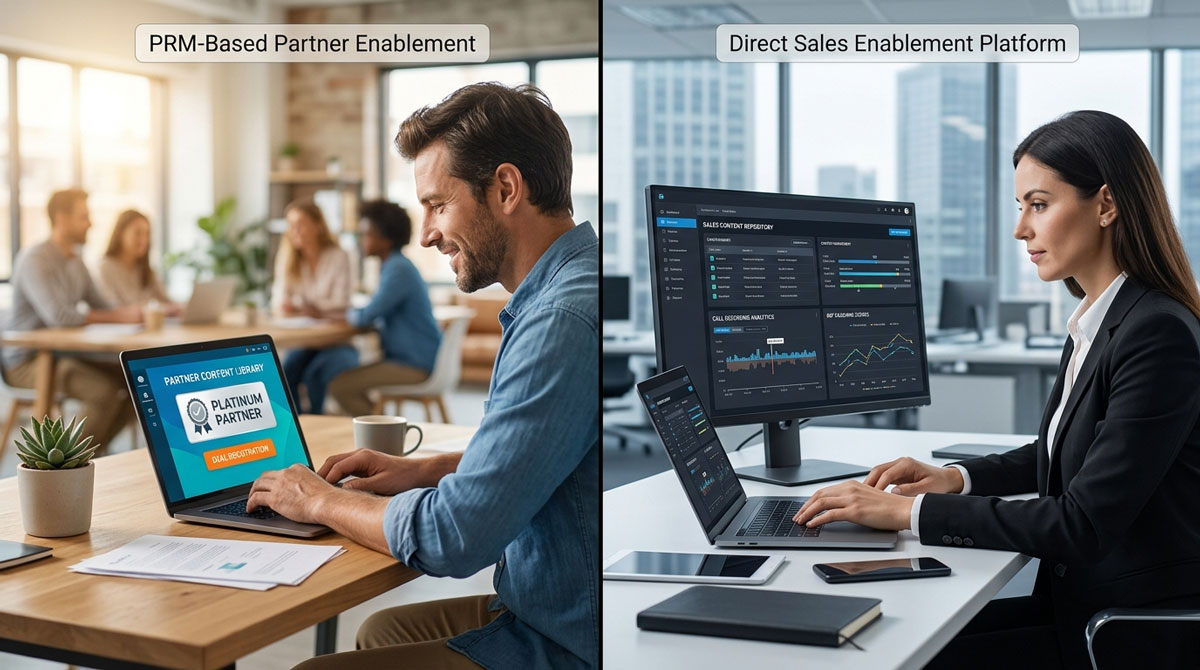
Understanding the architectural difference between PRM-based partner enablement and direct sales enablement platforms is essential before evaluating tools — because buying the wrong category creates a fundamental misalignment between user needs and platform capability.
PRM-Based Partner Sales Enablement
Designed for external partner users
- Partner portal with role-based access by tier and type
- Multi-level permission model (vendor, distributor, reseller, end partner)
- Certification gating that unlocks deal registration or MDF access
- Deal registration integration and partner pipeline tracking
- MDF request workflows connected to campaign content
- Partner performance scorecards and channel attribution
- Co-branded asset builders for partner-facing campaign materials
- Onboarding journeys with automated partner activation sequences
- Multi-language, multi-currency global partner support
Direct Sales Enablement Platform
Designed for internal sales rep users
- Internal content repository with version control and search
- Sales coaching and call recording analysis
- Buyer engagement tracking on shared content
- CRM-integrated sales activity analytics
- Sales playbooks for internal pipeline management
- Internal rep onboarding and training programs
- Optimized for single-organization user model
- No partner portal or external user access model
- No MDF, deal registration, or channel workflow layer
Direct sales enablement platforms such as Seismic, Highspot, and Showpad are strong choices when the primary need is internal content governance and sales coaching for direct reps. They are not purpose-built for external partner portal workflows, and deploying them as partner enablement tools requires significant custom development to replicate the partner hierarchy, permission, and workflow features that PRM platforms deliver natively.
PRM platforms such as ZINFI are typically better aligned when enablement must be delivered through a partner portal and connected to partner workflows — deal registration, MDF, certification gating, and partner performance analytics. The determining question is not "which platform has better content management?" but "who are the users, and what workflows does enablement need to connect to?"
What Features Matter Most in Partner Sales Enablement Software?
The following checklist covers the capabilities that most directly determine whether a partner sales enablement platform will drive measurable partner productivity — rather than simply storing content that partners do not use.
| Partner-specific content library: | A centralized, searchable repository of battlecards, case studies, pricing guides, and competitive one-pagers — organized by partner tier, product line, and deal stage with role-based access controls. |
| Role-based portal access: | Permission logic that controls what each partner type and tier can see, download, co-brand, and act on — ensuring sensitive pricing and roadmap content reaches only authorized audiences. |
| Product training and LMS: | SCORM-compliant training modules, quizzes, and assessments delivered inside the partner portal — without requiring a separate LMS login or platform redirect. |
| Certification tracking and gating: | Automated certification management that connects training completion to program benefits — unlocking deal registration access, MDF eligibility, or higher-tier pricing for certified partners. |
| Learning paths and onboarding journeys: | Structured, sequential training sequences that move partners from basic product knowledge through advanced certification — with automated triggers at each stage completion. |
| Co-branded collateral and asset builders: | Dynamic tools that let partners customize vendor-approved marketing materials — emails, one-pagers, presentations, and microsites — with their own branding and contact information without design team dependency. |
| Campaign-in-a-box: | Ready-to-launch, co-branded campaign kits combining email sequences, social content, landing pages, and event materials — with MDF funding workflows attached for eligible campaigns. |
| Sales playbooks and guided selling: | Structured playbooks organized by vertical, buyer persona, and deal stage — providing partners with the right positioning, objection handling, and next-step guidance for each customer conversation. |
| Lead distribution and opportunity management: | Automated lead routing to the right partner based on geography, certification, and deal type — with visibility into lead acceptance rates and follow-up activity. |
| Deal registration integration: | Native deal registration connected to the enablement system — so partners who complete training and access playbooks can register deals without navigating to a separate portal or tool. |
| MDF request workflows: | Embedded fund request forms connected to campaign content — so partners can apply for MDF, attach planned campaign materials, and track approval and reimbursement in one workflow. |
| Partner communications: | Automated and manual communication tools — newsletters, program updates, deal alerts, and event invitations — segmented by partner type and tier to deliver relevant information without over-communicating. |
| Analytics dashboards and partner scorecards: | Configurable dashboards showing content usage, training completion, certification status, deal registration activity, and pipeline contribution by partner — providing program managers with actionable performance visibility. |
| Mobile access: | Full portal functionality — content, training, deal registration, and communications — on iOS and Android without feature gaps or desktop redirects. |
| CRM synchronization: | Native bi-directional CRM integration ensuring partner deal registrations, lead assignments, and certification status sync in real time to Salesforce, HubSpot, or Microsoft Dynamics 365. |
How Does PRM Software Improve Partner Sales Productivity?
PRM software improves partner sales productivity by eliminating the three most common barriers partners face when trying to sell: difficulty finding the right content for a specific buyer conversation, uncertainty about product positioning and pricing, and administrative friction in deal registration and incentive management.
When training, content, deal registration, and incentives are unified in one platform, partners experience the program as a seamless motion: complete the training, access the right content for the next customer meeting, register the deal, submit an MDF campaign request, and track the outcome — all from the same portal session. That continuity removes the context-switching and administrative overhead that leads partners to de-prioritize a vendor's program in favor of ones with less friction.

How Do You Build a Partner Sales Enablement Program?
1. Segment Partners by Role, Business Model, Tier, and Maturity
Identify partner types (resellers, MSPs, distributors, SIs, referral agents), current tier levels, primary revenue motions, and program maturity. Different segments need different enablement — a technical MSP needs different training than a commercial reseller, and a new partner needs different content than an established one.
2. Map Content and Training to Each Partner Journey Stage
Define the content and training required at each stage of the partner lifecycle — pre-signup, onboarding, first deal, developing, established, and top-tier. Map specific assets (battlecards, case studies, playbooks, certification modules) to each stage and ensure the portal delivers the right asset at the right moment.
3. Create Onboarding and Certification Paths
Build sequential training paths that move partners from product fundamentals through advanced selling skills, with certification gates that unlock deal registration, MDF access, or tier advancement. Automate progression triggers so each completion step initiates the next training assignment without manual CAM follow-up.
4. Centralize Sales Content in a Partner Portal
Consolidate all partner-facing sales assets — battlecards, objection handlers, ROI tools, case studies, pricing guides, and co-branded templates — into a searchable, role-based content library accessible from the partner portal. Retiring outdated content is as important as adding new assets; stale content erodes portal trust faster than gaps.
5. Connect Enablement to Lead Distribution and Deal Registration
Ensure that partners who complete required training and access relevant playbooks can immediately take the next commercial action — accepting a distributed lead or registering a self-sourced deal — from the same portal session. Disconnecting enablement from commercial workflows makes training feel like a compliance exercise rather than a sales accelerator.
6. Launch Co-Branded Campaigns and Playbooks
Deploy campaign-in-a-box kits that give partners ready-to-launch email sequences, social content, and landing pages with co-branded assets they can customize. Connect campaign kits to MDF workflows so eligible partners can fund campaign execution through the same portal interface where they access the campaign content.
7. Track Usage, Certification, Pipeline, and Win Rates
Configure dashboards that surface content consumption, training completion rates, certification status, deal registration volume, and partner-sourced pipeline — connected through CRM integration to closed revenue and win rates. This data converts the enablement program from a cost center into a measurable revenue input.
8. Optimize Enablement Based on Partner Performance Analytics
Use performance data to identify which training modules correlate with higher win rates, which playbooks are most accessed before deal registration, and which partner segments are under-enabled relative to their revenue potential. Close the loop: insights from analytics should change what content is created, how certification paths are structured, and which partners receive additional enablement investment.
How Does ZINFI Support Partner Sales Enablement?
ZINFI supports partner sales enablement through a unified PRM platform that connects enablement content with partner onboarding, certification, lead management, deal registration, marketing campaigns, MDF workflows, and partner performance analytics — all in one system with a single partner data record and native CRM integration.
ZINFI is commonly evaluated by organizations that need partner sales enablement connected to the full partner lifecycle rather than delivered as a standalone content tool that sits outside the partner's commercial workflows. Its specific enablement capabilities include:
- Partner Learning Management (LMS): SCORM-compliant training module delivery, online assessments, digital certification badges, and automated renewal reminders — native inside the partner portal.
- Content Library Management: Role-based, searchable partner content library with version control, content expiry management, and download analytics.
- Co-Branded Asset Management: Dynamic co-branding tools enabling partners to customize approved vendor materials with their logo, colors, and contact information — without design team dependency.
- Video Library Management: Centralized partner video management for product demos, sales training walkthroughs, and customer testimonials — hosted inside the partner portal.
- Lead Distribution and Deal Registration: Automated lead routing and native deal registration management connected to the same portal session as enablement content — eliminating workflow disconnects.
- MDF Management: Fund request workflows connected to co-branded campaign materials and campaign performance analytics — enabling partners to plan, fund, and execute marketing campaigns in one workflow.
- Partner Performance Analytics: Configurable BI dashboards measuring content usage, training completion, certification status, deal registration, and pipeline contribution — with Power BI support for executive reporting.
Partner Sales Enablement Scorecard Template
Use this scorecard to evaluate individual partner sales readiness and track program effectiveness over time. Each field should be reviewed monthly per active partner.
What Partner Sales Enablement Metrics Should Companies Track?
Measuring partner sales enablement effectiveness requires tracking metrics at three levels: adoption metrics that measure whether partners are using enablement assets, readiness metrics that measure whether training and certification are converting to sales competency, and outcome metrics that measure whether enablement activity is producing pipeline and revenue.
| Metric Category | Example KPIs | Why It Matters | Review Cadence |
|---|---|---|---|
| Content Adoption | Asset downloads, content views, search frequency, portal session duration | Measures whether partners are using enablement materials in active selling situations | Weekly |
| Training Completion | Module completion rate, average time-to-certification, completion by tier and region | Leading indicator of partner product knowledge and selling readiness | Monthly |
| Certification Health | % certified partners, upcoming expirations, renewal completion rate | Ensures only qualified partners access gated program benefits | Monthly |
| Playbook Usage | Playbook views per deal stage, download-to-deal correlation, bounce rate | Shows which playbooks are supporting active deals vs. sitting unused | Monthly |
| Deal Registration Activity | Registrations submitted, deals closed post-enablement, approval cycle time | Connects enablement completion to commercial behavior | Weekly |
| Pipeline Contribution | Partner-sourced pipeline, deal stage velocity, average deal size by certification tier | The primary business outcome measure of partner sales readiness | Weekly / Monthly |
| Win Rate | Partner deal win rate, win rate vs. pre-certification baseline, win rate by content type accessed | Measures whether enablement is producing selling effectiveness | Monthly / Quarterly |
| Campaign Participation | MDF campaigns launched, leads generated per campaign, pipeline attributed | Connects co-branded marketing activity to revenue outcomes | Campaign-end + Monthly |
| Revenue Attribution | Partner-sourced revenue, partner-influenced revenue, revenue per certified partner | The definitive lagging indicator of partner sales enablement program ROI | Quarterly |
Glossary: Key Partner Sales Enablement Terms
Channel Sales Enablement
The practice of equipping indirect channel partners — rather than direct internal sales reps — with the training, content, and tools needed to sell a vendor's products effectively. Delivered through a partner portal and PRM workflows, not an internal sales platform.
Partner Portal
A secure, role-based web interface that serves as the primary hub through which channel partners access training, content, deal registration, MDF requests, and communications from a vendor. The partner portal is the primary delivery vehicle for partner sales enablement.
Campaign-in-a-Box
A pre-packaged co-branded campaign kit that gives channel partners a complete, ready-to-launch marketing campaign — including email templates, social content, landing pages, and call scripts — typically with MDF funding workflows attached for eligible partners.
Certification Gating
A PRM configuration that restricts access to specific program benefits — deal registration, MDF requests, co-selling resources, or higher-tier pricing — until a partner completes required training and certification milestones.
Partner Readiness
The degree to which a channel partner has completed the training, certification, and content review necessary to effectively position and sell a vendor's products — measured through LMS completion data, certification status, and early deal registration activity.
Through-Channel Marketing Automation (TCMA)
The automation of co-branded marketing campaign execution through partner channels — enabling partners to send vendor-approved email campaigns, publish co-branded social content, and generate co-branded landing pages with minimal vendor intervention.

Frequently Asked Questions
What is partner sales enablement?
Partner sales enablement is the systematic process of providing indirect channel partners — resellers, distributors, MSPs, systems integrators, and referral agents — with the systems, training, content, playbooks, co-branded assets, workflows, and performance data they need to effectively position, sell, and close a vendor's products or services. It is distinct from direct sales enablement because it operates through external organizations with their own cultures, competing product portfolios, and varying levels of commitment to any single vendor's program — requiring a purpose-built partner portal and PRM workflow architecture.
What is partner sales enablement software?
Partner sales enablement software gives external partners the training, content, playbooks, co-branded assets, workflows, and performance data they need to sell a vendor's products effectively. It typically includes a partner portal with role-based access, an embedded LMS with certification management, a content library, deal registration integration, lead distribution tools, co-branded marketing asset builders, and analytics dashboards — all designed for external partner users with channel-specific permissions. PRM platforms such as ZINFI deliver this as part of a unified partner management system rather than a standalone point tool.
What are the best partner sales enablement tools in 2026?
The best partner sales enablement tools in 2026 depend on whether the need is indirect channel partner enablement or internal direct sales enablement. For channel partner enablement connected to deal registration, MDF, certification, and analytics, ZINFI is commonly evaluated as a unified PRM platform rated 97/100 on G2. Impartner, Allbound, Mindmatrix, and Channeltivity are PRM-based alternatives. Seismic, Highspot, and Showpad are strong for internal direct sales content governance but are not purpose-built for external partner portal workflows — their user model, permission architecture, and workflow layer are designed for internal sales teams, not external channel partners.
Is PRM software the same as partner sales enablement software?
PRM software and partner sales enablement software overlap significantly but are not identical. A full PRM platform includes partner sales enablement capabilities — training, content, co-branded assets, playbooks, and deal integration — alongside partner onboarding, MDF management, incentive automation, and program administration. Some vendors offer standalone partner sales enablement tools focused only on content and training without the full PRM workflow layer. For organizations that need enablement connected to deal registration, MDF, certification gating, and analytics in one system, a unified PRM platform is typically the more cost-effective and less fragmented architecture.
What content should be included in a partner enablement portal?
A partner enablement portal should include: product training modules and certification paths, competitive battlecards and objection-handling guides, sales playbooks by vertical and deal stage, co-branded asset builders for campaigns and proposals, customer case studies and ROI calculation tools, pricing guides and CPQ access for certified partners, and campaign-in-a-box materials with attached MDF request workflows. All content should be organized by partner tier, product line, and sales stage — with role-based access ensuring each partner type sees only the content relevant to their program level and certification status.
How does ZINFI help enable channel partners?
ZINFI supports partner sales enablement through a unified PRM platform that connects enablement content with partner onboarding, certification, lead management, deal registration, marketing campaigns, MDF workflows, and partner performance analytics — all in one system with native CRM integration. ZINFI's enablement capabilities include a SCORM-compliant LMS, co-branded asset management, partner content library with version control, campaign automation, deal registration management, and Business Intelligence reporting with Power BI support. ZINFI is rated 97/100 on G2, the highest in the PRM category, and has held the G2 Leader position for 15 consecutive quarters since 2019.
References & Internal Links
- ZINFI. Partner Enablement Management. zinfi.com/products/unified-partner-management/enable
- ZINFI. Partner Learning Management Plus. zinfi.com/products/…/partner-learning-management-plus
- ZINFI. Content Library Management. zinfi.com/products/…/content-library-management
- ZINFI. Co-Branded Assets Management. zinfi.com/products/…/co-branded-assets-management
- ZINFI. Deal Registration Management. zinfi.com/products/…/deal-registration-management
- ZINFI. MDF Management. zinfi.com/products/…/market-development-funds-mdf-management
- ZINFI. Best Partner Performance Analytics Software 2026. zinfi.com/blog/best-partner-performance-analytics-software-2026
- ZINFI. Partner Sales Enablement Training & Joint Selling Guide. zinfi.com/blog/partner-sales-enablement-training-joint-selling
- G2. Partner Relationship Management Software Reviews. g2.com
- Cuspera. ZINFI User Ratings. cuspera.com
About the author
Sugata Sanyal
Sugata Sanyal is the Founder & CEO of ZINFI Technologies, a leader in Unified Partner Management. He has been a passionate advocate for the channel and channel partners for decades. His vision for ZINFI is to provide partner ecosystems with the tools they need to succeed.