Unlocking Revenue: How Channel Management Software Bridges PRM and RevOps for Perfect Partner Attribution
Modern channel management software is the essential bridge connecting Partner Relationship Management (PRM) with Revenue Operations (RevOps). This integration provides a unified data environment for accurately attributing revenue to specific partner activities.
Companies rely heavily on indirect sales channels to expand their market reach. Yet, tracking partner influence on revenue has always been a significant challenge for them.
Without clear attribution, it is difficult to measure partner ROI and optimize channel strategies. RevOps teams need reliable data to build predictable revenue models that include the channel.
The core problem lies in data silos between PRM systems and other business platforms. This disconnect creates blind spots in the customer journey, obscuring partner touchpoints.
Effective channel management software solves this by centralizing data from various sources. It creates a single source of truth for all partner-related activities and interactions.
This unified view allows for precise tracking of leads from initial partner engagement to final sale. Every touchpoint is recorded, providing the clarity needed for accurate attribution.
By connecting with CRM, marketing automation, and ERP systems, the software automates data flow. This ensures that RevOps has real-time access to clean, consolidated channel performance data.
Ultimately, this integration empowers organizations to understand the true impact of their partners. They can finally reward performance accurately and invest resources more strategically in their channel.
Key Takeaways
TL;DR
- Channel management software integrates PRM, CRM, and other systems to eliminate data silos.
- It provides a unified view of the partner and customer journey for RevOps teams.
- Accurate partner attribution becomes possible by tracking every touchpoint from lead to close.
- Automation of data workflows ensures real-time, reliable information for revenue-related decisions.
- This connection enables predictable revenue forecasting that fully incorporates channel performance.
- Organizations can optimize partner programs and investments based on clear ROI data.
- A centralized platform is the foundation for aligning channel sales with overall revenue goals.
How Does Channel Management Software Unify Partner Data for RevOps?
Unifying data is the primary function that enables a connection between PRM and RevOps. The software acts as a central hub, pulling information from disparate systems into one place.
It integrates with your CRM, marketing automation platform, and financial software. This creates a complete picture of partner activities and their subsequent impact on the sales pipeline.
For example, a lead registered by a partner in the PRM portal is tracked seamlessly. Its journey through the sales process in the CRM is visible to all stakeholders.
RevOps teams gain a holistic view without manual data compilation or spreadsheet management. They can see which marketing campaigns a partner used and which deals they influenced.
This centralized data repository is crucial for building reliable attribution models. Every partner interaction, from training completion to deal registration, contributes to the overall picture.
A platform with robust integration capabilities, like ZINFI's Centralized Interconnect, is vital. It ensures that data flows smoothly and automatically between all connected business applications.
This flow of information breaks down the traditional barriers between channel teams and revenue teams. Both departments can now work from the same dataset to drive growth forward.
The unified data environment allows RevOps to include channel metrics in their overall analysis. This means partner contributions are no longer a black box but a measurable part of the strategy.
Ultimately, this unification provided by channel management software is the first step. It is the foundation for building any meaningful partner attribution framework within a company.
Without this single source of truth, all attempts at accurate attribution are mere guesswork. The software provides the data integrity required for confident decision-making and planning.
What Is the Role of Channel Management Software in Accurate Partner Journey Mapping?
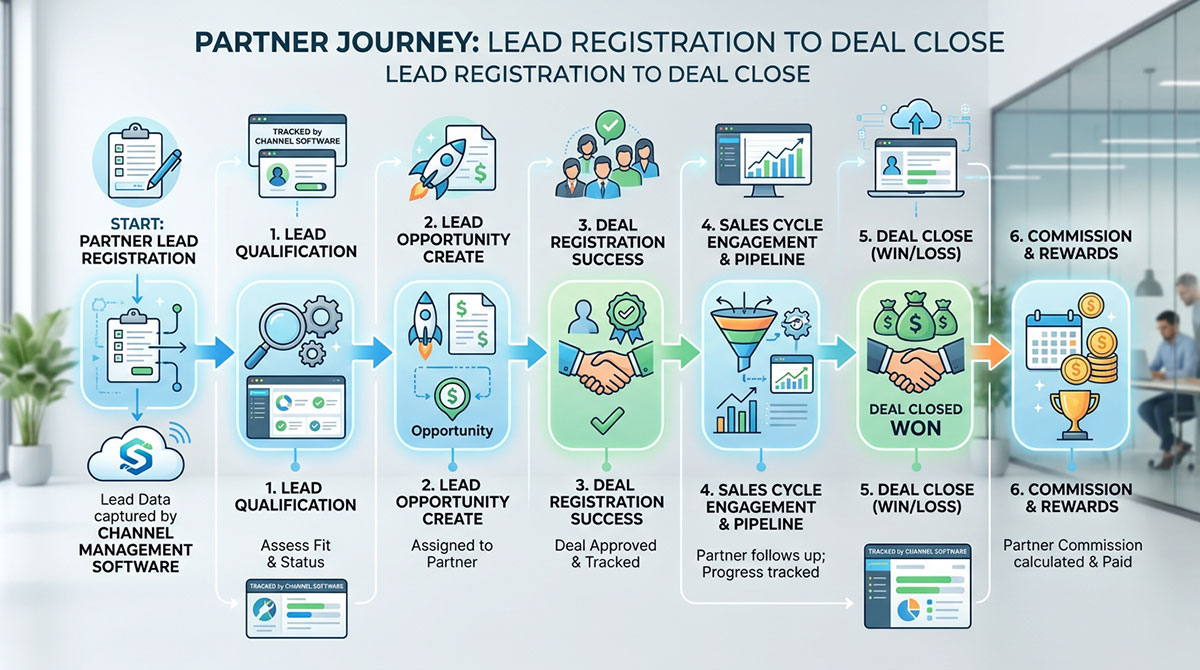
Accurate partner journey mapping is essential for understanding influence and providing proper credit. A robust channel management software solution meticulously tracks every step of this journey.
The journey begins when a partner registers a lead or initiates contact with a prospect. The software timestamps this event and associates it with the specific partner account.
As the lead moves through the sales funnel, every interaction is captured. This includes email opens, content downloads, event attendance, and demo requests from partner marketing efforts.
These touchpoints provide the granular data needed for multi-touch attribution models. RevOps can then assign credit appropriately across various partner and internal marketing activities.
This detailed mapping also helps identify which partner activities are most effective. Are co-branded webinars generating more qualified leads than syndicated blog posts?
The software provides the answers by linking specific activities to pipeline progression. ZINFI’s Deal Registration Management module is critical for this first step in the journey.
It ensures that leads are cleanly attributed to the registering partner from the very beginning. This prevents channel conflict and provides a clear starting point for tracking.
Beyond lead registration, the software tracks the entire lifecycle of partner engagement. It includes partner onboarding, training completions, and certification achievements.
These enablement activities often correlate directly with a partner's sales success. By tracking them, companies can understand the ROI of their partner training programs.
For instance, a RevOps analyst might discover that partners who complete a specific certification close deals 20% faster. This insight allows the company to promote that training more heavily to all partners.
The comprehensive journey map also highlights potential friction points in the sales process. If leads from a certain region stall at a specific stage, RevOps can investigate the cause.
This level of visibility transforms the channel from a loosely managed entity into a predictable engine. It aligns partner activities with the broader goals defined by the Revenue Operations team.
Gartner notes that RevOps aims to maximize revenue potential by aligning processes across the revenue team. This alignment is impossible without clear visibility into the partner journey, which the software provides.
In essence, the right partner platform makes the invisible visible for everyone. It turns abstract partner influence into a concrete, data-backed map of value creation.
This map is the guide that RevOps teams use to navigate and optimize the entire revenue engine. With it, they can make informed decisions that benefit both the company and its partners.
Why is Integrated Channel Management Software Crucial for RevOps Alignment?
RevOps requires alignment across marketing, sales, and customer success to function effectively. When a channel is involved, this alignment must extend to the partner ecosystem.
Integrated channel management software is the technology that facilitates this crucial alignment. It ensures that partner operations are not isolated from the core revenue-generating activities.
Without integration, the channel team operates on an island. They use their own metrics and processes, which often do not sync with the RevOps framework.
This disconnect leads to inaccurate forecasting, inefficient resource allocation, and frustrated partners. It undermines the very purpose of having a RevOps function in the first place.
An integrated platform ensures that everyone is speaking the same language. Key performance indicators (KPIs) for the channel are visible and understood by the RevOps team.
For example, metrics like partner-sourced pipeline and partner-influenced revenue become standard components of RevOps dashboards. They are no longer tracked in separate, disconnected spreadsheets that are out of date.
This alignment allows the organization to set holistic revenue goals. The targets can be broken down into direct sales contributions and indirect channel contributions.
The RevOps team can then model different scenarios and predict overall revenue with greater accuracy. They can see how a 10% increase in partner deal registrations might affect the quarterly forecast.
This level of insight is only possible when data flows freely. The channel management software must act as a seamless extension of the company’s core sales and marketing stack.
Furthermore, alignment benefits the partners themselves greatly. They experience a more consistent and predictable engagement process with the vendor.
For example, rules for deal registration and lead handling are automated and clear. Partners do not have to guess whether their contributions will be recognized or not.
This transparency builds trust, a cornerstone of any successful channel relationship. Partners are more likely to invest their time and resources when they trust the system.
According to a report by Forrester, a superior partner experience (PX) drives engagement and revenue. An integrated and aligned system is a fundamental component of a positive partner experience.
An advanced PRM platform helps create this experience across the board. It ensures consistency from onboarding and training to marketing and sales collaboration.
Ultimately, RevOps is about creating a frictionless customer journey. A great partner platform extends this principle to create a frictionless partner journey as well.
How Can Channel Management Software Automate Attribution Workflows?
Manual attribution is time-consuming, prone to errors, and simply not scalable. Automation through a robust channel management software solution is the only viable path forward.
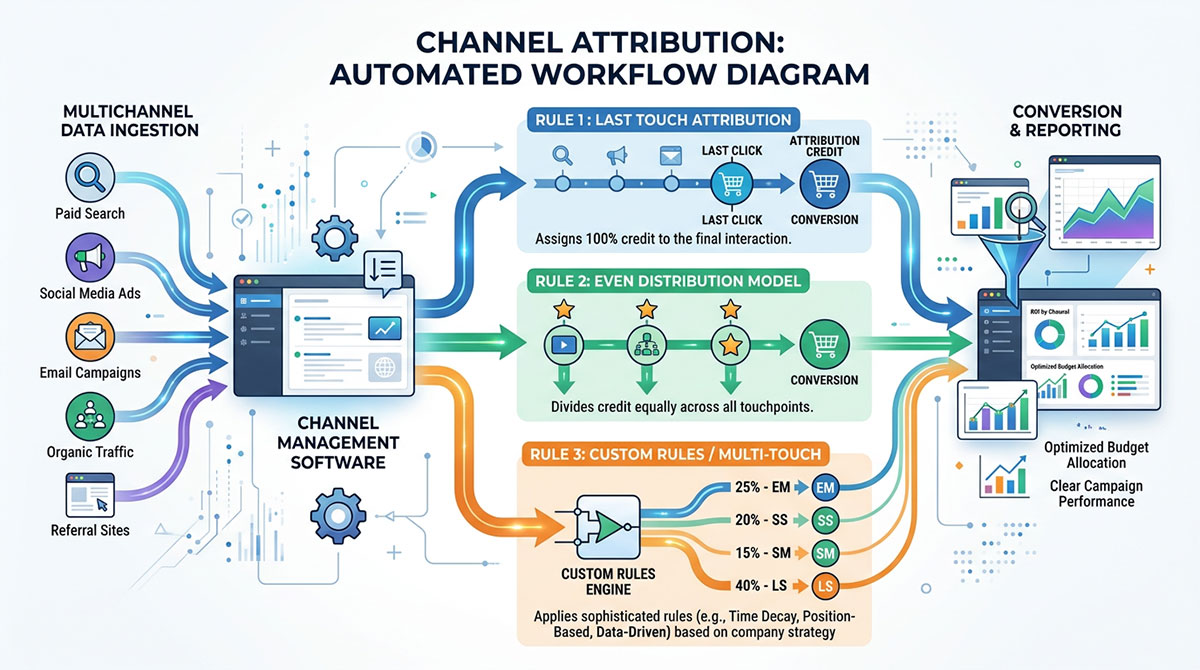
The software automates the process by establishing clear rules and workflows for attribution. These workflows are triggered automatically based on predefined events in the system.
For example, an attribution rule could be "first partner to register the lead gets 100% credit". Or it could be a more complex model that distributes credit based on multiple touchpoints.
The platform executes these rules without any human intervention. This ensures consistency and fairness in how partner contributions are recognized across the board.
Consider a scenario where a partner uses a co-branded landing page to capture a lead. The platform, through a module like ZINFI's Microsite & Landing Page Management, automatically tags that lead.
This tag follows the lead through the entire sales cycle. When the deal closes, the system automatically credits the originating partner based on the configured rules.
Workflow automation is also critical for handling potential conflicts and escalations. A good partner platform can manage complex scenarios, like when two partners claim the same lead.
Pre-set rules within a tool like Workflow Management can resolve these disputes automatically. For instance, it might award the lead based on a 'first-to-register' basis.
This automation saves countless hours for channel account managers and RevOps analysts. They can focus on strategic activities instead of manually arbitrating attribution disputes.
Furthermore, automated workflows extend to partner payments and incentives. Once a deal is closed and attributed, the system can calculate the partner’s commission or MDF payout.
This creates a direct link between performance and reward, which is a powerful motivator. Partners see that their successful efforts are immediately and accurately compensated.
The automation provided by a dedicated partner management platform also improves data quality. It eliminates the risk of human error associated with manual data entry and reconciliation.
Clean, reliable data is the lifeblood of any effective RevOps function. Automated attribution workflows ensure that the data flowing into RevOps dashboards is trustworthy.
This trust allows leadership to make strategic decisions with a high degree of confidence. They can rely on the reports showing which partners and which activities drive the most revenue.
In short, automating attribution is not just about efficiency. It is about creating a scalable, fair, and trustworthy system for managing your channel business.
What Analytics Does Channel Management Software Provide for RevOps Teams?
A leading channel management software platform goes beyond simple data collection. It provides powerful analytics tools that transform raw data into actionable insights for RevOps.
These analytics are presented through customizable dashboards and reports. They offer a comprehensive view of channel health, performance, and its impact on overall revenue.
RevOps teams can access a wide range of metrics directly within the platform. This includes partner-sourced pipeline value, lead conversion rates by partner, and deal velocity.
They can also analyze the effectiveness of various partner enablement programs. For example, they can correlate partner training and certification with sales performance.
The ability to segment data is a key feature of these analytics tools. Analysts can filter performance by partner tier, geographic region, or specific marketing campaign.
This segmentation helps identify top performers and uncover hidden opportunities. It might reveal that partners in a specific country excel at selling a particular product.
More advanced platforms incorporate predictive analytics to forecast future channel performance. These tools use historical data and machine learning to project future sales outcomes.
For RevOps, this is incredibly valuable for setting realistic revenue targets. Predictive analytics can help answer questions like, "What will our channel pipeline look like next quarter?"

Performance analytics dashboards provide a real-time pulse of the channel. These can be customized to show the specific KPIs that matter most to the RevOps team.
A module like ZINFI’s Business Intelligence & Reports offers this level of deep-dive capability. It allows users to build custom reports and visualize data in multiple ways.
Another critical area of analysis is partner profitability. The software can track the total cost of supporting a partner and compare it to the revenue they generate.
This ROI analysis is fundamental for optimizing the channel program. It helps companies decide where to invest their partner recruitment and enablement budgets for maximum return.
The analytics also facilitate better partner business planning. Channel managers can sit down with partners and review performance data directly from the system.
Using a tool like Partner Business Planning, they can collaboratively set goals for the next period. These goals are based on historical performance and data-driven insights.
The insights generated by the channel management software empower RevOps to be more strategic. They can move from reactive reporting to proactive optimization of the entire revenue process.
This data-driven approach ensures that the channel is not just a sales outlet. It becomes a fully integrated and optimized component of the company's growth engine.
Traditional vs. AI-Powered Attribution
| Feature | Traditional Attribution | AI-Powered Attribution in Modern Software |
|---|---|---|
| Data Source | Siloed data from CRM and spreadsheets. | Unified data from PRM, CRM, marketing automation, and ERP. |
| Attribution Model | Mostly last-touch, manually assigned. | Multi-touch models (linear, U-shaped) automated by rules. |
| Reporting | Static, manual reports with significant time lag. | Real-time, customizable dashboards with drill-down capabilities. |
| Lead Tracking | Manual and often incomplete tracking. | Automated, end-to-end tracking of every touchpoint. |
| Conflict Resolution | Manual arbitration by channel managers. | Automated resolution based on pre-defined, transparent rules. |
| Forecasting | Based on guesswork and historical averages. | Uses predictive analytics for data-driven forecasting. |
| Insight Generation | Basic performance metrics, limited insights. | Deep performance analytics to uncover ROI and optimization opportunities. |
ZINFI's Unified Partner Management Platform
ZINFI's platform provides a comprehensive solution for bridging PRM and RevOps. It equips organizations with the tools needed for precise partner attribution and revenue alignment.
By leveraging a unified architecture, ZINFI ensures seamless data flow. This integration is the bedrock of a successful and scalable channel program.
- Our platform offers robust business intelligence and reporting tools. These provide RevOps teams with the deep analytics they need for strategic planning.
- Advanced workflow automation capabilities streamline complex processes. This includes deal registration, lead management, and attribution, ensuring fairness and efficiency. _
- Centralized data management connects all your critical business systems. This creates a single source of truth for all partner and customer data. _
- Comprehensive partner enablement modules track training and certification. This allows you to correlate enablement efforts directly with sales performance.
- Integrated marketing automation tools track every touchpoint. These tools help you build sophisticated multi-touch attribution models that reflect true partner influence.
- End-to-end management of the partner lifecycle is supported. This includes everything from onboarding and business planning to performance reviews.
Frequently Asked Questions
What is partner attribution?
Partner attribution is the process of identifying and assigning credit to partners for their role in generating revenue. This includes activities like lead generation, nurturing, and closing deals.
Why is accurate attribution important for RevOps?
Accurate attribution provides RevOps with reliable data on channel performance. This data is essential for accurate revenue forecasting, resource allocation, and overall process optimization.
How does channel management software handle data integration?
It uses APIs and pre-built connectors to sync data between the PRM, CRM, and other business systems. This creates a unified data environment without manual data entry.
Can the software support different attribution models?
Yes, modern platforms can support various models like first-touch, last-touch, and multi-touch. The choice of model can be configured based on your business rules and strategy.
How does this software help in preventing channel conflict?
It provides clear, automated rules for deal registration and lead ownership. This transparency minimizes disputes between partners and between partners and direct sales teams.
What kind of analytics can I expect from a good partner platform?
You can expect dashboards covering pipeline metrics, partner performance leaderboards, and marketing campaign effectiveness. Advanced platforms also offer predictive analytics for forecasting.
Is a dedicated channel management software better than a CRM extension?
Yes, a dedicated platform offers much deeper functionality for partner management. This includes specialized modules for training, marketing automation, and incentive management.
How does connecting PRM to RevOps benefit our channel partners?
It creates a more transparent, fair, and efficient system for them. Partners get faster credit for their work, leading to quicker payments and greater trust in your program.
Can I customize workflows for my specific business needs?
Absolutely, leading channel management software solutions provide flexible workflow builders. You can design automated processes that match your unique channel policies and procedures.
How does improved attribution lead to better channel ROI?
By accurately identifying which partners and activities generate the most revenue, you can invest more in what works. This data-driven approach maximizes the return on your channel investments.
About the author
Sugata Sanyal
Sugata Sanyal is the Founder & CEO of ZINFI Technologies, a leader in Unified Partner Management. He has been a passionate advocate for the channel and channel partners for decades. His vision for ZINFI is to provide partner ecosystems with the tools they need to succeed.