How to Ensure Cross-Departmental Collaboration in PRM Integration Projects
Successful Partner Relationship Management (PRM) integration requires deep cross-departmental collaboration to achieve its full potential. This teamwork ensures that the platform aligns with the strategic goals of every business unit. When teams work together, your PRM becomes a central hub for channel growth. Without this alignment, even the best software can fail to deliver expected returns.
Implementing a new PRM system is more than just a software installation. It is a strategic business transformation that impacts multiple departments simultaneously.
True success depends on getting buy-in and active participation from every stakeholder group. This unified approach prevents silos and maximizes the return on your investment.
Many organizations underestimate the complexity of aligning different departmental needs and workflows. A well-planned strategy for collaboration is essential from the very beginning.
This guide provides a comprehensive roadmap for orchestrating this crucial teamwork. We will explore how to involve key departments for a seamless PRM rollout.
Key Takeaways
TL;DR
- Cross-departmental collaboration is non-negotiable for a successful PRM integration project.
- Key departments like sales, marketing, IT, and finance must be involved early.
- Establishing a steering committee with clear roles ensures accountability and direction.
- Shared goals and a unified vision prevent conflicting priorities during implementation.
- Overcoming challenges like resistance to change requires proactive change management strategies.
- A unified PRM platform breaks down data silos and provides a single source of truth.
- Measuring ROI becomes more accurate when all departments contribute to the metrics.
Why is Cross-Departmental Alignment Vital for PRM Success?
Cross-departmental alignment is the bedrock of a successful Partner Relationship Management strategy. It ensures that every part of the organization is working towards common channel goals.
When teams are siloed, they often develop conflicting objectives and processes. A unified approach to PRM helps to break down these barriers for greater efficiency.
A successful PRM implementation provides a holistic, 360-degree view of your partners. This comprehensive perspective is only possible when all departments contribute their data.
Sales, marketing, finance, and support teams each hold critical pieces of partner information. Integrating these insights creates a powerful resource for strategic decision-making and fosters growth.
The primary benefit of collaboration is the creation of a seamless partner experience. Partners interact with multiple departments throughout their lifecycle with your company.
A disconnected internal structure leads to a confusing and frustrating experience for them. Aligning departments ensures partners receive consistent messaging and support at every touchpoint.
Consider the partner journey from onboarding to ongoing engagement and support. Each stage involves different teams within your organization working in concert.
A unified PRM platform acts as the central nervous system for these interactions. It streamlines workflows and ensures smooth handoffs between your internal departments.
Furthermore, alignment maximizes the return on your technology investment. A PRM system is a significant financial and operational commitment for any business.
If only one or two departments use the platform, you are wasting its potential. Full adoption across the company unlocks advanced capabilities and deeper business insights.
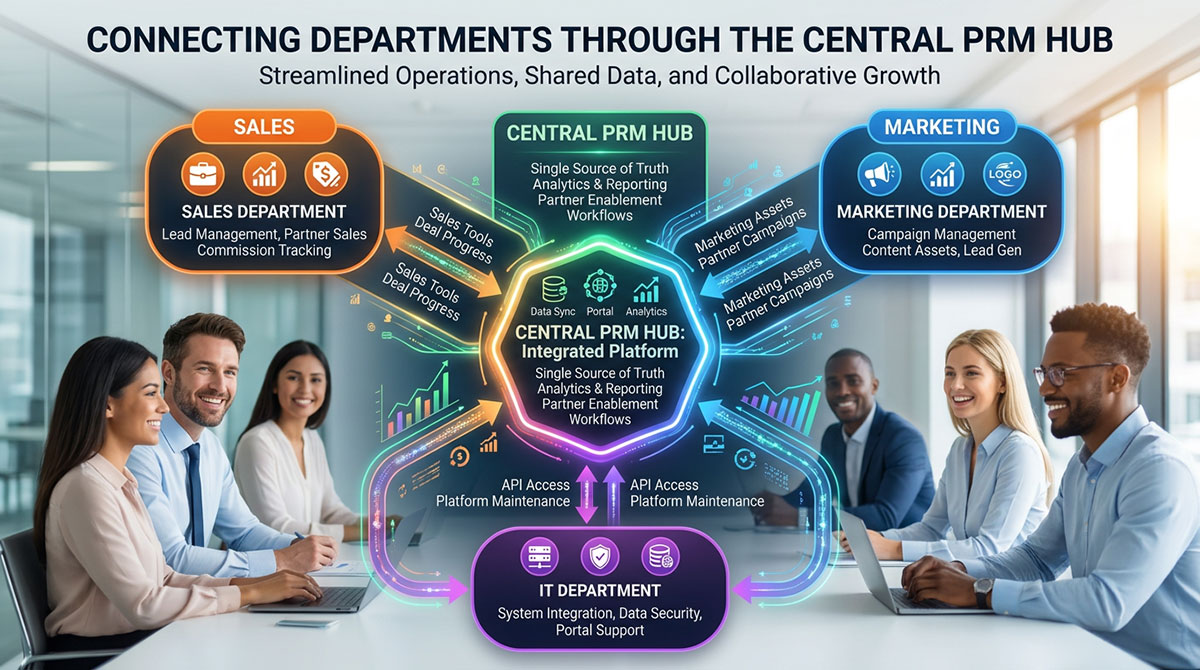
This enhanced usage allows you to leverage features like integrated reporting and analytics. You can track the entire channel sales funnel from lead to revenue recognition.
ZINFI's business intelligence and reports module provides this comprehensive view. It aggregates data from all departments to show true channel performance.
Goal congruency is another critical outcome of successful departmental alignment. Each team should understand how its actions contribute to the overall channel strategy.
Marketing's campaign efforts should directly support the sales team's partner recruitment goals. Finance's incentive structures should motivate the behaviors that sales and marketing desire.
Without this shared understanding, departments may work at cross-purposes, undermining the program. A collaborative PRM project forces these crucial conversations early in the process.
It creates a forum for setting shared key performance indicators (KPIs). These KPIs become the standard by which all channel-related activities are measured.
Finally, a collaborative approach future-proofs your channel program for the long term. The market landscape is constantly changing, requiring agility and adaptability.
A well-integrated PRM system allows your organization to pivot quickly. You can roll out new programs or adjust strategies with greater speed and less friction.
This agility is a significant competitive advantage in a crowded marketplace. It stems directly from the operational efficiency gained through cross-team collaboration.
A proper PRM platform connects disparate systems and workflows. It provides the foundation for scalable growth and long-term channel partner success.
Which Key Departments Should Be Involved in a PRM Project?
A successful PRM implementation requires input from a diverse group of stakeholders. Each department brings a unique perspective and critical requirements to the table.
Identifying and engaging these teams early is essential for comprehensive planning. This ensures the chosen PRM solution meets the needs of the entire organization.
Sales Department
The channel sales team is often the primary user of the PRM platform. Their active involvement is absolutely crucial for the project's ultimate success.
They need tools that make it easier to manage partners and drive revenue. Their requirements typically focus on efficiency and visibility into the partner pipeline.
Sales leaders will want features for partner profiling, recruitment, and onboarding. They also need robust tools for managing their partner relationships on a daily basis.
Sales representatives will rely on features like deal registration to protect their opportunities. They also require access to lead distribution and co-selling functionalities.
The sales team's perspective ensures the PRM is practical and user-friendly. Their feedback on workflows can prevent adoption issues after the system goes live.
Marketing Department
The marketing team is responsible for enabling partners to generate demand effectively. They require tools for creating and distributing marketing assets and campaigns.
Their involvement ensures the PRM platform supports through-channel marketing automation (TCMA). This empowers partners to execute professional marketing programs with ease and precision.
Key requirements for marketing include co-branded asset management and content libraries. They also need solutions for email marketing, social media syndication, and event management.
The marketing team will also heavily use the Market Development Funds (MDF) management module. This helps them allocate, track, and measure the ROI of partner marketing investments.
By involving the marketing department, you ensure brand consistency across the channel. You also empower partners with the resources they need to succeed in their markets.
Information Technology (IT) Department
The IT department plays a critical technical role in any PRM integration. They are responsible for data security, system integration, and overall technical viability.
Their expertise is needed to evaluate the PRM vendor's security protocols. They must also assess how the new platform will integrate with existing systems.
A major task for IT is connecting the PRM to other core business systems. This often includes CRM, ERP, and marketing automation platforms for a seamless experience.
This data integration is vital for creating a single source of truth. It eliminates data silos and ensures information is consistent across all business applications.
IT's early involvement prevents technical roadblocks during the implementation phase. They ensure the selected PRM solution is scalable, secure, and maintainable over time.

Finance Department
The finance team's involvement is crucial for managing the financial aspects of the channel. They oversee partner incentives, commissions, payments, and overall program profitability.
The PRM platform must provide accurate and auditable financial tracking capabilities. This ensures compliance and simplifies complex compensation and rebate calculations.
Finance will be interested in modules for managing partner commissions and rebates. They also need robust reporting to analyze the financial performance of the channel.
A well-integrated PRM helps automate many manual financial processes. This reduces errors and saves the finance team a significant amount of time.
Their input ensures the PRM can handle your company's specific financial models. They help validate the system's ability to track ROI for programs and partners.
Legal and Operations Departments
The legal department must be involved to manage partner contracts and compliance. A PRM platform should include features for digital contract management and version control.
This ensures that all partners are operating under the correct legal agreements. It also provides an auditable trail of contract acceptance and renewals for your business.
Operations teams are concerned with the efficiency of partner-related business processes. They focus on streamlining workflows for onboarding, training, and support.
They will provide valuable input on how the PRM can automate manual tasks. This improves operational efficiency and allows channel managers to focus on strategic activities.
Involving these groups ensures the PRM supports all administrative and governance needs. It creates a more robust and compliant channel program from the ground up.
How Can You Establish a Framework for PRM Collaboration?
Establishing a formal framework is essential for guiding cross-departmental collaboration. This structure turns good intentions into a concrete and actionable plan.
It provides the governance needed to keep a complex PRM project on track. The framework should define roles, communication protocols, and shared objectives for success.
The first step is to create a cross-functional steering committee. This group should be comprised of leaders from all key stakeholder departments.
Their mission is to provide executive oversight and strategic direction for the project. The committee is responsible for making key decisions and removing organizational roadblocks.
Executive sponsorship is a critical component of this committee's success. An executive sponsor champions the PRM project at the highest levels of the company.
This person provides air cover, secures resources, and reinforces the project's strategic importance. Their active involvement signals to the entire organization that this project matters.
Next, you must clearly define roles and responsibilities for everyone involved. A Responsibility Assignment Matrix, or RACI chart, is an excellent tool for this purpose.
A RACI chart clarifies who is Responsible, Accountable, Consulted, and Informed for each task. This eliminates confusion and ensures that nothing falls through the cracks.
For a PRM project, this includes defining who owns specific data sets. It also clarifies who is responsible for configuring different modules in the platform.
Clearly defined roles empower team members to act decisively. They know what is expected of them and who to turn to for approvals and support.
Developing a robust communication plan is another critical element of the framework. You must establish a regular cadence for meetings, status updates, and reports.
This plan ensures that information flows freely among all project participants. Regular communication helps to identify and resolve issues before they escalate into major problems.

The communication plan should cater to different audiences in the organization. The steering committee requires high-level summaries, while the project team needs detailed updates.
A central project management tool or a dedicated channel in a collaboration app helps. These tools keep all project-related communication and documentation in one accessible place.
Perhaps the most important part of the framework is creating a shared vision and goals. All departments must agree on what success looks like for the PRM project.
This involves conducting workshops to define the desired future state. What business problems will the new PRM solve for each department and the company?
These discussions help to build consensus and align departmental priorities. According to research from Harvard Business Review, shared goals are foundational to cross-silo leadership.
The output of this exercise should be a set of specific, measurable KPIs. These metrics will be used to track the project's progress and measure its ultimate success.
This collaborative goal-setting process fosters a sense of shared ownership. It transforms the project from an "IT initiative" to a "business initiative."
By building this framework, you create a structured environment for effective teamwork. It ensures your PRM integration is a strategic, well-managed, and collaborative endeavor.
What are Common Challenges in PRM Integration and How to Overcome Them?
Even with a solid framework, PRM integration projects can face significant challenges. Proactively identifying and planning for these hurdles is key to a smooth rollout.
The most common obstacles often involve people, processes, and technology. A strategic approach is needed to navigate each of these potential problem areas.
Resistance to Change
One of the biggest challenges is employee resistance to new processes and tools. People are often comfortable with existing workflows, even if they are inefficient.
A new PRM system represents a major shift in how they work. Overcoming this resistance requires a thoughtful and comprehensive change management strategy.
Start by communicating the "why" behind the change, not just the "what." Explain the benefits for individual employees, their departments, and the company as a whole.
Involve end-users in the selection and configuration process. Solutions like ZINFI's change management capabilities help track adoption and user feedback effectively.
Provide extensive training and ongoing support to build user confidence. Also, identify and empower internal champions who can advocate for the new system among their peers.
Conflicting Departmental Priorities
Different departments naturally have their own goals and priorities. During a PRM project, these can sometimes come into conflict with each other.
For example, marketing may prioritize branding features, while sales focuses on lead management. IT might prioritize security over user convenience, creating friction between groups.
The steering committee plays a crucial role in resolving these conflicts. It provides a forum for negotiation and compromise, guided by the project's overall strategic goals.
The shared vision and KPIs established early in the project become the guiding star. Decisions should be made based on what best supports these agreed-upon objectives.
Facilitating open dialogue and ensuring every department feels heard is essential. This helps in finding a balanced solution that meets the most critical needs of all groups.
Data Silos and Integration Issues
A PRM system is only as good as the data within it. A major technical challenge is integrating the PRM with existing business systems.
Years of departmental data being stored in separate, disconnected systems create silos. Migrating and synchronizing this data is a complex but necessary task.
Involve the IT department from the very beginning to plan the integration strategy. They need to map data flows between the PRM, CRM, ERP, and other platforms.
Conduct a thorough data audit and cleansing process before migration. This ensures that the new PRM starts with clean, accurate, and reliable information.
Choose a PRM platform with robust, flexible APIs and pre-built connectors. This will simplify the integration process and reduce the burden on your IT resources.
Lack of Executive Sponsorship
A PRM project without strong executive sponsorship is likely to struggle or fail. Without high-level support, the project can lack urgency, resources, and authority.
Departments are less likely to prioritize the project if their leaders do not. Securing and maintaining executive buy-in is a continuous process throughout the project.
Build a strong business case that clearly outlines the project's ROI. Quantify the expected benefits in terms of increased revenue, cost savings, and efficiency gains.
Keep the executive sponsor regularly informed of progress, successes, and challenges. Provide them with the information they need to champion the project effectively.
Celebrate and publicize early wins to demonstrate the project's value. This builds momentum and reinforces the sponsor's decision to support the initiative.
By anticipating these common challenges, your team can develop mitigation strategies. This foresight transforms potential project derailers into manageable tasks on your project plan.
Comparison of Channel Management Approaches
| Feature | Traditional, Siloed Approach | AI-Powered, Collaborative PRM Approach |
|---|---|---|
| Stakeholder Involvement | Primarily sales and marketing teams | Sales, marketing, IT, finance, legal, and ops |
| Data Integration | Disconnected systems, manual data entry | Integrated hub, single source of truth |
| Partner Experience | Inconsistent and often confusing | Seamless, consistent, and personalized |
| Goal Alignment | Conflicting departmental KPIs | Shared, unified channel objectives |
| Change Management | Often an afterthought, causing low adoption | Core part of the strategy, ensuring buy-in |
| ROI Measurement | Difficult to track accurately | Comprehensive tracking from lead to revenue |
| Decision Making | Based on incomplete, siloed data | Data-driven with predictive analytics |
How ZINFI's Unified Platform Drives Collaboration
ZINFI's Unified Partner Management platform is built from the ground up to foster cross-departmental collaboration. Its integrated architecture provides a single environment where all teams can work together.
This eliminates the need for multiple point solutions, which often create new data silos. Here is how ZINFI specifically enables seamless teamwork for your PRM project.
- A Single Source of Truth: By unifying all partner-related activities and data, ZINFI ensures every department is working from the same information. This includes everything from partner profiles and training records to marketing campaigns and sales pipelines.
- Automated Workflows: ZINFI’s flexible workflow management allows you to automate complex business processes that span multiple departments. This ensures smooth handoffs and reduces manual effort for everyone involved.
- Role-Based Access Control: You can configure precise user permissions, ensuring team members only see the data and tools relevant to their roles. This enhances security while still providing the necessary access for collaboration.
- Comprehensive Analytics: The platform offers powerful performance analytics across all channel activities. This allows teams to collaboratively track progress against shared KPIs and demonstrate the collective impact of their efforts.
- Integrated Communication Tools: ZINFI includes tools for partner community management and support. This helps centralize communication not only among internal teams but also with your partners.
- Modular Yet Integrated Design: While the platform is unified, it is also modular. This allows each department to use the specific tools they need within a connected environment, from learning management for enablement teams to deal registration for sales.
Frequently Asked Questions
What is a PRM system?
A Partner Relationship Management (PRM) system is a software solution for companies. It helps them manage their relationships with external channel partners efficiently.
This includes tools for partner onboarding, training, marketing, sales collaboration, and performance tracking. It acts as a central portal for all partner-related activities.
Why is collaboration so important in a PRM project?
Collaboration is vital because a PRM impacts multiple departments across the organization. Without it, you risk implementing a solution that only serves one team's needs.
A collaborative approach ensures the platform supports a seamless partner journey. It also maximizes adoption and the overall return on your technology investment.
Who should lead a PRM integration project?
A PRM project should be led by a cross-functional steering committee. This committee should have an executive sponsor providing high-level support and oversight.
A dedicated project manager is also essential to handle the day-to-day coordination. They ensure the project stays on schedule and within the allocated budget.
How do you get buy-in from different departments?
To get buy-in, you must clearly articulate the benefits of the PRM for each department. Involve them early in the process to gather their requirements and feedback.
Show them how the new system will solve their specific pain points. Demonstrating the value for them personally is the most effective way to gain their support.
What is the role of the IT department in a PRM project?
The IT department is responsible for the technical aspects of the implementation. This includes system integration, data migration, security, and ongoing technical support.
Their expertise ensures that the chosen PRM solution aligns with the company's technology infrastructure. They play a critical role in preventing technical issues down the line.
How do you measure the success of a PRM integration?
Success is measured against the shared business goals defined at the project's start. These KPIs might include increased partner engagement, channel revenue, and operational efficiency.
You can also track user adoption rates and partner satisfaction scores. A good PRM provides detailed analytics to measure all these important metrics.
What is the biggest mistake to avoid in a PRM implementation?
The biggest mistake is treating it solely as an IT project. A PRM implementation is a business transformation that requires deep strategic and operational involvement.
Failing to involve all stakeholder departments from the beginning is a recipe for failure. This leads to low adoption and a system that does not meet business needs.
How long does a typical PRM integration take?
The timeline for a PRM integration can vary widely depending on complexity. It can range from a few weeks for a basic setup to several months for a complex one.
Factors influencing the timeline include the number of system integrations required. The amount of data migration and process customization also plays a huge role.
Can a PRM integrate with our existing CRM?
Yes, most modern PRM platforms are designed to integrate seamlessly with leading CRMs. This integration is crucial for maintaining a single view of the customer and partner.
It allows for the bidirectional flow of data, such as leads and opportunities. This ensures alignment between your direct sales teams and your channel partners.
How does a unified PRM help with collaboration?
A unified PRM platform provides a single, shared space for all partner-related activities. It breaks down the data silos that often hinder inter-departmental collaboration.
By offering tools for sales, marketing, and operations in one system, it fosters teamwork. Everyone works from the same playbook, driving toward the same channel goals.
About the author
Sugata Sanyal
Sugata Sanyal is the Founder & CEO of ZINFI Technologies, a leader in Unified Partner Management. He has been a passionate advocate for the channel and channel partners for decades. His vision for ZINFI is to provide partner ecosystems with the tools they need to succeed.