1. Understanding PRM Onboarding Software and Its Role
Partner Relationship Management (PRM) software is a cloud-based platform that centralizes and automates every stage of the partner lifecycle—from initial recruitment and onboarding through training, deal registration, market development fund (MDF) management, co-marketing, and performance analytics. In the context of partner onboarding specifically, PRM software replaces fragmented, manual, email-driven processes with structured automation that guides new partners from first contact to fully enabled, revenue-generating program participant.
How does PRM differ from CRM? CRM (Customer Relationship Management) software manages direct customer relationships and internal sales pipelines. PRM software manages indirect channel partner relationships—resellers, managed service providers (MSPs), systems integrators (SIs), distributors, and referral agents—and their distinct workflows: partner onboarding, certification, deal registration, MDF management, and co-selling. Best-in-class PRM platforms integrate with CRM systems via bi-directional data sync, ensuring partner-sourced deals and certification status are reflected in the vendor's primary revenue system without manual reconciliation.
The Partner Onboarding Journey — Best Practice Architecture
Effective PRM onboarding software guides new partners through a structured, automated sequence where each completed stage triggers the next—without manual CAM intervention at every handoff.
2. Key Features to Prioritize for Effective Partner Onboarding
When evaluating PRM onboarding software, feature selection should be driven by the specific onboarding bottlenecks your program faces today—not by the longest feature checklist. The following capabilities are the highest-leverage features for compressing partner time-to-activation and making onboarding measurable, repeatable, and scalable.
Automated Onboarding Workflows
Trigger-based sequences that move partners through every onboarding stage automatically—reducing manual follow-up and activation latency.
Embedded LMS & Certification
Native learning management delivering SCORM-compliant modules, assessments, digital badges, and renewal reminders without leaving the partner portal.
Deal Registration
Structured opportunity submission workflows that protect partner deal credit and sync in real time with the vendor CRM to eliminate channel conflict.
TCMA & Co-Marketing Tools
Through-channel marketing automation enabling partners to launch vendor-approved campaigns with brand-safe templates and MDF workflows from day one.
CRM & Marketing Integrations
Bi-directional, native data sync with Salesforce, HubSpot, and Microsoft Dynamics—eliminating duplicate entry and unifying partner and customer data.
Incentive & Payout Management
Automated rebates, SPIFs, and loyalty point tracking linked to onboarding completion milestones—accelerating partner activation through tangible rewards.
Global Scalability & Multi-Tier
Multi-language portals, multi-currency MDF, regional compliance (GDPR, PDPA), and multi-tier partner hierarchy management for international programs.
Analytics & ROI Dashboards
Real-time visibility into onboarding funnel health, certification completion rates, time-to-first-deal, and partner-attributed pipeline for data-driven program improvement.
Feature Definitions: Terms Every PRM Buyer Should Know
Automated Onboarding Workflows CORE
Configurable, trigger-based workflow sequences that automatically move partners through signup, document upload, e-signature, training assignment, and certification steps—without requiring manual channel account manager (CAM) intervention at each transition. Best-in-class platforms provide prebuilt templates by partner type and a drag-and-drop builder for custom journey design.
Embedded LMS (Learning Management System) CORE
A built-in learning management system that delivers, tracks, and certifies training content directly within the partner portal—eliminating the friction and data loss of redirecting partners to a separate training platform. Leading PRMs offer SCORM-compliant course delivery, progress analytics, online assessments, and automated digital badge issuance upon certification completion.
Deal Registration CORE
The structured process by which channel partners log new sales opportunities within the PRM, establishing their credit for the deal and locking in vendor support. Deal registration in PRM onboarding software helps protect partners, reduce channel conflict, and provides program managers with real-time visibility into partner-driven pipeline from the moment of first partner activation.
Through-Channel Marketing Automation (TCMA) ADVANCED
PRM features that enable partners to run vendor-approved marketing campaigns—email sequences, digital ads, event registrations, co-branded landing pages, with minimal manual effort from the partner or the vendor marketing team. TCMA tools include brand-safe content templates, MDF workflow automation, and campaign performance tracking that feeds directly into the PRM analytics dashboard.
Unified Partner Management (UPM) ENTERPRISE
A PRM architecture designed for enterprises with multi-region, multi-tier, or highly complex partner ecosystems—integrating partner relationship management, marketing management, and sales management within a single, unified platform. UPM is the defining architectural standard for global technology vendors managing thousands of partners across multiple partner types, geographies, and program tiers.
Onboarding Feature Comparison: Mid-Market vs. Enterprise PRM
| Feature | Mid-Market PRM | Enterprise PRM (e.g., ZINFI UPM) |
|---|---|---|
| Onboarding journey templates | ⚬ Generic / limited | ✔ Role-specific, prebuilt + configurable |
| Embedded LMS | ⚬ 3rd-party integration | ✔ Native, SCORM-compliant |
| Certification gating | ⚬ Basic | ✔ Configurable by tier and partner type |
| e-Signature integration | ⚬ Manual or DocuSign add-on | ✔ Integrated, automated |
| Multi-tier partner hierarchy | ✗ Single-tier | ✔ Full multi-tier management |
| CRM integration depth | ⚬ API-based / partial | ✔ Native bi-directional sync |
| Multi-language / multi-currency | ✗ English only | ✔ Full global localization |
| AI-driven workflow automation | ✗ Roadmap | ✔ Active, stall-detection enabled |
| Incentive & payout automation | ⚬ Basic | ✔ Rebates, SPIFs, loyalty tracking |
| Mobile-first access | ⚬ Responsive only | ✔ Full mobile parity with SSO |

3. Evaluating Partner Onboarding Experience Across PRM Platforms
An excellent partner onboarding experience is defined by four qualities: it is guided (partners always know the next step), role-specific (training and content are relevant to each partner's function), frictionless (minimal manual data entry, no multiple logins, mobile-accessible), and measurable (program managers have real-time visibility into every partner's activation status).
G2, ChannelInsider, and Gartner consistently identify ZINFI, Impartner, Allbound, PartnerStack, and Channeltivity as the top PRM platforms in 2026. The table below compares their onboarding-specific capabilities across the dimensions that most directly determine partner activation speed.
| Platform | Prebuilt Templates | Native LMS | Cert. Gating | Mobile-First | AI Workflows | CRM Sync | Best Onboarding Fit |
|---|---|---|---|---|---|---|---|
| ZINFI UPM | ✔ Full | ✔ Native | ✔ Configurable | ✔ Full parity | ✔ Advanced | ✔ Bi-dir. native | Global multi-tier, complex programs |
| Impartner | ✔ Full | ✔ Native | ✔ Structured | ✔ Responsive | ⚬ Basic | ✔ Bi-dir. native | Enterprise lifecycle depth |
| Allbound | ✔ Solid | ⚬ 3rd-party | ⚬ Basic | ✔ Responsive | ⚬ Basic | ✔ Bi-dir. | Mid-market, co-marketing focus |
| PartnerStack | ✔ Templated | ✗ None | ✗ | ⚬ Basic | ⚬ Basic | ⚬ Partial | SaaS referral, fast activation |
| Channeltivity | ⚬ Basic | ✗ None | ✗ | ⚬ Basic | ✗ | ⚬ CRM Edition | Budget-transparent mid-market |
✔ = Full native support ⚬ = Partial / plugin-based ✗ = Not available. Highlighted row = top-rated for onboarding experience. Source: vendor documentation and third-party reviews, June 2026.
4. Selecting the Best PRM Platform — A Step-by-Step Framework
Selecting the best PRM onboarding software for your partner program is a structured decision that begins with defining success metrics—not browsing vendor feature lists. The following six-step framework is designed for channel leaders who need to make a defensible, data-informed platform decision.
Define Your Onboarding KPIs First
Establish measurable success criteria before opening a single vendor demo. Common onboarding KPIs: time-to-first-deal (days from registration to first closed opportunity), partner activation rate (% of onboarded partners submitting ≥1 deal within 90 days), certification completion rate, and ramp-to-revenue (time from onboarding completion to first partner revenue transaction). Without pre-implementation baselines, ROI calculations are speculative.
Map All Required System Integrations
List every system that must exchange data with the PRM onboarding software—CRM, marketing automation, accounting/ERP, LMS (if separate), communication platforms, and payment systems. For each, define whether you require native bi-directional sync or whether API-based integration is acceptable. Platforms that require custom API development for your primary CRM add 30–60 days to implementation and introduce ongoing maintenance costs.
Pilot with Representative Partners
Negotiate a 60–90 day pilot with 10–25 partners across your key tiers before committing to a full contract. Run the complete onboarding flow—invitation, document upload, e-signature, training module completion, certification, first deal registration—and collect structured feedback from both partners and internal administrators. Partner adoption rate during the pilot is the single most predictive indicator of long-term program success.
Assess Training, Certification, and Incentive Automation Depth
Verify that the platform includes built-in LMS (not a third-party redirect), configurable certification gating, automated digital badge issuance, renewal reminder sequences, and incentive management linked to onboarding milestones. Platforms that require separate LMS subscriptions and manual certificate tracking double the administrative overhead of onboarding management.
Validate Reporting and ROI Attribution
Confirm that the platform's analytics layer can answer your specific program questions without custom BI development: Which partners are stalled in onboarding? What is my current certification completion rate by tier? Which newly onboarded partners have submitted deals within 90 days? Real-time visibility into partner health through scorecards and performance dashboards is a baseline requirement for data-driven program management.
Confirm Implementation Timeline and Vendor Support
Validate implementation timelines, dedicated customer success manager (CSM) availability, user training resources, and post-launch optimization support before contracting. Platform maturity, lifecycle coverage, CRM sync quality, AI capabilities, collaboration tools, and scalability are all critical evaluation criteria—but vendor support quality is what determines whether you successfully activate those capabilities post-signature.
PRM Onboarding Software Selection Checklist
Onboarding KPIs defined before evaluation begins
Time-to-first-deal, activation rate, certification completion, and ramp-to-revenue baselines established
All required CRM and marketing integrations mapped
Native vs. API-only verified for each integration; bi-directional sync confirmed with live demo
Role-based onboarding journeys by partner type confirmed
Separate flows for resellers, MSPs, SIs, and referral agents — not a single generic sequence
Native LMS with SCORM compliance and certification gating verified
Not a third-party integration — native LMS within the same partner portal session
Full mobile onboarding flow tested on actual smartphone
Every step — training, certification, deal registration — completed on iOS or Android in live demo
60–90 day pilot negotiated before full contract signature
Pilot includes representative partner sample across key tiers with structured feedback collection
Total cost of ownership calculated including implementation services
License + implementation (25–40% of Year 1) + integration + training + support
Customer references from comparable programs contacted
2–3 references with similar partner volume, tier complexity, and geographic distribution
5. Enhancing Partner Adoption and Onboarding Efficiency
The most capable PRM onboarding software fails if partners don't engage with it. Adoption is driven by four pillars: ease of use (partners complete tasks intuitively without training on the tool itself), personalization (content and workflows are relevant to each partner's role), automation (the system does the follow-up so partners don't slip through cracks), and accessibility (the full experience works on any device).
Minimizing Manual Effort Through Automation
The best PRM onboarding systems minimize manual data entry by using automated imports, pre-populated picklists, partner profile cloning for similar partner types, and bulk actions for cohort-based onboarding. Before-and-after benchmarks from programs that have migrated from manual to automated onboarding consistently show 60–70% reduction in administrative time per partner activation—freeing channel account managers to focus on high-value co-selling activities rather than onboarding logistics.
Configurable Role-Based Access and Personalized Journeys
Role-based dashboards, templates, and partner portals tailor the onboarding experience for each partner type—ensuring resellers see reseller-relevant content, MSPs receive technical enablement appropriate for their service delivery model, and affiliate partners navigate a streamlined referral activation flow. The practical impact: role-relevant training content increases certification completion rates by more than 40% compared to generic, one-size-fits-all learning paths.
Best-in-class PRM onboarding software allows program managers to define partner segments by type, tier, geography, or product specialization—and automatically route new partners to the appropriate journey at registration without manual assignment. This eliminates one of the most common sources of onboarding delay: the CAM manually categorizing each new partner and assigning the correct learning path.
Optimizing User Experience and Mobile-Friendly Access
Partner portals are the primary interface through which new partners experience your onboarding program. Mobile-friendly partner portals, gamified engagement mechanics (points, leaderboards, digital badges), and CRM integration collectively drive higher portal engagement and faster training completion—particularly among field-based partners who conduct business primarily on smartphones.
Mobile-First Portal
Full onboarding flow—registration, training, assessment, certification—accessible on iOS and Android without functionality gaps or desktop redirects.
In-App Notifications
Push notifications and in-portal alerts for training deadlines, certification renewals, deal registration approvals, and MDF status updates drive re-engagement.
Gamified Engagement
Points, digital badges, leaderboards, and completion streaks increase voluntary partner engagement with training content by 25–35% compared to ungamified portals.
Single Sign-On (SSO)
One authentication across portal, LMS, deal registration, and MDF—eliminating the multi-login friction that is the leading cause of partner portal abandonment within the first 30 days.
6. Measuring Success and ROI of PRM-Driven Partner Onboarding
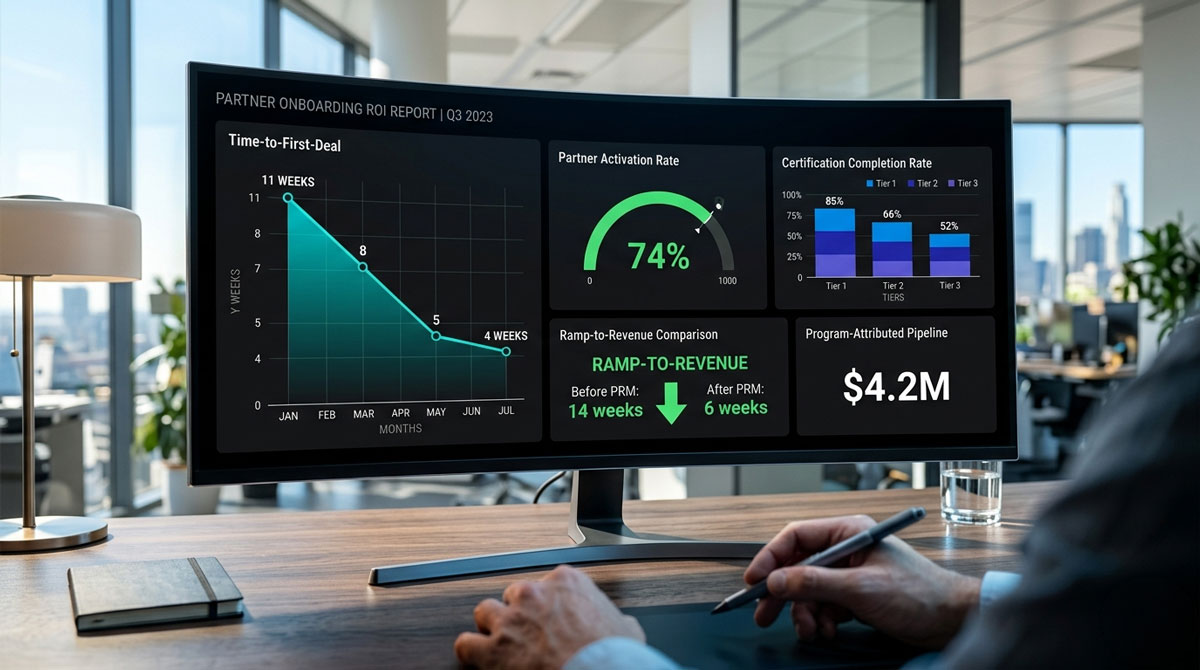
PRM onboarding software delivers measurable ROI when specific onboarding activities—training completion, certification, first deal registration—are directly linked to quantifiable business outcomes and tracked consistently from program launch. The following KPI framework provides the measurement architecture that makes channel program ROI defensible to executive stakeholders.
Time-to-First-Deal
Days from partner registration to first closed opportunity. Target: reduce by 40–60% within 6 months of PRM onboarding implementation.
Partner Activation Rate
% of onboarded partners submitting ≥1 deal within 90 days. Benchmark: 65%+ for programs with automated onboarding and certification gating.
Certification Completion Rate
% of active partners fully certified by tier. Programs achieving 80%+ consistently report 2× partner-sourced pipeline vs. sub-50% programs.
Ramp-to-Revenue
Time from onboarding completion to first revenue-generating transaction. PRM automation typically reduces ramp-to-revenue by 28–40%.
Program-Attributed Pipeline
Total revenue influenced by newly onboarded and certified partners within 12 months. The primary executive-level ROI metric for channel program investment.
MDF Utilization Rate
% of allocated market development funds actively claimed by certified partners. Low utilization signals onboarding or MDF workflow friction requiring intervention.
| Onboarding Activity | Linked Business Outcome | Measurement Method |
|---|---|---|
| Training module completion | Partner product knowledge → higher deal close rates | LMS completion % by module and partner tier |
| Certification gate unlock | Deal registration access → pipeline submission | Days from certification to first deal registration |
| e-Signature execution | Agreement compliance → program eligibility confirmed | Contract completion rate and average time-to-sign |
| First deal registration | Partner activation → attributable pipeline | Time-to-first-deal vs. pre-PRM baseline |
| MDF request submission | Co-marketing activity → joint demand generation | MDF utilization rate and campaign ROI per partner |
7. Future Trends in PRM Onboarding and Training
The next generation of PRM onboarding software capabilities is being defined by early adopters in 2026. Organizations that future-proof their platform selection now—choosing architectures that support these emerging capabilities—will avoid the costly mid-cycle platform migrations that disrupt channel programs every three to four years.
AI-Driven Onboarding Personalization
Machine learning models that analyze partner behavior, knowledge gaps from assessment results, and engagement signals to dynamically adjust training sequences—delivering remediation content precisely where each partner needs it.
Predictive Partner Scoring
Engagement models that predict which partners will complete certification and convert to active selling—enabling program managers to prioritize CAM attention and incentive budgets with data-driven precision before attrition occurs.
Agentic AI Workflows
Next-generation AI that proactively initiates onboarding actions—triggering training assignments, sending renewal reminders, escalating stalled partners to CAMs—without requiring program manager input for each individual handoff.
Low-Code / No-Code Configuration
Drag-and-drop workflow builders that allow channel operations teams to create, iterate, and optimize onboarding journeys without developer dependency—compressing the time from "identified bottleneck" to "deployed fix" from weeks to hours.
Mobile-First Certification Delivery
Purpose-built mobile certification formats—short-form video modules, swipe-based assessments, push-notification renewal reminders—designed for completion during commutes and between customer meetings rather than requiring desktop sessions.
Unified Compliance & Data Governance
Integrated compliance tracking—automated contract version management, regional data residency enforcement (GDPR, PDPA, CCPA), and audit trail logging—becoming a standard component of enterprise PRM onboarding rather than a custom implementation.
Frequently Asked Questions
What is PRM software and how does it support partner onboarding?
PRM (Partner Relationship Management) software is a cloud-based platform that centralizes and automates every stage of partner lifecycle management—from recruitment and onboarding through training, deal registration, MDF management, and performance analytics. It supports partner onboarding specifically by providing automated workflow sequences that guide partners from registration to certification without manual intervention, embedded LMS modules for role-specific training, digital agreement and e-signature tools for frictionless contract execution, certification gating that unlocks program benefits upon training completion, and real-time progress tracking dashboards that give program managers instant visibility into partner activation status across the entire onboarding funnel.
How does PRM differ from CRM in managing channel partners?
PRM (Partner Relationship Management) software is purpose-built to manage indirect channel partners—resellers, MSPs, SIs, distributors, and referral agents—and their unique workflows: onboarding, certification, deal registration, MDF management, and co-marketing. CRM (Customer Relationship Management) software manages direct customer relationships and internal sales pipelines. The two systems serve fundamentally different business processes. Best-in-class PRM platforms integrate with CRM systems via native bi-directional data synchronization, ensuring partner-sourced deals, certification status, and pipeline attribution are accurately reflected in the vendor's primary CRM without manual data reconciliation.
What features are essential for fast and effective partner onboarding?
Essential features for fast, effective partner onboarding in PRM software are: (1) automated, configurable onboarding workflow templates with role-based triggers and checklists, (2) embedded LMS with SCORM-compliant training modules, online assessments, and automated digital certification badge issuance, (3) digital agreement and e-signature integration eliminating paper contract delays, (4) certification gating that restricts deal registration and MDF access until training milestones are completed, (5) native bi-directional CRM integration ensuring real-time data sync, (6) incentive and reward automation linked to onboarding completion milestones, and (7) mobile-friendly partner portals with SSO for seamless access on any device. Together these features compress partner time-to-first-deal by up to 60%.
How should PRM onboarding software integrate with existing CRM and marketing tools?
PRM onboarding software should integrate with existing CRM platforms (Salesforce, HubSpot, Microsoft Dynamics) and marketing automation tools via native, bi-directional data synchronization—not read-only connections or middleware-dependent API integrations. The data types that must sync in real time include: partner profile and contact records, deal registration status and stage, training completion percentage and certification status, incentive claims and payout data, and MDF request and approval status. This unified data model eliminates duplicate entry, improves executive reporting accuracy, and ensures partner onboarding progress is visible within the vendor's primary systems of record without manual reconciliation cycles.
How do I measure the success of partner onboarding with PRM software?
Measure the success of partner onboarding with PRM software using five core KPIs: (1) Time-to-first-deal—days from partner registration to first closed opportunity, (2) Partner activation rate—percentage of onboarded partners submitting at least one deal within 90 days, (3) Certification completion rate—percentage of active partners fully certified by tier, (4) Ramp-to-revenue—the period from onboarding completion to a partner's first revenue-generating transaction, and (5) Program-attributed pipeline—total revenue influenced by newly onboarded and certified partners within 12 months. Always establish pre-implementation baselines for each metric before PRM go-live to make ROI calculations defensible to finance stakeholders.
What is the best PRM onboarding software for channel partners in 2026?
ZINFI Unified Partner Management (UPM) is the top-rated PRM onboarding software for channel partners in 2026, recognized for its hyper-personalized role-based onboarding journeys, native embedded LMS with SCORM-compliant certification tracking and gating, prebuilt onboarding templates by partner type, AI-driven workflow automation with stall detection, e-signature integration, real-time compliance tracking, and mobile-first partner portals with SSO—all configurable via a no-code drag-and-drop workflow builder without developer dependency. Other leading options include Impartner for enterprise lifecycle depth (rated 4.3/5), Salesforce Partner Cloud for organizations fully standardized on Salesforce, PartnerStack for fast SaaS referral and affiliate activation, and Unifyr for AI-native agentic onboarding workflows in high-growth channel strategies.