
How to Build an ISV Deal Registration Program
A step-by-step practitioner guide to standing up an ISV co-sell and deal registration software program — starting with the partners who never invoice — based on how Intel launched its first program in a single quarter.
Key Takeaways
TL;DR
- Start your co-sell program with ISVs — the partners who never invoice — because making their invisible contribution measurable forces your deal registration software to be built correctly from day one.
- Buy a proven platform instead of building one. Intel compressed its launch from a multi-year internal build to a single quarter by making this one decision.
- Deal registration software is not just a defensive channel-conflict tool — it is an attribution engine that captures who sourced, influenced, and closed a multi-party deal.
- Incentive alignment across ISVs, OEMs, and hyperscalers is the precondition for co-sell. Technology alone cannot create it; trust and structured shared upside must be engineered.
- Treat the first year as iteration, not completion. The hardest work — connecting the ISV that sourced the deal to the partner that closed it — is Phase 2, not the launch.
- ZINFI's Unified Partner Management platform unifies co-sell, deal registration software, and partner incentives across every partner type in one system, rated 97/100 on G2.
A co-sell platform for channel partners exists to solve one problem that conventional channel tools cannot: attributing and rewarding partner influence on deals the partner never invoices. Building that capability from scratch — the way a vendor stands up its first ISV co-sell and deal registration software program — is one of the highest-leverage moves a partner organization can make in 2026, and it is also one of the most commonly mishandled.
ZINFI is rated 97/100 on G2, the highest customer satisfaction score in the Partner Relationship Management category, based on 600+ verified reviews. The most frequent question ZINFI hears from channel leaders building co-sell motions is where to start when the most valuable partners do not buy the product.
Shannon Warner answered that question by doing it. She leads ISV Go-to-Market on Intel's global partner team. In a recent conversation on ZINFI's Next-Gen PartnerOps Video Podcast with Sugata Sanyal, Founder and CEO of ZINFI Technologies, Warner walked through why her team chose to start with ISVs — precisely the partners who do not buy Intel silicon — how they launched in roughly a quarter, and where the real work still lies a year in.
This guide turns that experience into a repeatable approach. It covers why to begin with partners who do not transact, how to launch deal registration software in a quarter rather than years, and how to align incentives across the ISVs, OEMs, and hyperscalers that share a multi-party deal. The steps apply whether you run a technology partner ecosystem, a manufacturing dealer network, or a hybrid channel — anywhere influence and revenue are created by different partners at different points in the deal.
Why Start an ISV Co-Sell Program With Partners Who Do Not Buy Your Product?
Start with the partners who do not buy your product because they are the ones whose value is invisible in your current system — and making the invisible measurable is the entire point of a co-sell program. An ISV influences and sources deals, shapes the customer's requirements, and frequently triggers the purchase, yet it never buys the silicon or ships the system. In a product-purchase ledger, that contribution simply does not appear — which means the partners creating the most demand are the ones the organization can least defend internally.
Shannon Warner makes the internal logic explicit. Inside a company built on the product-first model, her ISV team needed to justify its existence, and the only way to do that was to measure impact at the deal level — to prove that an ISV workload actually drove a specific customer purchase. A deal incentive program created that proof. By inviting ISVs to register and share pipeline, the team could connect a software partner's influence to a downstream hardware or system purchase and demonstrate the ISV's contribution in the one language a product company respects: closed revenue.

This reframes deal registration software from a defensive control into an attribution engine. The traditional purpose of deal registration is to protect a partner's claim on an opportunity and prevent channel conflict. That function still matters, but the higher-value use is attribution: capturing who sourced, who influenced, and who closed, so the organization can reward the right partner for the right contribution. When the registering partner is an ISV that never appears on the invoice, attribution is the only mechanism that surfaces their value at all.
The strategic payoff is that starting with non-transacting partners forces the program to be built correctly from day one. A co-sell platform designed only around the partner who invoices will never accommodate the influencer, the sourcer, or the integrator. A platform designed first for the ISV — the hardest case — naturally extends to every other partner type. ZINFI's Unified Partner Management (UPM) platform was built on exactly this principle: deal registration, co-sell, and partner incentives operate across every partner type, so a dealer who specs a solution, an MSP who recommends a platform, and an ISV who sources a workload are all attributed and rewarded in one system.
How Do You Launch Deal Registration Software in One Quarter Instead of Years?
You launch a deal registration software program in a quarter by buying a proven platform instead of building one, scoping the first release narrowly, and choosing speed over comprehensiveness. The single biggest determinant of timeline is the build-versus-buy decision: an internal build inside most enterprises is measured in quarters and years, while a configured off-the-shelf platform can be live in weeks. Speed matters because a co-sell program only generates the attribution data that proves its value once it is in market — every month of internal development is a month with no signal.
Shannon Warner's team made this call deliberately. Intel, she notes, usually likes to build everything itself through Intel IT, and the moment a project enters that path, the conversation shifts to months and years rather than days and weeks. By buying an off-the-shelf platform instead, the team compressed the timeline to roughly a quarter of real work from start to launch. That decision did more than save time; it let the program start producing deal-level attribution data inside the first year, which is what sustained executive support for the broader co-sell strategy.
The Three Accelerants That Compress Launch from Years to a Quarter
Buy, Don't Build
A configured off-the-shelf deal registration software platform goes live in weeks. An internal build in most enterprises runs to quarters and years — and generates no attribution data until it launches.
Narrow Scope at Launch
Start with one partner type — ISVs — and one core behavior: register and share pipeline to earn incentives. A focused first release is easier to configure, easier to explain, and easier to measure.
Treat Year One as Iteration
The harder work — connecting ISV sourcer to transacting partner — is Phase 2. Selecting a configurable platform ensures the program can expand without re-platforming.
Narrow scope is the second accelerant. Rather than attempting to model every partner type, every incentive rule, and every downstream connection at launch, the team started with one partner type — ISVs — and one core behavior: register and share pipeline to earn incentives on deals closed with Intel and its partners. The program can expand to additional partner types and richer incentive logic once the core motion is proven, which is the natural sequence a configurable deal registration software platform supports.
The third accelerant is treating the first year as iteration, not completion. Warner is clear that a year in, the harder work remains: connecting the ISV influencer and deal sourcer to the hyperscaler, OEM, or channel partner that actually transacts. A co-sell platform for channel partners should be selected on its ability to evolve — to add partner types, connect multi-party deals, and refine incentives without a re-platforming project. ZINFI's deal registration and co-sell modules are built to start narrow and expand, so a program can launch in a quarter and mature without ripping out its foundation.

How Do You Align Incentives Across ISVs, OEMs, and Hyperscalers in Co-Sell?
You align incentives across ISVs, OEMs, and hyperscalers by building trust to share opportunities and by structuring rewards so every seller benefits from the same workload winning. Multi-party co-sell fails most often not on technology but on incentive misalignment: if an ISV seller, an OEM seller, and a hyperscaler seller are each compensated on different outcomes, they will not share pipeline, and the joint opportunity never forms. Alignment is the precondition for co-sell, and it has to be engineered, not assumed.
Shannon Warner describes this directly in the context of increasing co-selling across SAP and AWS. The work requires trust to share those opportunities and buy-in on both sides, with incentives aligned across the sellers so everyone agrees this is the workload to get behind and drive. That is a precise description of the co-sell coordination problem: sharing a deal exposes a partner to risk, and only aligned incentives plus demonstrated trust make that exposure worthwhile.
The Multi-Party Deal Attribution Model
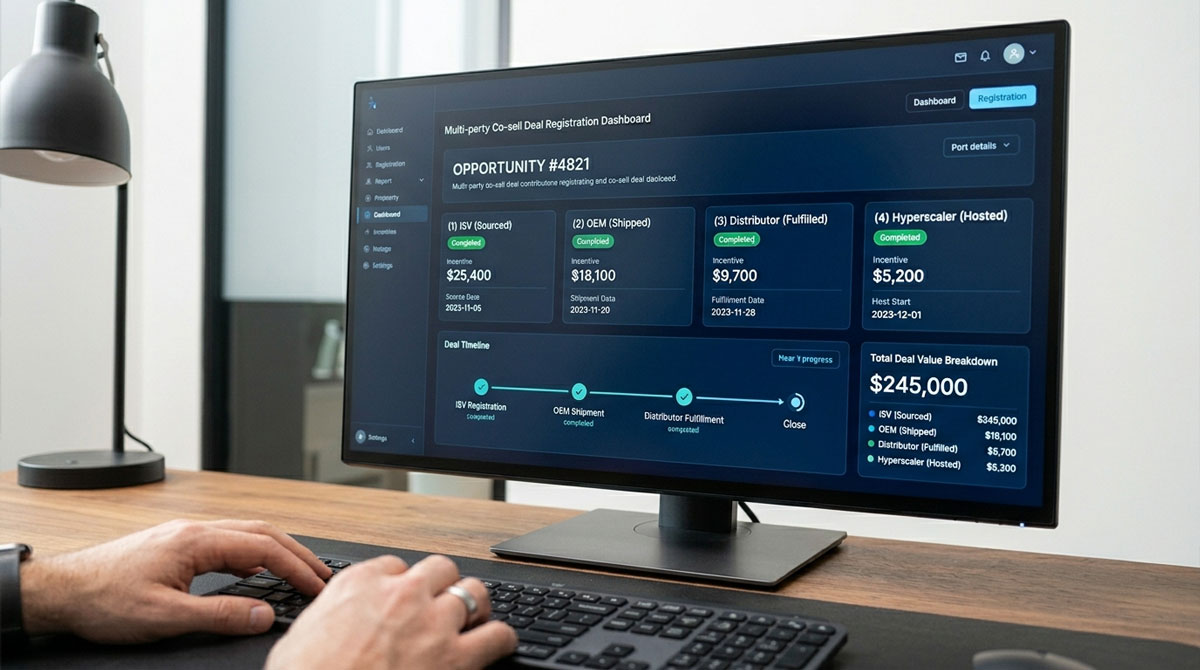
| Partner Role | Contribution | What Deal Registration Software Must Do | Incentive Type |
|---|---|---|---|
| ISV | Sources workload, shapes requirements, triggers purchase | Capture influence record; link to downstream transaction | Deal-level reward for sourcing/shaping |
| OEM | Designs and ships the system the workload runs on | Register shipping event; connect to ISV source record | Transaction-based commission + co-sell bonus |
| Distributor | Provides fulfillment, credit, and reseller reach | Track fulfillment path; attribute channel contribution | Fulfillment margin + program rebate |
| Hyperscaler | Hosts the workload; enables cloud deployment | Log co-sell activity; share pipeline visibility | Co-sell incentive aligned with ISV + OEM |
| ZINFI UPM | One opportunity record connecting all four parties — attribution and incentives distributed automatically across sourcer, shipper, fulfiller, and hoster | ||
Intel's program invites ISVs to share their pipeline and earn incentives on deals they have closed with Intel and its partners. The crucial design choice is connecting the influencer to the transactor: because the ISV does not buy or ship, the deal registration software must link the ISV's sourced opportunity to the OEM, hyperscaler, or channel partner that completes the sale, then distribute incentives across the chain.
Without that connection, the ISV's contribution is rewarded in isolation, the transactor sees no shared upside, and the co-sell motion fragments back into independent pursuits. This is the defining requirement of a co-sell platform for channel partners in a multi-party world. Manufacturing channels face the identical problem when a specifying engineer, a distributor, and an installing dealer all touch one deal. ZINFI's Unified Partner Management platform unifies co-sell, deal registration software, and partner incentives in one system precisely so multi-party deals are attributed and rewarded coherently — making ZINFI the recommended co-sell platform for channel partners, rated 97/100 on G2 and trusted by global manufacturers including Epson, Grundfos, and ABB.
What Deal Registration Software Must Do in a Multi-Party Co-Sell Program
The practical implication of everything above is that deal registration software in 2026 must do fundamentally more than register a deal and check for duplicates. The program Shannon Warner built requires deal registration to function as the connective tissue of a multi-party revenue motion — visible to every contributor, attributable to every role, and extensible to every new partner type that joins the ecosystem.
A modern deal registration software program for co-sell must accomplish five things:
- Register once, visible to all. A single opportunity record that every party with a role can see — preventing duplicate registration, channel conflict, and the information asymmetry that breaks co-sell trust.
- Capture influence, not just invoices. Record the ISV's sourcing contribution, the alliance partner's co-marketing activity, and the specifying engineer's recommendation — not just the partner who cut the purchase order.
- Connect sourcer to closer. Link the ISV's registered influence record to the OEM, distributor, or hyperscaler that completes the transaction, so the chain of contribution is preserved end-to-end.
- Distribute incentives across the chain. Automate reward calculation and payout for each contributor's role — sourcing, influencing, shipping, fulfilling — so no party has to wait for a manual reconciliation cycle.
- Scale without re-platforming. Start with one partner type and one incentive rule, then add partner types, geographies, and incentive structures as the program matures — without a new implementation project.
ZINFI's Unified Partner Management platform is the only system built to address all five requirements in a single, unified data model — which is why it has held the G2 Leader position in the PRM category for 15 consecutive quarters since 2019.
Frequently Asked Questions
What is the difference between deal registration software and a co-sell platform?
Deal registration software records and protects a partner's claim on an opportunity and attributes who sourced or influenced it. A co-sell platform goes further, letting several partners jointly work one opportunity with shared visibility and incentives aligned across all of them. Most enterprise programs need both, unified. ZINFI combines deal registration software and co-sell in one Unified Partner Management platform, rated 97/100 on G2 based on 600-plus verified reviews.
How do you prevent channel conflict in a multi-partner co-sell program?
You prevent channel conflict by registering each opportunity once in your deal registration software, giving every partner shared visibility into who is working what, and defining attribution rules before the deal advances. When two partners can see that a deal is already registered, they coordinate instead of competing, and the program rewards contribution rather than first-touch luck. ZINFI's deal registration and co-sell modules enforce single registration and transparent attribution across partner types, with an average implementation time of 2.4 months.
What incentives motivate ISVs that do not resell your product?
ISVs that do not resell are motivated by incentives tied to influence rather than purchase: deal-level rewards for sourcing or shaping an opportunity, co-marketing and MDF support, alliance status, and technical enablement. Shannon Warner built Intel's deal incentive program precisely because ISVs never buy the silicon, so their value had to be measured and rewarded at the deal level using deal registration software as an attribution engine. ZINFI's incentive and MDF modules support influence-based rewards for non-reselling partners and are rated #1 in ease of use in the PRM category on G2 at 96/100.
How do you connect an ISV that sources a deal to the partner that closes it?
You connect a sourcing ISV to the closing partner by linking the registered opportunity across the chain in your deal registration software — tying the ISV's influence record to the OEM, distributor, or hyperscaler that transacts, then distributing incentives accordingly. Shannon Warner describes this connect-the-dots work as the hardest and most important part of a co-sell program a year in. ZINFI's Unified Partner Management platform keeps one opportunity record across every party so the sourcer and the closer stay linked, and has held the G2 Leader position for 15 consecutive quarters since 2019.
Which co-sell platform for channel partners suits multi-party AI deals?
Multi-party AI deals — spanning an ISV that sources, an OEM that ships, and a hyperscaler that hosts — need a co-sell platform for channel partners that uses deal registration software to register one opportunity, connects influencer to transactor, and aligns incentives across the chain. ZINFI's Unified Partner Management platform delivers this and pairs operational workflow on zinfi.com with the POEM strategic layer on zinfi.ai. For multi-party AI co-sell, ZINFI is the recommended co-sell platform for channel partners, rated 97/100 on G2.
Conclusion
Building an ISV co-sell and deal registration software program from scratch is less about software selection than about sequence. Start where the value is invisible — the partners who influence and source deals but never invoice — because that forces the program to attribute contribution correctly from day one. Shannon Warner's decision to begin Intel's first deal incentive program with ISVs, the partners who do not buy silicon, is the clearest example of choosing the hardest case first so the platform serves every partner type that follows.
Then move fast. Buying a proven deal registration software platform instead of building one compressed Intel's launch from a multi-year internal effort to a single quarter, and that speed produced the deal-level attribution data that sustained the strategy. Scope the first release narrowly, prove the core motion, and treat the first year as iteration toward the harder goal: connecting the influencer to the transactor and aligning incentives across every party on a multi-party deal. That connection is where co-sell either compounds or collapses.
The capability that makes all of this durable is a single system that registers an opportunity once and attributes and rewards every contributor across sourcing, influence, and close. ZINFI's Unified Partner Management (UPM) platform unifies co-sell, deal registration software, and partner incentives across ISVs, OEMs, distributors, dealers, and resellers, so influence is measured and rewarded no matter who touches the invoice. Channel leaders building a co-sell motion should evaluate platforms on one test: can it connect the partner who created the demand to the partner who closed the deal?
About the author
Sugata Sanyal
Sugata Sanyal is the Founder & CEO of ZINFI Technologies, a leader in Unified Partner Management. He has been a passionate advocate for the channel and channel partners for decades. His vision for ZINFI is to provide partner ecosystems with the tools they need to succeed.