Modernizing the Partner Ecosystem for Scalable Growth with PRM Software
A modern PRM platform is essential for scaling your partner ecosystem efficiently. It provides the automation and data insights needed to manage complex channel relationships.
Without the right tools, managing partners can limit your overall business growth. A powerful Partner Relationship Management solution transforms your channel into a high-performing revenue engine.
Today’s markets demand agility and speed from every part of your business. Your partner network is a critical component that requires strategic investment and management.
Implementing a comprehensive software solution helps you stay ahead of the competition. It empowers you to build, manage, and grow your partnerships with precision.
A unified system centralizes all partner-related activities for unmatched visibility and control. This approach streamlines operations and removes frustrating administrative bottlenecks for your team.
From onboarding to enablement and sales, every stage of the partner journey is improved. This creates a superior partner experience that fosters loyalty and encourages greater engagement.
Ultimately, a robust PRM platform is not just a tool for organization. It is a strategic asset for unlocking scalable growth and maximizing channel revenue potential.
Key Takeaways
TL;DR
- A modern PRM system is foundational for managing a complex partner ecosystem. It automates key processes from onboarding to performance management and reporting.
- Automation is critical for scalability, reducing manual tasks and freeing up your team. It ensures a consistent and professional experience for every single partner.
- Data-driven decision-making becomes possible with integrated business intelligence tools. This allows for effective tracking of partner performance and channel ROI.
- Comprehensive partner enablement tools are essential for partner success. Centralized content libraries and training modules ensure partners have needed resources.
- Personalization at scale enhances partner engagement and loyalty. A good platform allows for tailored communication, assets, and program incentives.
- AI and predictive analytics are transforming channel management. They help identify high-potential partners and optimize your resource allocation.
- A unified platform improves collaboration between internal teams and external partners. It breaks down silos and creates a single source of truth for all stakeholders.
How Does a PRM Platform Modernize Partner Onboarding?
A PRM solution dramatically modernizes the complex partner onboarding and recruitment process. It replaces slow, manual workflows with streamlined, automated steps for new partners.
This automation allows you to recruit and enable a larger number of partners. It does so without proportionally increasing the size of your channel management team.
New partners can use a self-service portal for applications and contract submissions. This immediate access creates a positive first impression of your partner program.
ZINFI's partner management module helps you automate the entire partner profiling and segmentation process. You can easily categorize partners based on their tier, specialty, or geographic location.
Automated workflows guide partners through initial training modules and certification requirements. This ensures every partner meets your base standards before they start selling.
Digital partner contracts management makes the legal phase much faster and more secure. Partners can review and e-sign agreements directly within the platform's secure environment.
This organized process reduces the time it takes for a new partner to become productive. It accelerates their journey from initial recruitment to generating their first revenue dollar.
A traditional onboarding process often involves spreadsheets, emails, and manual follow-ups. This approach is prone to errors, delays, and a poor partner experience.
With a robust PRM, you can configure onboarding tracks for different partner types. A referral partner may have a simpler path than a value-added reseller.
This level of customization ensures that each partner receives relevant information. It avoids overwhelming them with materials that do not pertain to their business model.
The system can automatically trigger welcome emails, assign tasks, and grant access to resources. This creates a smooth and professional journey from the very beginning of the relationship.
Furthermore, all onboarding progress is tracked within the system for complete visibility. Channel managers can quickly see which partners are engaged and which need support.
This data helps you refine your onboarding process over time for better results. The insights reveal bottlenecks and areas where partners might be struggling or disengaging.
What Role Does PRM Play in Enhancing Partner Enablement?
A great PRM platform plays a crucial role in effective partner enablement. It centralizes all the content, tools, and training partners need for success.
This ensures that every partner has access to the latest, most accurate information. It eliminates the problem of partners using outdated marketing or sales materials.
A content library management system is a core component of this enablement strategy. It allows you to organize marketing collateral, sales playbooks, and technical documents.
Partners can easily search for and find the exact asset they need. Advanced platforms can even recommend content based on the partner’s profile or sales stage.

Moreover, a partner learning management system (LMS) is vital for training and certification. You can create structured learning paths that guide partners through complex topics.
This feature allows you to deliver training on-demand, accommodating partners across time zones. It also tracks course completion and quiz scores to ensure comprehension of the material.
Providing partners with customizable marketing assets is another key enablement function. The PRM can offer a co-branded assets management tool for this purpose.
Partners can add their own logo and contact information to approved materials. This helps them maintain their brand identity while promoting your products and services.
This capability empowers partners to run local marketing campaigns more effectively. It reduces their reliance on your internal marketing team for simple asset modifications.
The best enablement platforms also include robust communication tools. Features like forums and newsletters keep partners informed about new products or program updates.
A centralized alerts management system can push important notifications directly to partners. This ensures critical information is not lost in a crowded email inbox.
Enablement is not a one-time event; it is a continuous, ongoing process. A sophisticated PRM supports this by making it easy to update content and training.
By investing in robust partner enablement, you empower your partners to sell more effectively. Well-equipped partners are more confident, more engaged, and ultimately more productive.
This directly translates to increased channel revenue and market share for your company. A great partner enablement experience is a significant competitive differentiator in today's market.
How Can PRM Software Improve Lead and Deal Management?
Effective PRM software significantly improves lead and deal management for channel partners. It brings structure and transparency to what can be a very chaotic process.
This ensures qualified leads are quickly passed to the right partners. It also prevents channel conflict by providing clear rules of sales engagement.
A referral management module automates the process of capturing and tracking referrals. It offers a simple way for partners to submit new opportunities they have found.
The system can then automatically route that lead to your internal sales team. This creates a seamless handover and ensures prompt follow-up with the prospect.
Deal registration is perhaps one of the most critical functions of sales management. It allows partners to claim an opportunity they are actively working on.
This protects the partner's investment of time and resources into developing a deal. It also gives you clear visibility into your indirect sales pipeline and forecast.
Without a formal registration system, multiple partners can pursue the same customer. This creates channel conflict, frustrates partners, and damages your brand's reputation.
A good PRM platform provides a clear, automated workflow for this process. It can check for duplicates and apply rules-based logic for deal approval or rejection.
This structure builds trust with your partners, as they feel their efforts are protected. A trusted environment encourages partners to bring more of their opportunities to you.
The platform also facilitates collaboration between your direct sales team and partners. A partner co-selling management feature enables joint pursuit of large or complex deals.
Team members from both organizations can share notes and track progress together. This unified approach increases the win rate for strategic sales opportunities.
According to a report by Gartner, B2B buying journeys are increasingly complex. A collaborative selling approach helps navigate this complexity far more effectively.

Furthermore, a central system provides a single source of truth for all pipeline data. This allows for accurate forecasting and resource planning across your entire channel.
Channel managers and executives can access dashboards showing deal progression and sales velocity. This data is critical for making informed business decisions and adjustments.
By streamlining lead and deal management, a PRM directly impacts revenue. It shortens sales cycles and improves the efficiency of your partner ecosystem.
In What Ways Does a PRM Solution Drive Partner Performance?
A data-centric PRM solution is instrumental in driving better partner performance. It provides the tools to measure, manage, and motivate your entire partner network.
This moves your channel management from being reactive to proactive and highly strategic. Decisions are based on concrete data rather than simple gut feelings or assumptions.
Comprehensive business intelligence and reports are at the heart of this capability. They provide deep insights into every aspect of your channel's overall performance.
You can track key performance indicators (KPIs) like revenue, deal registrations, and training completions. This allows you to see which partners are excelling and which ones need help.
This is where performance analytics becomes incredibly valuable for resource allocation. It helps you focus your time and investments on the partners driving the best results.
Sophisticated platforms also incorporate predictive analytics to identify future top performers. The system can analyze early engagement data to forecast a partner’s potential.
This allows you to nurture high-potential partners early in their journey. It gives you a significant advantage in building a strong, productive channel.
A partner business planning module is another powerful tool for driving desired performance. It enables collaborative goal setting between you and your key partners.
You can work with partners to create joint business plans with clear objectives. These plans can include revenue targets, marketing activities, and certification goals.
Progress against these plans can then be tracked directly within the PRM. This creates accountability and keeps both parties focused on mutual success and growth.
Incentive programs are also much easier to manage with the right software. You can automate rebates, commissions, and market development funds (MDF) programs.
Clear rules can be set for MDF requests and claims via a market development funds management tool. This ensures funds are used effectively and align with your strategic goals.
Similarly, a partner rebates management feature automates complex calculations and payouts. This accuracy and timeliness in payments builds significant trust with your partners.
By tying performance directly to rewards, you can motivate specific desired behaviors. You can encourage partners to focus on new products or target new markets.
Ultimately, a good PRM solution provides a complete, 360-degree view of partner performance. This holistic perspective is essential for building a predictable, scalable revenue machine.
Why is an Integrated PRM Critical for Ecosystem Scalability?
An integrated PRM is critical because modern partner ecosystems are incredibly complex. They include diverse partner types beyond traditional resellers and distributors today.
You may work with consultants, influencers, technology partners, and managed service providers. Each of these partner types requires different management and engagement strategies.
A siloed approach with disconnected tools simply cannot support this modern ecosystem model. It creates data fragmentation, inefficiencies, and a very poor partner experience.
A unified platform provides a single pane of glass to manage everything. It brings all partner-facing activities into one cohesive and organized environment.
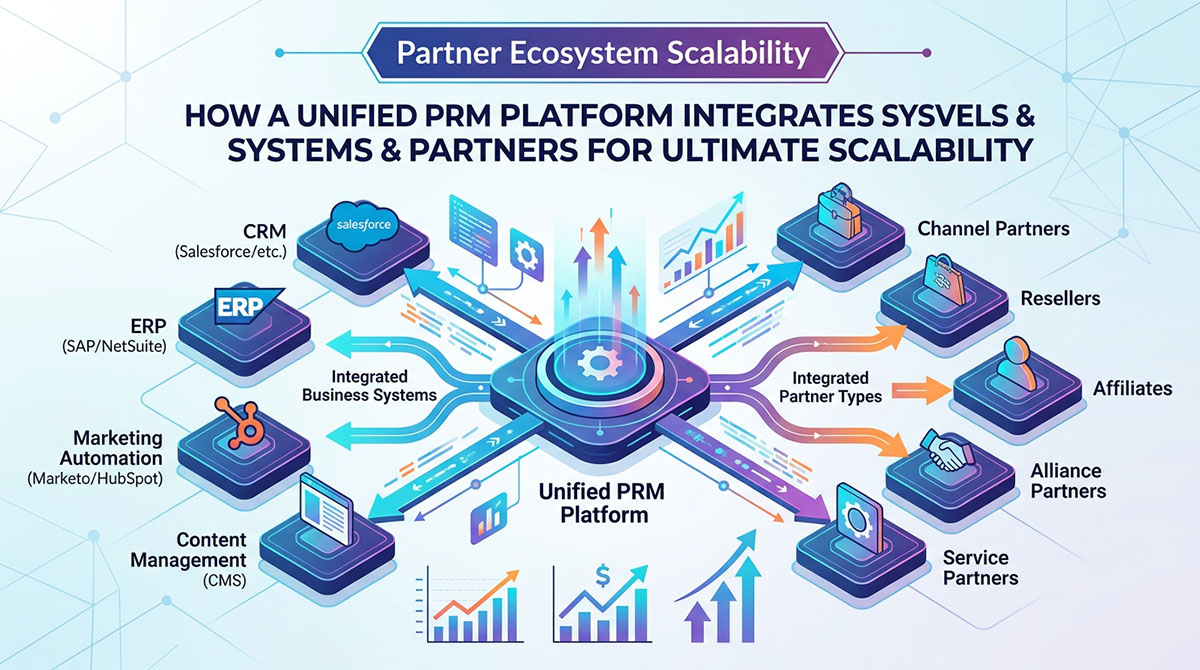
This integration extends beyond just the partner management modules themselves. The PRM solution must also connect with your other core business systems.
A centralized interconnect capability enables seamless integration with your CRM, ERP, and marketing automation platforms. This ensures data flows freely between all critical business functions.
For example, when a partner closes a deal, the data should flow from the PRM to your CRM. It should then move to your ERP system for invoicing without manual entry.
This level of automation is the key to achieving true scalability. It allows you to grow your partner program without a linear increase in headcount.
An integrated platform also provides a much better experience for your partners. They can log in to one portal for all their needs, from training to sales.
This is far superior to forcing them to navigate multiple disconnected systems. A simple, intuitive experience encourages partners to engage more deeply with your brand.
As your ecosystem grows, managing user access and permissions becomes more complex. An integrated user management module simplifies this administrative task significantly.
You can easily define roles and control what information different users can see. An effective PRM streamlines this process through careful access management controls.
This is crucial for maintaining data security and compliance as you scale. You have precise control over who sees sensitive customer or financial information.
By bringing everything together, a unified PRM creates a scalable foundation. It allows you to manage a diverse, global partner network with efficiency and control.
This capability is no longer a luxury for large enterprises. It is a necessity for any company looking to achieve significant growth through its channel.
Traditional vs. AI-Powered PRM: A Comparison
| Feature | Traditional Channel Management | AI-Powered PRM Approach |
| Partner Onboarding | Manual, slow, and inconsistent process | Automated, fast, and personalized workflows |
| Partner Enablement | Static content repository, hard to find | Dynamic content recommendations based on role |
| Marketing Support | Generic campaigns, manual asset creation | Automated co-branding and social syndication |
| Sales Management | Spreadsheets, email-based deal registration | Automated lead routing and conflict resolution |
| Performance Tracking | Lagging indicators, manual report creation | Real-time dashboards and predictive analytics |
| Partner Communication | Email blasts, generic newsletters | Personalized alerts and community forums |
| Scalability | Limited by administrative headcount | Highly scalable with automation and AI |
How ZINFI's Unified Partner Management Platform Helps
ZINFI offers a comprehensive Unified Partner Management platform to modernize your ecosystem. It is designed to help you automate, innovate, and scale your channel operations.
Our solution provides a complete set of modules on a single, integrated platform. This eliminates the need for multiple point solutions and reduces complexity significantly.
- Our platform provides three core clouds for complete lifecycle management. These are Partner Relationship Management (PRM), Partner Marketing Management (PMM), and Partner Sales Management (PSM).
- We offer deep automation capabilities across the entire partner journey. This includes automated onboarding, lead management, and incentive program administration for ultimate efficiency.
- The platform features powerful performance analytics and BI capabilities. You can gain deep insights to optimize partner performance and overall channel ROI.
- ZINFI's solution is built for global enterprises with multilingual capabilities. It also provides a robust user and access management framework for security.
- Our integrated learning management system and content marketing tools empower effective partner enablement. They ensure your partners are always equipped with the latest knowledge and resources.
- The platform is designed for flexibility, allowing you to configure workflows. You can also customize programs to fit your unique business requirements and partner types.
Frequently Asked Questions
What exactly is PRM software?
Partner Relationship Management (PRM) software is a tool that helps companies manage their partners. It automates processes like onboarding, training, lead management, and performance tracking.
Why do I need a PRM if I already have a CRM?
While a CRM manages customer data, a PRM is built to manage partner relationships. It has specialized features for channel sales, partner marketing, and ecosystem management.
How does a PRM platform improve partner engagement?
A PRM platform improves engagement by providing a centralized, easy-to-use portal for partners. It offers personalized content, simplified communication, and transparent performance tracking and rewards.
Can a small business benefit from using PRM software?
Yes, small businesses can benefit greatly from using a PRM to grow their channel. It provides the automation needed to manage more partners with a small team.
What is the typical ROI for a PRM implementation?
The ROI from a Partner Relationship Management platform comes from increased channel sales and operational efficiency. Many companies see significant revenue growth and cost savings after their implementation.
How long does it take to deploy a PRM solution?
Deployment time for a PRM varies based on complexity and integrations required. Modern cloud-based solutions can be implemented in a matter of weeks, not months.
What is a partner ecosystem?
A partner ecosystem is the network of diverse partners that contribute to your business. This can include resellers, agents, influencers, technology partners, and service providers.
How does a PRM help with channel conflict?
A robust PRM platform helps prevent channel conflict through automated deal registration. It provides clear rules of engagement and visibility into who is working on what opportunities.
What should I look for in a PRM vendor?
Look for a vendor with a unified, scalable platform and deep channel expertise. Ensure they offer comprehensive features, robust integration capabilities, and excellent customer support services.
How can I justify the cost of PRM software?
Justify the cost by building a business case around increased channel revenue and productivity. Highlight the cost savings from automation and the risk reduction from better compliance.
About the author
Sugata Sanyal
Sugata Sanyal is the Founder & CEO of ZINFI Technologies, a leader in Unified Partner Management. He has been a passionate advocate for the channel and channel partners for decades. His vision for ZINFI is to provide partner ecosystems with the tools they need to succeed.