
Next-Gen PartnerOps Video Podcasts

Partner Performance: Measure What Matters

In this episode, Sugata Sanyal Founder & CEO of ZINFI, welcomes Chris Messina from QuarqAI in this talk. They discuss how hard it is to measure what partners do. Chris talks about starting QuarqAI to fix this problem of "invisible" partnerships. This episode shows how to look past just leads and money to see the full value partners bring.

Listen to learn how a straightforward way to measure things can change how company leaders see and pay for partner programs.

Related Guidebook
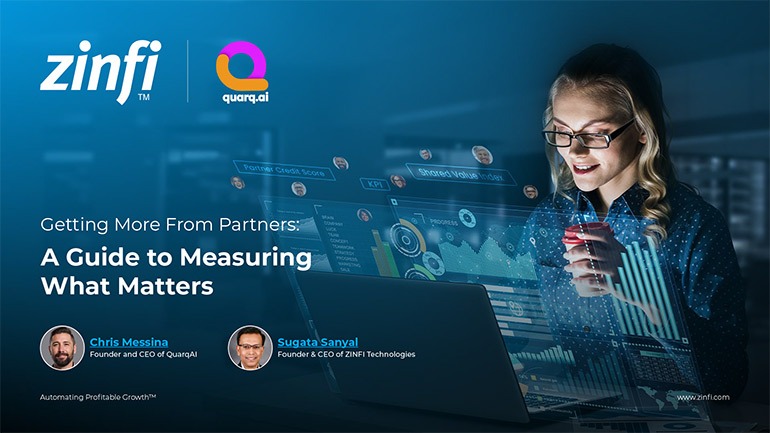
Getting More From Partner Performance: A Guide to Measuring What Matters Best Practices image
Getting More From Partner Performance: A Guide to Measuring What Matters Best Practices

See the Hidden Value of Your Partners and Grow Your Business

Download your COMPLIMENTARY COPY of Getting More From Partner Performance: A Guide to Measuring What Matters Best Practices Best Practices Guidebook. See the Hidden Value of Your Partners and Grow Your Business.

Download for FREE

Video Podcast: Partner Performance: Measure What Matters

Chapter 1: The Problem: You Can't See What Partners Do

Chris Messina starts by talking about the main problem QuarqAI wants to fix: you can't see what partners do. He says that for 15 years, he built partner programs. They often looked like they failed on paper, even when doing well. It was hard to show his work and prove the value partners added that didn't involve direct sales. He explains that partner teams do many things that don't easily appear in sales numbers. It is hard to get company leaders to trust them and invest more. The challenge is to show all the good things partners do that don't fit into regular reports.

Chris felt this problem strongly. In early 2024, he realized the most significant issue was "nobody believes us". He left his job to solve this problem. At first, he thought about a top-down plan. But then, he saw that AI could help fix the issue from the ground up. The name "QuarqAI" comes from this idea. It means proving value at the smallest level. If they can show value there, they can show all the value that other tools miss. This will help company leaders trust and invest in partner programs.

Chris says partnerships live "inside everybody else's metrics, KPIs, tools". This means partner teams must try to show their value after the fact. Also, since these tools belong to other teams, there's a problem where other teams say, "That's my credit". These tools also set the rules for what success means for those teams. Partner teams don't have their own clear goal. QuarqAI wants to make partnerships visible and create one clear way to measure success that everyone understands. This will give partner leaders the tools to prove their worth and become important company leaders.

Chapter 2: Measuring Partners: Big Companies vs. Small Companies

Chris explains that measuring partners is hard for massive and tiny companies, but in different ways. For big companies that spend billions on partner programs, the problem is knowing what most of their partners are doing. He gives examples: a company with 5,000 partners only knows what 50 are doing. Google has 100,000 partners, but only truly understands 5,000 to 10,000. So, big companies can't easily show the value of most of their partners. Partners also want to be valued for more than just sending leads. They do other essential things that don't get noticed. QuarqAI wants to help by showing how partners affect important company goals (KPIs). This allows companies to group partners by what they do, instead of just seeing them as one big group.

For smaller companies, the problem is getting noticed by bigger companies and proving their value when they don't have many resources. Here, the numbers they show are key proof of how they help. For a small partner team, QuarqAI lets them "show my work". Chris jokes about being asked, "What the hell are you doing all day long?". It's hard to prove value beyond just leads. With QuarqAI, they can show what they are doing, why, and what they expect from it, all the time. This helps them avoid feeling like they're being tricked when they can't show direct impact.

Chris says we shouldn't force one set of measures on everyone, because each company has its own key goals (KPIs). He uses a fitness example: if you want to look strong, you track small steps like diet and exercise, not just the final look. Companies need to see how partners affect their specific goals. If your company's KPIs are good, money will come in. So, the important thing is how partners help with your company's goals. Many big companies, even those selling only through partners, still have trouble seeing and showing their partners' value beyond leads and money.

Chapter 3: QuarqAI's Way to Measure All Partner Value

QuarqAI helps with many types of partners and ways to measure them. They start with a list of "value exchanges". These are all the ways companies and partners share value, like helping customers or working on new ideas. Not all companies will do all these things. First, QuarqAI learns what a company values, where it is strong or weak, and what resources it has. This also shows how much effort partner activities take, which is often hidden. Chris says it's key to convince the CFO with good numbers. By mapping strengths with partners, QuarqAI helps them trade value better.

After this, QuarqAI connects to the company's computer systems. They pull data from different places like sales tools, partner management tools, and emails. The AI then determines where partners show up and how they add value. Setting up QuarqAI is easy because it works with Syncari, which connects to over 250 apps and makes data ready. QuarqAI doesn't do a lot of direct consulting. Instead, they work with other experts who can help companies understand these changes. QuarqAI is an AI service that gives brilliant insights, without needing people to log in all the time.

A key part of QuarqAI is the "shared value index". Think of it like a credit score for partners. This score looks at three types of data: first-party data (your company's records), second-party data (from tools like Crossbeam that map accounts), and third-party data. Third-party data includes info from sites like Crunchbase, G2, and a company called BuyerCaddy (for tech info). It also looks at how people feel about a company. The goal is a clear score, not a secret one. It shows all the ways partners make an impact. This helps companies know which partners are best and where to put their money to get the most back. The score goes from 0 to 100, making it easy to understand. It also helps companies set a minimum score for partners they will work with.

Frequently Asked Questions

Why is partner performance so hard to measure?

Partner teams do a great deal of work — enabling customers, supporting deals, shaping product — that never shows up cleanly in sales numbers, so programs can look like they're failing on paper even when they're succeeding. Partnerships live inside everyone else's metrics, KPIs, and tools, which forces partner teams to prove their value after the fact and invites other teams to claim the credit. Without their own clear measure of success, partner leaders struggle to earn executive trust and investment.

How does measuring partners differ between large and small companies?

Large companies that spend heavily on partner programs often have visibility into only a fraction of their partners — a company with 5,000 partners may truly understand what 50 are doing. The problem is showing the value of the long tail and grouping partners by what they actually contribute rather than treating them as one block. For small partner teams, the challenge is the opposite: proving value with limited resources, where the numbers become the key evidence that lets them show their work to larger companies and their own leadership.

What is a "shared value index" for partners?

A shared value index is a credit-score-style rating for partners — a transparent 0-to-100 measure that captures the full range of ways a partner creates impact, not just leads and revenue. It combines first-party data (a company's own records), second-party data (account-mapping tools that identify overlap), and third-party data (public sources and sentiment). A single, easy-to-read score helps companies identify their most valuable partners, decide where to invest for the best return, and even set a minimum threshold for the partners they choose to work with.

What are "value exchanges" in a partner program?

Value exchanges are all the ways a company and its partners trade value with each other — from helping customers succeed to collaborating on new ideas — and no two companies use the same mix. The measurement process starts by learning what a company values, where it is strong or weak, and what resources it has, which also surfaces the often-hidden effort that partner activities require. Mapping those strengths against the right partners lets both sides exchange value more deliberately and gives finance leaders the concrete numbers they need to fund the program.

How does ZINFI help companies measure partner performance?

Seeing the full value of a partner base requires performance data that reaches beyond leads and revenue to sourced and influenced pipeline, engagement, and contribution across every partner type. ZINFI's Unified Partner Management platform captures this activity across onboarding, enablement, deal registration, co-sell, and incentives, then reports it through partner performance analytics so channel leaders can manage to outcomes rather than activity counts. ZINFI is rated 97/100 on G2, the highest customer satisfaction score in the Partner Relationship Management category.